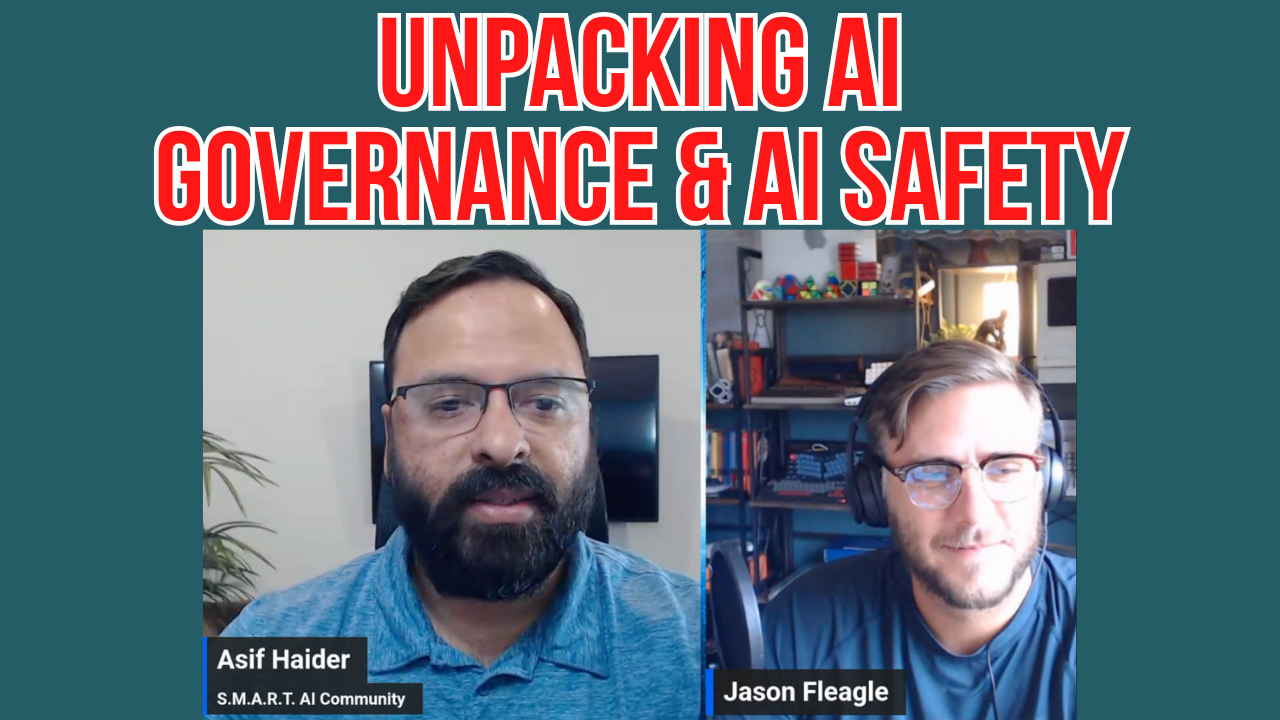
Hey everyone,
Last week, Asif and I were talking about a recent conversation with a business leader who told us about an intern at their law firm who took a picture of confidential legal notes and fed them into ChatGPT to “help organize their thoughts.”
That intern had no idea they’d just exposed privileged attorney-client information to a system that could potentially make it searchable on Google. The firm had no idea it happened. And this kind of “shadow AI” incident is happening thousands of times a day across organizations worldwide.
If you think your company is immune because you haven’t officially deployed AI yet, you’re wrong. Your employees are already using AI tools—they’re just doing it in the shadows, without governance, without security, and without your knowledge.
Today, Asif and I are going to talk about the AI governance and security crisis that’s brewing in every organization, and more importantly, how to get ahead of it before it becomes a catastrophic problem.
The Shadow AI Problem You Don’t Know You Have
Here’s the uncomfortable truth: while executives are still debating AI strategy in boardrooms, their employees have already made the decision. They’re using ChatGPT, Claude, Copilot, and dozens of other AI tools to get their work done faster.
And why wouldn’t they? These tools are incredibly powerful. They can help write emails, analyze data, generate code, create presentations, and solve complex problems in seconds. The productivity gains are undeniable.
But here’s what most people don’t realize: every time you feed information into these AI systems, you’re potentially training their models on your data. That confidential client information, proprietary business strategy, or sensitive financial data you just shared? It could end up being accessible to anyone who knows how to search for it.
This isn’t theoretical. We’ve already seen cases where ChatGPT conversations have become indexed by Google, making private information searchable on the internet. Imagine explaining to your biggest client that their confidential information is now discoverable through a simple Google search.
The problem isn’t just about data exposure—it’s about the complete lack of governance around how AI tools are being used in your organization. Most companies have strict policies about data handling, security protocols, and technology usage. But when it comes to AI, there’s often a complete governance vacuum.
Why Traditional Data Governance Isn’t Enough
Many business leaders assume their existing data governance frameworks will handle AI-related risks. After all, data is data, right?
Wrong.
AI introduces entirely new categories of risk that traditional data governance wasn’t designed to handle. When you upload a document to a shared drive, it stays in that shared drive. When you feed that same document into an AI system, you have no idea where that information goes, how it’s processed, or who might eventually have access to it.
Consider the new challenges AI introduces:
LLM Token Exposure: Every interaction with a large language model involves tokens—pieces of your data that get processed and potentially stored. Traditional data governance has no framework for managing token-level data exposure.
Model Training Contamination: Your proprietary information could become part of the training data for future AI models, essentially giving your competitors access to your intellectual property.
Cross-Platform Data Leakage: AI tools often integrate with multiple platforms and services. Data you think is contained within one system could easily flow to others without your knowledge.
Inference-Based Data Reconstruction: Even if your specific data isn’t stored, AI models might be able to infer sensitive information based on patterns in the data they’ve seen.
This is why we need AI governance frameworks that go beyond traditional data governance. We need new approaches that understand the unique risks and opportunities that AI presents.
The Vibe Coding Security Nightmare
If shadow AI usage is concerning, the rise of “vibe coding” should terrify every CISO and business leader.
Vibe coding—where anyone can describe what they want in natural language and AI generates functional code—is democratizing software development in unprecedented ways. Tools like Bolt, Cursor, and Claude can turn a simple description into a working application in minutes.
This is incredibly powerful. The “idea guy” can now build their vision without needing to hire a development team. Small businesses can create custom applications without massive budgets. Innovation cycles that used to take months now happen in days.
But here’s the problem: most people using these tools have no understanding of security best practices, data protection protocols, or secure coding principles. They’re creating applications that might work beautifully but are fundamentally insecure.
I’ve seen AI-generated applications that:
•Store sensitive data in plain text
•Have no authentication mechanisms
•Expose APIs to the public internet without protection
•Include hardcoded credentials and API keys
•Have no input validation or SQL injection protection
When someone with no security background uses AI to build an application that handles customer data, payment information, or business-critical processes, they’re creating potential security disasters.
The challenge is that these applications often work perfectly for their intended purpose. The security vulnerabilities aren’t visible to non-technical users until it’s too late—until there’s a data breach, a hack, or a compliance violation.
The Framework That Actually Works
After working with dozens of organizations on AI governance, Asif and I have seen what works and what doesn’t. The companies that successfully navigate AI governance don’t try to ban AI usage—they create frameworks that make safe AI usage easier than unsafe usage.
Here’s the approach that consistently delivers results:
Start with SWOT Analysis for Every AI Initiative: Before implementing any AI tool or allowing any AI usage, conduct a thorough SWOT analysis. What are the Strengths this AI tool brings? What are the Weaknesses or limitations? What Opportunities does it create? What Threats does it introduce? This framework forces you to think holistically about AI implementation.
Implement PESTEL Analysis for Strategic Planning: For larger AI initiatives, use PESTEL analysis to understand the broader implications. Consider the Political landscape (regulations, compliance), Economic factors (costs, ROI), Social impact (employee adoption, customer perception), Technological requirements (infrastructure, integration), Environmental considerations (energy usage, sustainability), and Legal implications (liability, intellectual property).
Establish Data Classification at Three Levels: Create clear policies for data at rest (stored data), data in motion (data being transferred), and data in use (data being processed). Each category requires different security measures when AI is involved.
Create AI-Specific Governance Roles: Don’t assume your existing IT governance team can handle AI governance. AI introduces unique challenges that require specialized knowledge. Designate AI governance champions who understand both the technology and the business implications.
Build Trust Through Transparency: The most successful AI governance programs are built on trust and authenticity. Create safe spaces for employees to discuss their AI usage, ask questions, and report concerns without fear of punishment.
If you want an AI Governance Framework blueprint, check out our data sheet on our website.
The OnStak Approach to AI Governance
At OnStak, we’ve developed a comprehensive approach to AI governance that addresses these challenges head-on. We don’t just help companies implement AI solutions—we help them implement AI solutions safely and sustainably.
Our AI governance framework covers four critical areas:
AI/Data Governance: We help organizations extend their existing data governance frameworks to handle AI-specific challenges, ensuring that data remains protected throughout the AI lifecycle.
AI/Edge Security: As AI moves to edge environments and IoT devices, we implement security measures that protect against new attack vectors while maintaining performance.
AI/Performance Monitoring: We establish monitoring and governance systems that track AI performance, usage patterns, and potential security issues in real-time.
AI/Migration Safety: When organizations migrate AI workloads or transition between AI platforms, we ensure that governance and security measures remain intact throughout the process.
The key is understanding that AI governance isn’t a one-time implementation—it’s an ongoing process that evolves with your AI usage and the broader technology landscape.
Your Action Plan
If you’re a business leader concerned about AI governance and security, here’s your immediate action plan:
Audit Your Current AI Usage: Before you can govern AI, you need to know how it’s being used. Conduct an honest assessment of AI tool usage across your organization. You’ll probably be surprised by what you find.
Establish Clear AI Usage Policies: Create policies that are practical and enforceable. Don’t try to ban AI usage—instead, create guidelines that make safe usage the easy choice.
Implement Data Classification: Establish clear categories for different types of data and create specific protocols for how each category can be used with AI tools.
Train Your Team: AI governance only works if your team understands it. Invest in training that helps employees understand both the opportunities and risks of AI usage.
Start Small and Scale: Don’t try to implement comprehensive AI governance overnight. Start with your highest-risk use cases and gradually expand your governance framework.
Partner with Experts: AI governance is complex and evolving rapidly. Consider partnering with organizations that specialize in AI implementation and governance to ensure you’re following best practices.
If this all looks overwhelming to you, our team at OnStak can definitely help guide you in the right direction.
The Bottom Line
AI governance isn’t about slowing down innovation—it’s about enabling sustainable innovation. The organizations that implement strong AI governance frameworks today will be the ones that can safely and confidently leverage AI’s full potential tomorrow.
The companies that ignore AI governance are playing Russian roulette with their data, their customers’ trust, and their business continuity. In an era where a single data breach can destroy decades of reputation building, that’s a risk no organization can afford to take.
The choice is simple: you can either proactively implement AI governance on your terms, or you can reactively deal with AI governance after something goes wrong. I know which option I’d choose.
At OnStak, we’re committed to helping organizations navigate this challenge successfully. We believe that with the right governance frameworks, AI can be both powerful and safe, innovative and secure.
The AI revolution is happening whether you’re ready or not. The question is: will you be leading it safely, or will you be scrambling to clean up the mess?
What’s your organization’s approach to AI governance? Have you encountered shadow AI usage in your company? Share your experiences and challenges in the comments below—let’s learn from each other as we navigate this new landscape together.
Looking for AI Growth?
Let’s Talk About Your AI Goals!
What would you do if you could determine the top AI use cases or opportunities for you and your team?
We can help you go from surviving to thriving – with done-for-you business growth implementations.
You can learn more about our top AI case studies here on our website.
Learn more about my AI resources here on my youtube channel.
And check out my AI online course.