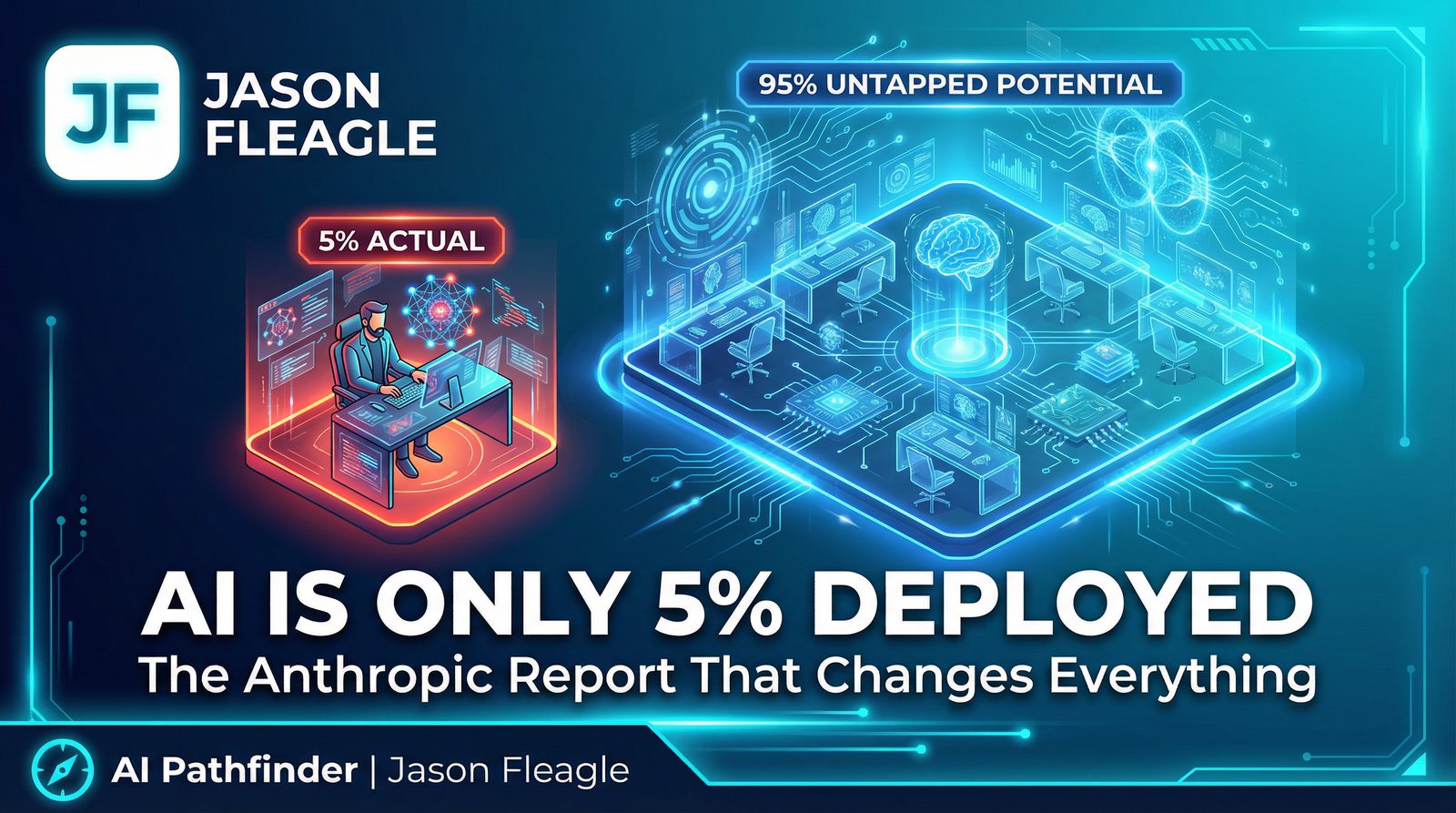
TLDR: Anthropic published a landmark labor market study using real data from millions of Claude conversations. The headline finding: AI is only deployed at roughly 5% of its theoretical capability. The gap between what AI could automate and what’s actually being automated is staggering — and it represents the single largest business opportunity of the next decade.
What Happened
Anthropic — the company behind Claude and one of the “Big Three” in generative AI alongside OpenAI and Google — published a research report that stopped me cold. What makes this study different from every other AI-and-jobs analysis you’ve read is the data source. They didn’t use surveys or theoretical models. They used real usage data from millions of Claude conversations to measure what AI is actually being deployed for in professional settings.
The result is a new metric they call “observed exposure” — a measure that combines theoretical AI capability with actual real-world usage, weighted toward automated (not just assistive) and work-related applications. It’s the first honest accounting of the gap between AI’s potential and its deployment.
And the gap is enormous.
The Chart That Changes Everything
The Anthropic data tells the whole story in two colors:
- Blue bars = what AI could theoretically handle in each occupational category
- Red bars = what’s actually happening in the real world
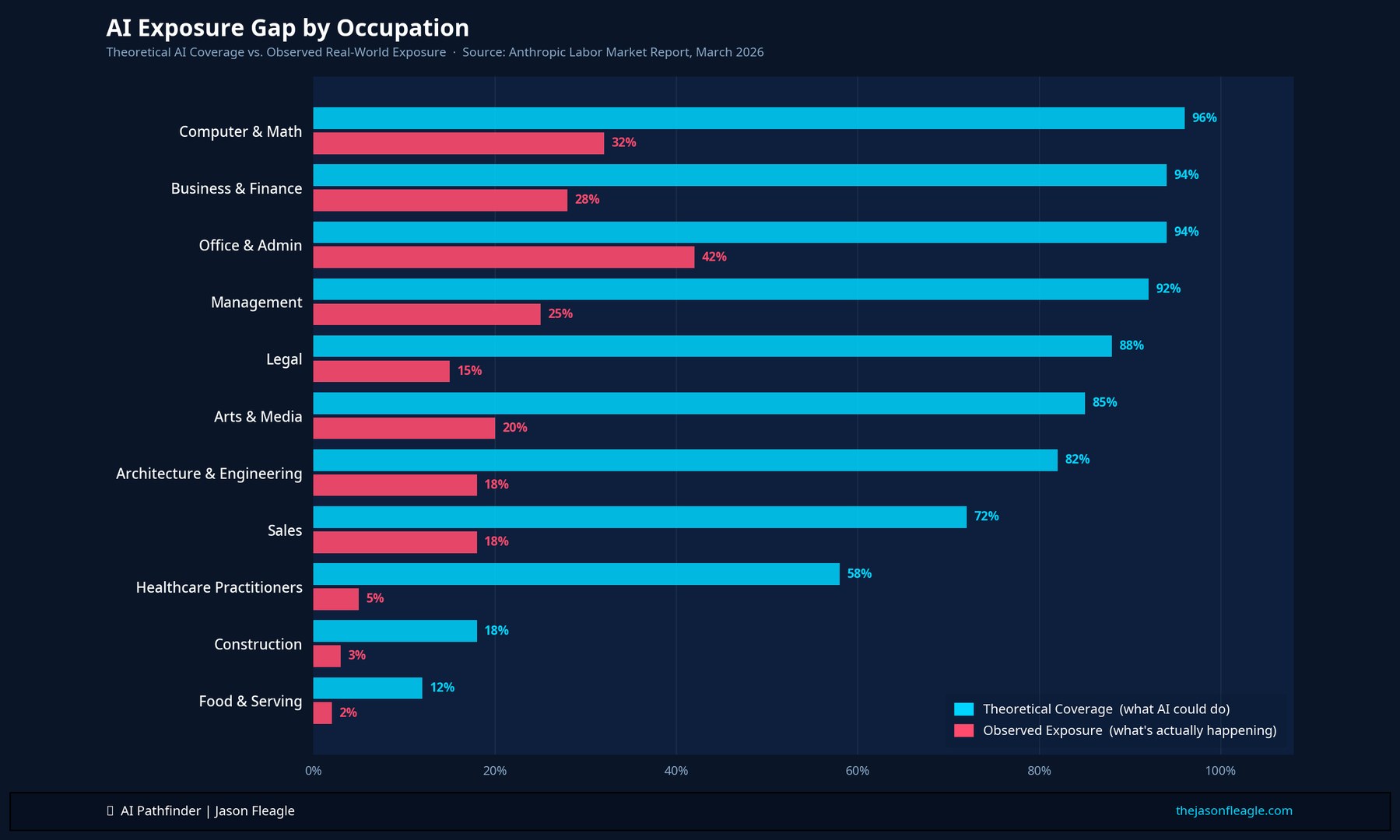
The numbers are staggering. Computer and Math occupations have 96% theoretical AI coverage — but only 32% observed exposure. Business and Finance sits at 94% theoretical / 28% actual. Office and Admin: 94% / 42%. Even the most “covered” category in practice is barely scratching the surface of what’s possible.
Across all occupations, we’re operating at roughly 5% of theoretical AI deployment potential. That’s not a technology problem. That’s a leadership, workflow design, and systems problem.
3 Signals Every Leader Needs to Act On
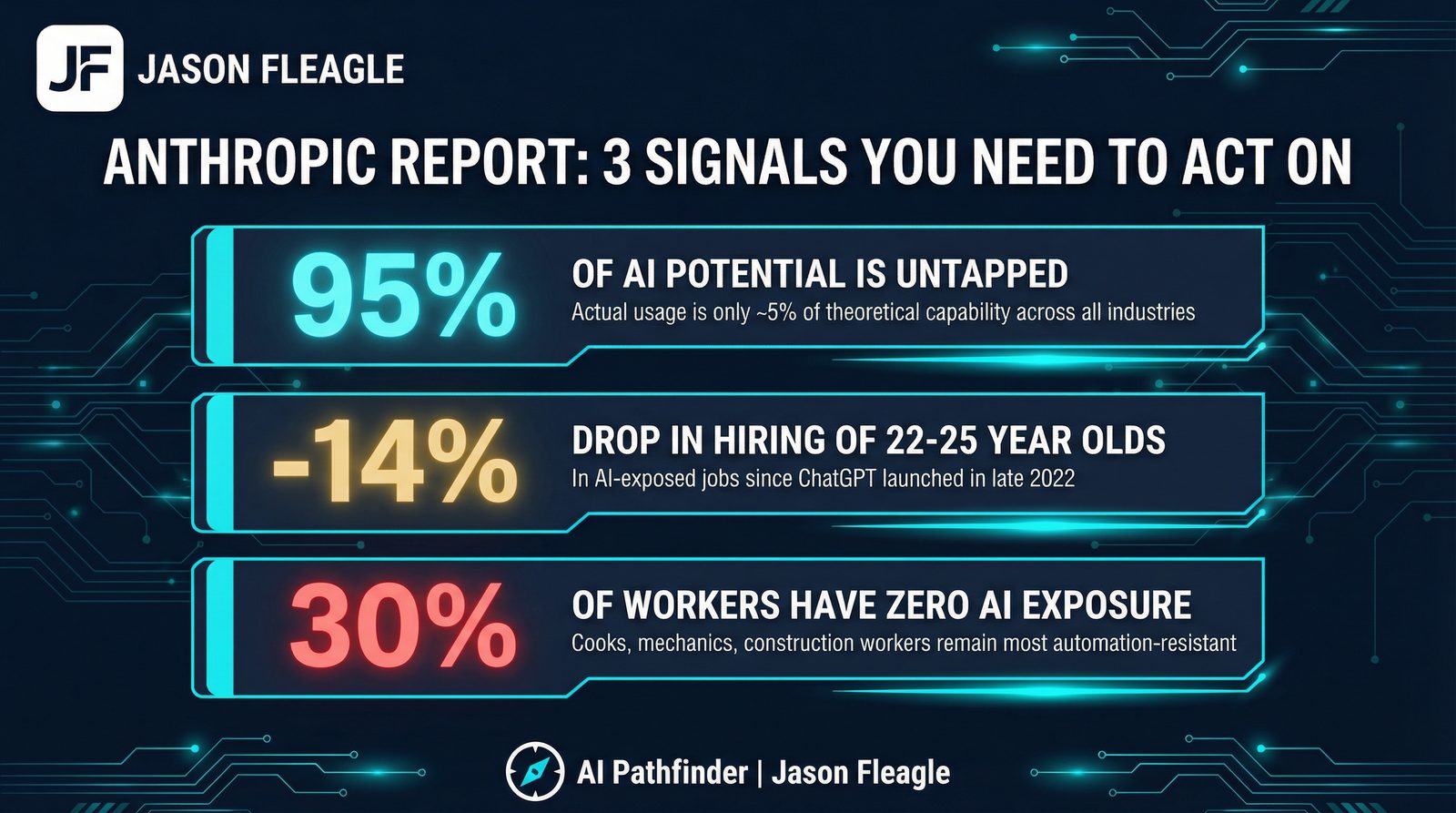
1. The 95% Gap Is Your Competitive Advantage
Most of your competitors are stuck at 5% deployment too. The organizations that close this gap over the next 24 months will have a structural cost and productivity advantage that will be nearly impossible to overcome. The question isn’t whether to close the gap — it’s whether you’ll be the one who does it first in your market or does it better.
The report found that occupations with higher observed AI exposure are projected by the Bureau of Labor Statistics to grow less through 2034. That’s a signal. The work is shifting. The organizations that redesign their workflows now will capture the value; the ones that wait will find themselves competing on price in a commoditized market.
2. The Entry-Level Moat Is Drying Up — Fast
Here’s the data point that should concern every executive and every 22-year-old in equal measure: hiring of workers aged 22-25 into AI-exposed jobs has dropped 14% since ChatGPT launched in late 2022. The traditional career ladder — where you learn by doing routine, repeatable tasks — is being slowly and quietly dismantled.
The workers most exposed to AI displacement aren’t who most people assume. They’re not minimum-wage employees. According to Anthropic’s data, the highest AI-exposed workers are disproportionately older, more educated, higher-paid, and female. These are your senior knowledge workers — the people whose jobs revolve around writing, analysis, research, and synthesis. The very skills that made them valuable are now the skills AI does best.
3. 30% of the Workforce Is Untouched — For Now
A full 30% of workers have virtually zero AI exposure. Cooks, bartenders, mechanics, construction workers — jobs requiring physical presence, real-world judgment, and hands-on skill. The irony of the AI era is that the trades are becoming more valuable, not less. As digital intelligence becomes a commodity, the premium shifts to things that can’t be digitized.
My Thoughts & Perspectives
There are several ways to interpret this data, but the interpretation that excites me most is this: AI might be the first technology in human history that actually makes us more human.
Every major technology of the past promised to free us and connect us — and delivered the opposite. The printing press, the telephone, the internet — they all demanded we adapt to them. We learned to type. We learned to structure our thoughts like databases. We learned to communicate in short, machine-readable bursts. We became more efficient and, in many ways, less ourselves.
What’s remarkable about truly intelligent AI is that it’s so capable it no longer needs us to adapt. We don’t need to learn to code in its language — it’s learned ours. We don’t need to organize our thoughts for its benefit — it can understand our tangents, our contradictions, our entirely human, messy way of thinking in stories and emotions and half-formed ideas.
For the first time, we’ve built technology sophisticated enough that we can remain completely, irrationally, beautifully human while working with it. We can focus on the things only we can do: building relationships, creating in the real world, and paying attention to each other.
It’s like we’ve created artificial minds so advanced that they’ve finally given us permission to stop being artificial ourselves.
So maybe this is what the future looks like. Not us merging with the machines — but machines becoming so capable that humans can finally, fully, be human again.
What To Do Now
For Leaders: Stop focusing on task automation and start focusing on workflow redesign. The 95% gap is your opportunity. Pick one complex, multi-step workflow in your organization and challenge your team to close that gap in the next 90 days. Set KPIs upfront. Measure hard ROI.
For Individuals: If your job is 80-90% repeatable tasks, you’re not competing with a colleague — you’re competing with an algorithm. The skills that will matter most in the next five years are the ones AI can’t replicate: emotional intelligence, managing AI agents, real-world relationship building, and judgment in ambiguous situations.
The humans who thrive won’t be the ones who compete with AI at routine tasks. They’ll be the ones who focus on what becomes more valuable as intelligence gets commoditized.
It’s all about delivering value to people who need it the most. AI can accelerate that value delivery if done right.
Ready to Close the Gap?
If you’re ready to move from AI experiments to building a true AI-powered organization, let’s talk. We help leaders design and implement the strategies and systems needed to capture the 95% that’s still on the table.
Work with me on AI consulting →
Subscribe to my YouTube channel →
Learn AI marketing fundamentals →
About Jason Fleagle
Jason Fleagle is a Chief AI Officer and Growth Consultant working with global brands to help with their successful AI adoption and management. He helps humanize data — so every growth decision an organization makes is rooted in clarity and confidence. Jason has helped lead the development and delivery of over 500 AI projects and tools, and frequently conducts training workshops to help companies understand and adopt AI. With a strong background in digital marketing, content strategy, and technology, he combines technical expertise with business acumen to create scalable solutions.
Source
Anthropic. “Labor market impacts of AI: A new measure and early evidence.” March 5, 2026. https://www.anthropic.com/research/labor-market-impacts