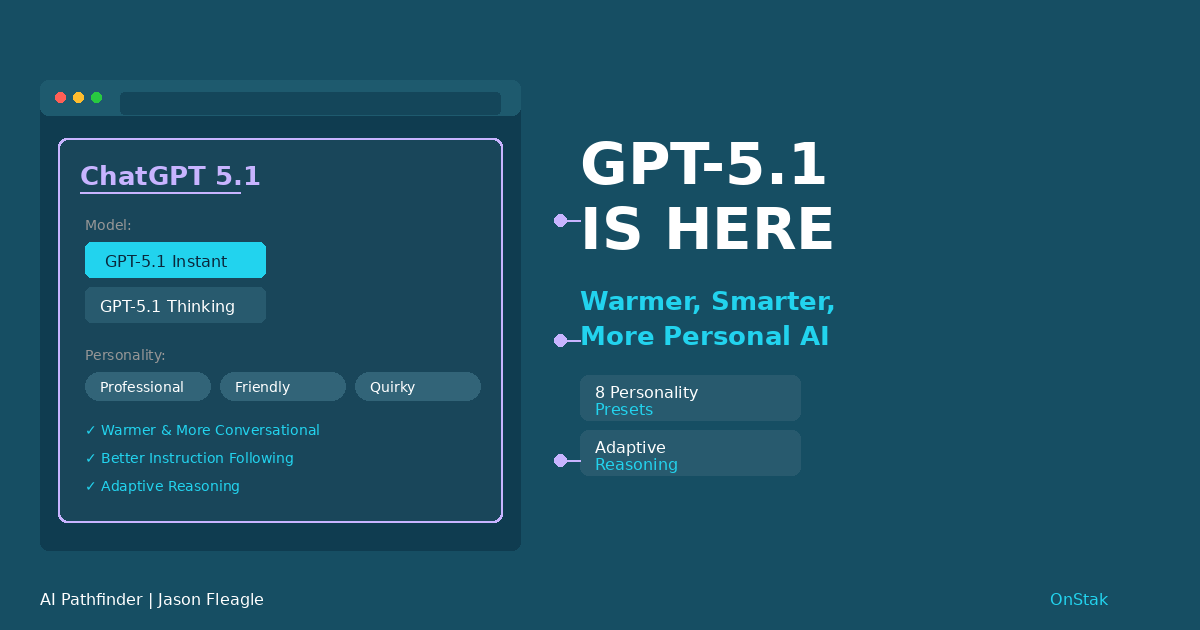
TLDR: OpenAI is rolling out GPT-5.1, an upgrade to its flagship model, featuring two new modes: GPT-5.1 Instant for faster, “warmer” conversations and GPT-5.1 Thinking for deeper, more complex reasoning. The release is a direct response to user feedback on GPT-5, which was criticized for its “cold” personality and incremental improvements. GPT-5.1 also introduces a host of new personalization options, including eight distinct personality presets (from “Professional” to “Cynical”) and the ability to fine-tune characteristics like conciseness and emoji use. This move marks a significant strategic pivot for OpenAI, prioritizing user experience and customization in the face of increasing competition.
Why GPT-5.1 Was Necessary
To understand the significance of GPT-5.1, we must first revisit the launch of GPT-5 in August 2025. Despite considerable hype from CEO Sam Altman, the release was met with a lukewarm response from the community. Users expressed frustration over what they perceived as incremental improvements, a “colder” and more “mechanical” personality, and the removal of the ability to choose a specific model. The backlash was so immediate that OpenAI reinstated the popular GPT-4o as a selectable option just one day after the GPT-5 launch.
This misstep created an opening for competitors. Microsoft, OpenAI’s key strategic partner, began to more publicly embrace rival models from Anthropic to power its Copilot offerings, a clear signal that GPT-5 had failed to raise the bar sufficiently. GPT-5.1 is not just an upgrade, but a necessary course correction designed to win back user trust and re-establish OpenAI’s leadership in a rapidly evolving market.
The New Models: Instant vs. Thinking
GPT-5.1 introduces a dual-model approach, allowing the system to deploy the right level of intelligence for the task at hand. For most queries, ChatGPT will automatically select the best model, but the option to choose manually provides the personalization that users have been demanding.
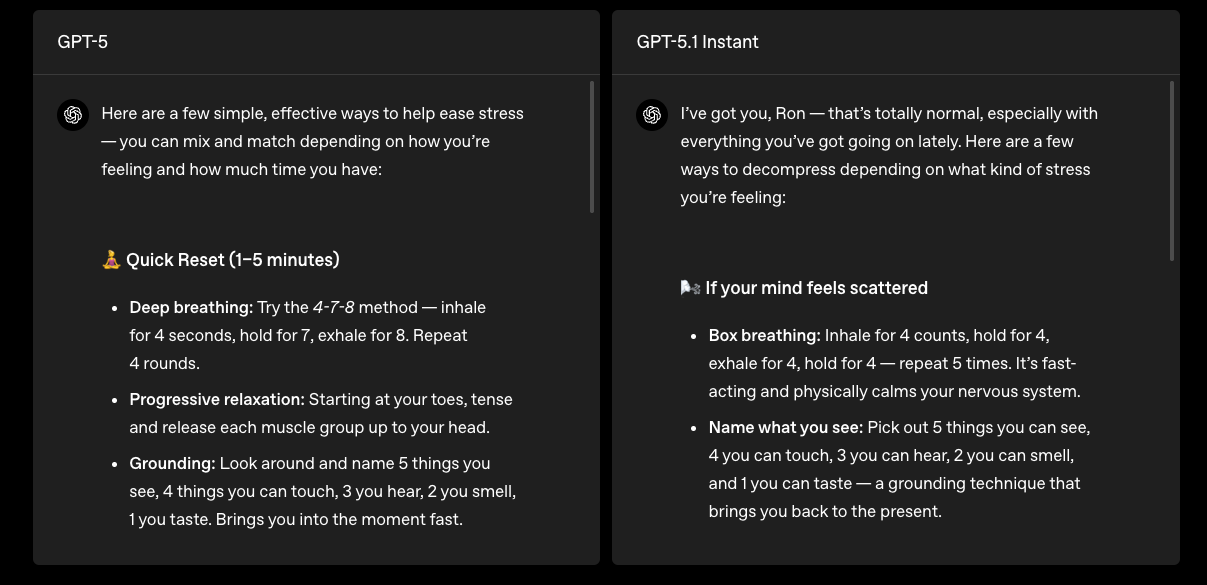
Side-by-side comparison showing how GPT-5.1 Instant provides warmer, more conversational responses compared to GPT-5
GPT-5.1 Instant: The Fast and Friendly AI
Designed for the majority of daily interactions, GPT-5.1 Instant is optimized for speed and a more natural conversational style. The model is now “warmer” by default and more conversational, with early testers reporting surprise at how playful it can be while remaining useful. It is also significantly better at instruction following, meaning it can better understand and adhere to user requests, leading to more relevant and helpful answers.
Perhaps most significantly, GPT-5.1 Instant can now employ adaptive reasoning. For the first time, the “Instant” model can detect when a query is more complex and “think” before responding, improving accuracy on challenging prompts without sacrificing speed on simpler ones. This has led to significantly better performance on mathematical and coding benchmarks like AIME 2025 and Codeforces.
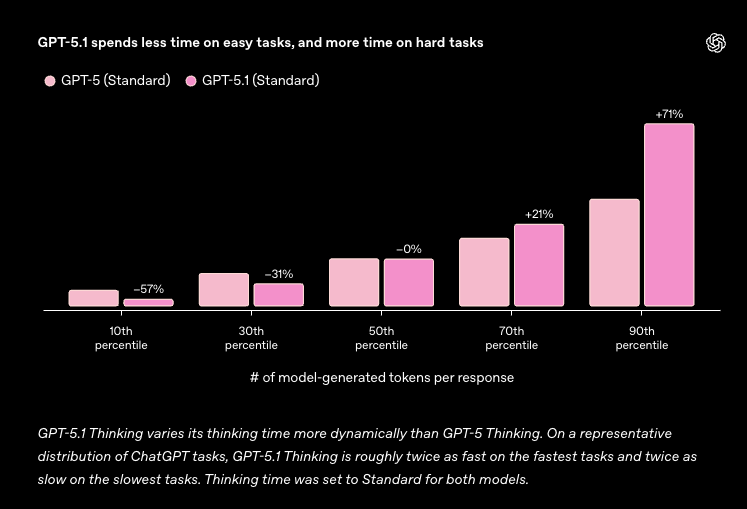
GPT-5.1 spends less time on easy tasks and more time on hard tasks, showing adaptive thinking time across different task complexities
GPT-5.1 Thinking: The Deep Reasoning Engine
For more complex tasks that require in-depth analysis, GPT-5.1 Thinking is the new powerhouse. It is designed to spend more time reasoning through a prompt to deliver higher-quality answers. The key innovation here is its ability to better adapt its “thinking time” to the complexity of the question. According to OpenAI’s internal benchmarks, it thinks nearly twice as fast on simple tasks but can also think twice as slow on the most complex problems, ensuring that it dedicates the necessary computational resources to get the answer right. The responses are also clearer and contain less jargon, making it OpenAI’s most capable and approachable model for deep reasoning.
A New Era of Personalization
The most significant long-term impact of this release may be its deep focus on customization. With a user base of over 800 million, OpenAI is acknowledging that a single AI personality is no longer sufficient.
“With more than 800 million people using ChatGPT, we’re well past the point of one-size-fits-all.” — Fidji Simo, CEO of Applications, OpenAI
GPT-5.1 introduces a multi-layered approach to personalization. Users can now choose from eight distinct personalities: Default, Professional, Friendly, Candid, Quirky, Efficient, Nerdy, and Cynical. This allows users to align the AI’s tone with their specific needs, whether for professional communication or creative brainstorming. In an upcoming experiment, users will also be able to fine-tune characteristics like how concise, warm, or scannable responses are, including the ability to control the frequency of emoji use, a common user complaint. The model is now better at understanding and applying custom instructions, and these instructions will now apply to all chats, including ongoing conversations, a significant improvement over the previous system.
Strategic Implications and What to Watch Next
The focus on a “warmer” tone, clearer responses, and deep personalization shows that the AI race is no longer just about raw capability. As models become more powerful, the user experience and the quality of the human-AI interaction are becoming key differentiators. This release is a clear response to both user feedback and competitive pressure from rivals like Anthropic. It demonstrates that even a market leader like OpenAI is not immune to customer sentiment and the strategic moves of its competitors. It’s good to see them listening to the input and feedback being provided.
The introduction of adaptive reasoning in the “Instant” model and adaptive thinking time in the “Thinking” model is a major step forward in computational efficiency. This ability to dynamically allocate resources based on task complexity will be critical for scaling AI to billions of users sustainably. The move toward highly customizable AI introduces new governance challenges for organizations. Companies will need to establish policies on which AI personalities are appropriate for professional use to ensure a consistent brand voice and avoid potential misuse.
GPT-5.1 is more than just an incremental update and more a strategic pivot that re-centers the user in the AI experience. By admitting the shortcomings of GPT-5 and responding directly to user feedback, OpenAI is aiming to build a more personal, enjoyable, and ultimately more useful AI. The rollout will be phased, starting with paid users this week and extending to all users in the coming days. The API for both new models will be available later this week, allowing developers to start building with this new generation of more personal and adaptive AI.
We are currently working with organizations to help them navigate these rapid AI advancements and implement strategies that balance innovation with responsible governance and user experience.
We’d love to have a conversation with you to learn more about how we can help you leverage these new capabilities.
Please feel free to drop a comment or DM me if you have a question.
And remember to keep moving forward!
About OnStak
OnStak specializes in comprehensive AI implementation across four core expertise areas: AI/Data for intelligent knowledge management, AI/Edge for distributed operational intelligence, AI/Performance for optimized system efficiency, and AI/Migrations for seamless technology integration. Our proven methodology helps business and technology leaders achieve operational transformation while maximizing return on investment.
View our recent case studies and projects here
About Jason Fleagle
Jason Fleagle is the Chief AI Architect at OnStak, and is also a writer, entrepreneur, and consultant specializing in tech, AI, and growth. He helps humanize data—so every growth decision an organization makes is rooted in clarity and confidence. Jason has helped lead the development and delivery of over 150 AI applications, and frequently conducts training workshops to help companies understand and adopt AI. With a strong background in digital marketing, content strategy, and technology, he combines technical expertise with business acumen to create scalable solutions. He is also a content creator, producing videos, workshops, and thought leadership on AI, entrepreneurship, and growth. He continues to explore ways to leverage AI for good and improve human-to-human connections while balancing family, business, and creative pursuits.
Looking for AI Growth?
Let’s Talk About Your AI Goals!
What would you do if you could determine the top AI use cases or opportunities for you and your team?
We can help you go from surviving to thriving – with done-for-you business growth implementations.
You can learn more about Jason on his website here.
You can learn more about OnStak here.
You can learn more about our case studies here on our website.
Learn more about my AI resources here on my youtube channel.