TLDR: OpenAI’s new ChatGPT Atlas browser is a powerful productivity tool, but it introduces significant security and privacy risks that make it unsuitable for sensitive use cases. Its “agentic” nature, which allows it to take actions on your behalf, creates a new attack surface for prompt injection attacks that can leak data, steal credentials, or download malware. While OpenAI has implemented safeguards, the core vulnerabilities remain unsolved. For now, Atlas should be treated as a test environment, not a daily driver for business-critical or personal tasks.
For decades, the web browser has been a passive window to the digital world. We type, we click, we read. But with the launch of AI-powered browsers like OpenAI’s ChatGPT Atlas, that paradigm is fundamentally shifting. These new “agentic” browsers don’t just display information; they interact with it, understand it, and act upon it. They promise a future of automated efficiency, where the browser becomes a proactive assistant.
But this leap in capability comes with a steep cost: a dramatically expanded attack surface and a model of “total surveillance” that should give every business leader pause. The question is no longer just “Is this useful?” but “Is this safe?”
After a deep dive into the security architecture of ChatGPT Atlas and its competitors, the answer is clear: the convenience may not yet be worth the risk.
Let’s unpack my thoughts here and what you should know.
The Unsolved Problem: Prompt Injection
The single greatest threat in AI browsers is indirect prompt injection. This is where a malicious actor hides commands within a webpage’s text or code. Because the AI cannot reliably distinguish between your trusted instructions and the untrusted content on a webpage, it can be tricked into executing these hidden commands.
Security researchers have demonstrated that this isn’t a theoretical threat. Vulnerabilities in other AI browsers, like Perplexity’s Comet, have been exploited to:
- Read and exfiltrate data from a user’s Gmail account.
- Download malicious files without the user’s knowledge.
- Attempt to make purchases on scam websites.
OpenAI’s Chief Information Security Officer, Dane Stuckey, has openly admitted that “prompt injection remains a frontier, unsolved security problem.”
While Atlas has built-in defenses like a “logged-out mode” for its agent and content filtering, these are mitigations, not solutions. The fundamental vulnerability remains.
“The main risk is that it collapses the boundary between the data and the instructions. It could turn an AI agent in a browser from a helpful tool to a potential attack vector against the user.” – Joseph Chalhoub, Security Researcher
From Intimate to Total Surveillance
Beyond the active security threats, the very design of ChatGPT Atlas is built on a model of unprecedented data collection. Privacy-focused organization Proton has aptly described the evolution of this model:
- Traditional Search (Google): Surveillance of isolated queries.
- Conversational AI (ChatGPT): Intimate surveillance, building detailed narratives about your life.
- Agentic Browser (Atlas): Total surveillance, observing every page you visit, how long you stay, and what you do next.
Atlas’s “Browser Memories” feature, while optional, sends page content to OpenAI’s servers for summarization. Although OpenAI claims to filter personal data and delete raw text, this architecture means your browsing activity is continuously processed and analyzed in the cloud. For any organization handling sensitive client data, intellectual property, or financial information, this is a non-starter.
This does open up a lot of security concerns that you should be thinking about as you use ChatGPT Atlas. Should you use it? In my opinion, yes but with caution.
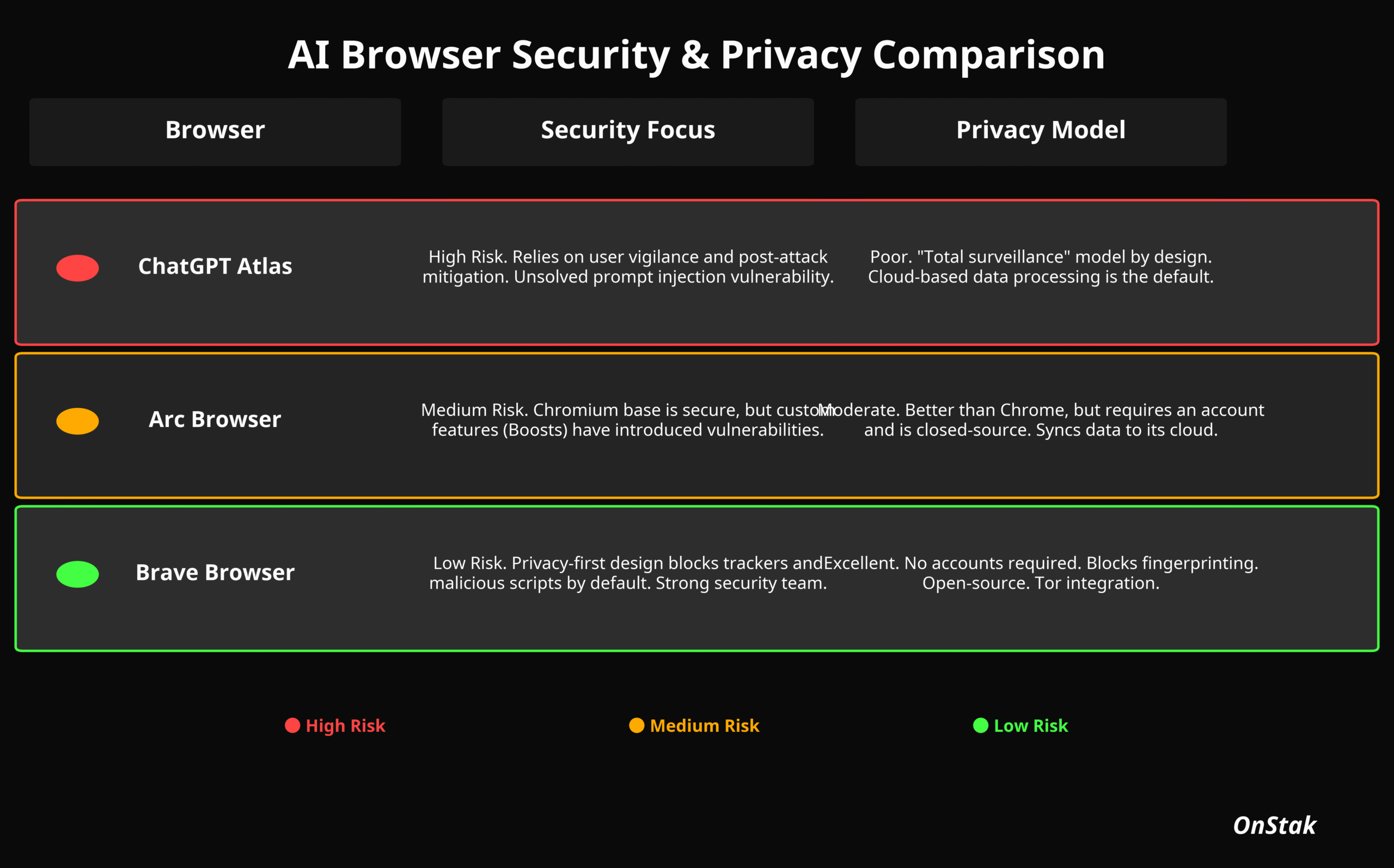
How Atlas Stacks Up: A Browser Comparison
Not all AI browsers are created equal. When evaluating the trade-offs between productivity and privacy, a clear spectrum emerges.
The Verdict: Should You Use ChatGPT Atlas?
The answer depends entirely on your threat model.
For Personal, Non-Sensitive Use: If you are an AI enthusiast who understands the risks and wants to experiment with the future of browsing, Atlas can be a fascinating tool. Treat it like a test environment: do not log into your bank, email, or any sensitive accounts.
For Professional or Enterprise Use: Absolutely not. The risks of data leakage, credential theft, and compliance violations are far too high. The fundamental security flaws and the invasive data collection model make it a liability for any organization that takes data security seriously.
For businesses looking to leverage AI in the browser, Brave offers a much more mature and secure alternative. Its privacy-preserving AI, “Leo,” provides helpful features without exposing your data to third-party servers or creating a detailed profile of your online activity.
ChatGPT Atlas is a glimpse into the future of how we will interact with the internet. But until the foundational security and privacy issues are solved, it remains a high-risk experiment, not a tool for the modern enterprise.
About OnStak
OnStak specializes in comprehensive AI implementation across four core expertise areas: AI/Data for intelligent knowledge management, AI/Edge for distributed operational intelligence, AI/Performance for optimized system efficiency, and AI/Migrations for seamless technology integration. Our proven methodology helps manufacturing leaders achieve operational transformation while maximizing return on investment.
Here’s a few recent AI projects we’ve delivered:
- Case Study: Cricket Sports Team Uses AI to Gain An Advantage
- Case Study: Transforming Mental Healthcare With AI
- Case Study: ARI AI Chatbot Helps Military Veterans Community
- Case Study: AI Helps Healthcare Professionals Roleplay Patient Care
- Case Study: AI Document Processing for Real Estate Investment
About Jason Fleagle
Jason Fleagle is the Chief AI Architect at OnStak, and is also a writer, entrepreneur, and consultant specializing in tech, AI, and growth. He helps humanize data—so every growth decision an organization makes is rooted in clarity and confidence. Jason has helped lead the development and delivery of over 150 AI applications, and frequently conducts training workshops to help companies understand and adopt AI. With a strong background in digital marketing, content strategy, and technology, he combines technical expertise with business acumen to create scalable solutions. He is also a content creator, producing videos, workshops, and thought leadership on AI, entrepreneurship, and growth. He continues to explore ways to leverage AI for good and improve human-to-human connections while balancing family, business, and creative pursuits.
Looking for AI Growth?
Let’s Talk About Your AI Goals!
What would you do if you could determine the top AI use cases or opportunities for you and your team?
We can help you go from surviving to thriving – with done-for-you business growth implementations.