Most companies are investing in AI. Only 1% are getting transformative results. Here’s the practical playbook that bridges the gap—focused on the three things every executive actually cares about: time, money, and people.
The tension in every boardroom right now is palpable. On one hand, the promise of AI is staggering—McKinsey estimates a $4.4 trillion corporate productivity potential. On the other, the reality is that only a fraction of companies are capturing it. While 92% of executives plan to increase their AI spend in the next three years, most are still stuck in a frustrating cycle of pilots and demos, failing to achieve the substantial outcomes that define mature AI integration.
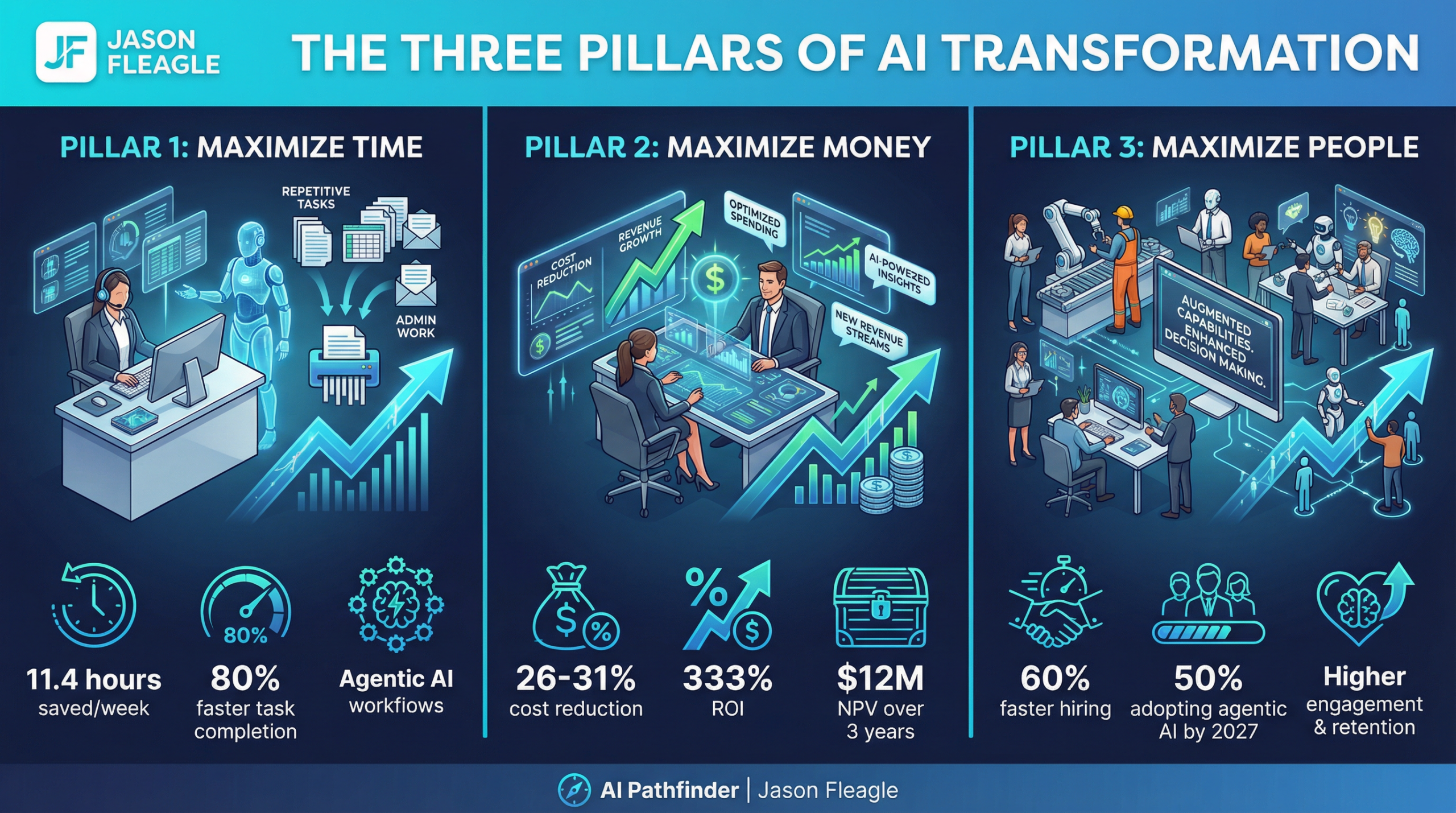
The data tells a story of a massive missed opportunity. Knowledge workers could be saving 11.4 hours per week right now. Early adopters are already seeing 26–31% cost reductions in core functions like supply chain and finance. A recent Forrester Total Economic Impact study on enterprise AI revealed a staggering 333% ROI and a $12 million net present value over three years for composite organizations that get it right.
The gap isn’t technology. It’s leadership. Employees are already using AI—94% are familiar with generative AI, and their actual daily usage is often three times what their leaders estimate. The winners in 2026 will be the organizations that stop treating AI as a shiny object or a simple cost center and start treating it as the ultimate multiplier of time, money, and human potential.
The Three Pillars of AI-Powered Transformation
To move from experimentation to enterprise-wide impact, leaders need to focus their AI strategy on three core pillars. This isn’t about chasing every new model; it’s about systematically applying AI to the metrics that matter.
Pillar 1: Maximize Time – From Repetitive Work to Superagency
The conversation around AI and time has evolved. It’s no longer just about automating simple tasks; it’s about augmenting human capability to achieve a state of “superagency.” Research from Anthropic shows that AI can reduce task completion time by up to 80%, and McKinsey predicts that AI will automate three hours of daily cognitive work by 2030. The goal is to free your most valuable people from low-value work so they can focus on high-impact strategic initiatives.
Actionable Strategies:
- Deploy Agentic AI: Rethink entire workflows from the ground up. Instead of just automating steps, use agentic AI to handle complex, multi-step processes autonomously. As PwC predicts for 2026, the key is to go “narrow and deep” on 2–3 high-value processes first. For example, companies using platforms like Salesforce Agentforce are creating “digital teammates” that can handle customer queries, perform fraud checks, and execute marketing campaigns with minimal human intervention.
- Embrace AI Copilots: Equip your teams with AI copilots and agents for everyday tasks like summarization, coding, research, and scheduling. This is the low-hanging fruit that adds up to significant time savings across the organization.
- Quick Win: Conduct an audit of the top 10 biggest time sinks in your organization this week. Identify the repetitive, manual processes that are draining your team’s energy and target them for an AI-powered overhaul.
Pillar 2: Maximize Money – Proven ROI That CFOs Will Love
AI investments must deliver a clear return. The good news is that when implemented correctly, they do. Beyond the headline-grabbing 26–31% cost savings in optimized functions, top-performing organizations are seeing returns of 3–10x on their AI investments. The key is to prioritize use cases with a direct line to the P&L and measure them with rigor.
How to Do It:
- Prioritize for P&L Impact: As PwC advises, leadership must identify the areas where business priority, data readiness, and available talent align. Focus on solving expensive problems first.
- Measure with Hard Metrics: Move beyond vanity metrics. Track hours saved and translate them into labor cost reductions. Measure the financial impact of error reduction, cycle time compression, and increased revenue per employee.
- Learn from Case Studies: Companies like New American Funding have seen 100–200% efficiency gains and massive agency cost avoidance by using AI to streamline content creation and other workflows. Finance and supply-chain teams are consistently reporting cost reductions of over 25%.
- Pro Tip: Start with a 90-day pilot focused on a single, high-impact workflow transformation. Define your success metrics upfront and build a clear business case that your CFO will endorse.
Pillar 3: Maximize People – Build the Blended Human-Machine Workforce
The most successful AI strategies are human-centric. According to Deloitte, by 2027, 50% of generative AI users will be piloting agentic AI, which will fundamentally redefine the boundaries between human and machine tasks. The future of work is a blended model where AI handles speed, repetitive tasks, and data-heavy analysis, while humans provide judgment, empathy, and strategic oversight.
Harvard Business Review’s 2026 trend analysis confirms this: organizations that focus AI on solving employee pain points achieve higher-quality work and better financial returns than those that simply mandate usage from the top down.
Strategies for a Blended Workforce:
- Invest in AI-Powered Upskilling: Use AI to create internal talent marketplaces and provide real-time coaching. This can lead to a 60% faster time-to-hire for internal roles and significantly lower employee turnover.
- Create New Roles: The rise of AI agents creates a need for AI Orchestrators and AI Generalists—people who can manage, train, and direct teams of digital workers.
- Reduce Burnout and Increase Engagement: By automating the “workslop” and joyless tasks that lead to burnout, you can free your people to focus on more creative and fulfilling work, leading to higher engagement and retention.
The AI Pathfinder 5-Step Roadmap
Moving from theory to practice requires a clear, repeatable plan. This 5-step roadmap is designed to help you build momentum and deliver measurable results.
- Assess: Run a 1-week audit of your organization’s time, money, and people challenges to identify the most promising AI use cases.
- Prioritize: Score potential use cases based on their ROI potential, technical feasibility, and impact on your people.
- Pilot & Measure: Launch a 60–90 day pilot with clearly defined KPIs (e.g., time saved, cost avoided, employee Net Promoter Score).
- Scale with Governance: As you scale, implement a robust framework for responsible AI, including human-in-the-loop oversight and comprehensive change management.
- Iterate & Upskill: Conduct monthly reviews of your AI initiatives and foster a culture of continuous learning through hackathons, training programs, and incentives.
Pitfalls & How High-Performers Avoid Them
Many AI initiatives fail not because of the technology, but because of common, avoidable mistakes.
- Leadership Lag: When leaders are not actively championing and driving the AI strategy, initiatives stall.
- “Workslop”: Generating poor-quality, AI-generated content that creates more work for humans to fix.
- Measuring Activity, Not Outcomes: Focusing on how many people are using AI instead of the actual business value being created.
- Ignoring Culture: Overlooking the importance of mental fitness, psychological safety, and a culture that embraces change—a blind spot for 91% of CIOs.
The Time Is Now
2026 is the year AI moves from a series of isolated experiments to the core operating system of the enterprise. The organizations that treat it as a powerful multiplier of time, money, and people will build an insurmountable competitive advantage. The rest will fall further and further behind.
Ready to Build Your AI Pathfinder Strategy?
If you’re ready to move beyond pilots and demos to achieve transformative AI results, I can help. My team has delivered hundreds of AI projects for enterprise organizations, and we specialize in building practical, ROI-driven strategies that focus on time, money, and people.
Work with me on AI consulting →
Subscribe to my YouTube channel →
Learn AI marketing fundamentals →
About Jason Fleagle
Jason Fleagle is an AI architect and Chief AI Officer who helps enterprise organizations turn data into growth. As the founder of Catalyst Brand Group, he’s delivered over $70M in revenue impact through AI-powered marketing, automation, and strategic consulting. His work focuses on practical, ROI-driven AI implementations that deliver measurable results in time savings, cost reduction, and workforce transformation.
Sources
- McKinsey & Company. (2023). “The Economic Potential of Generative AI: The Next Productivity Frontier.” McKinsey Global Institute.
- PwC. (2026). “AI Predictions 2026: The Future of Enterprise AI Strategy.” PwC Technology Consulting.
- Forrester Research. (2025). “The Total Economic Impact of Enterprise AI Platforms.” Forrester Consulting Study.
- Deloitte. (2026). “State of Generative AI in the Enterprise: Adoption, Impact, and Future Trends.” Deloitte Insights.
- Harvard Business Review. (2026). “AI Trends 2026: How Leading Organizations Are Achieving Transformative Results with AI.”
- Anthropic. (2025). “Measuring the Impact of AI on Knowledge Work: Time Savings and Productivity Gains.” Anthropic Research.
- Gartner. (2025). “AI Maturity Model: From Experimentation to Enterprise-Wide Transformation.” Gartner Research.
- Salesforce. (2026). “Agentforce: Building Digital Teammates for the Modern Enterprise.” Salesforce AI Research.
- New American Funding. (2025). “Case Study: Achieving 100-200% Efficiency Gains with Enterprise AI.” Company White Paper.
- McKinsey & Company. (2025). “The Future of Work: How AI Will Automate Three Hours of Daily Cognitive Work by 2030.” McKinsey Quarterly.