Did Google NotebookLM Just Get Scary Good?
TLDR:
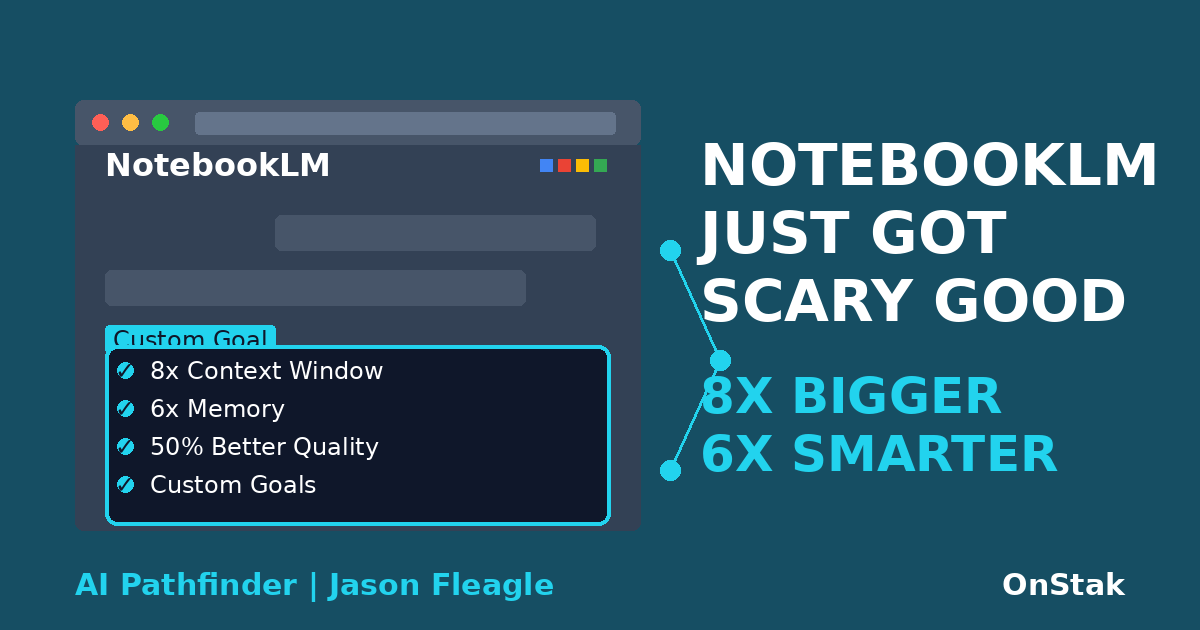
Google’s NotebookLM just received a massive upgrade that fundamentally changes how you can work with AI research tools. We’re talking about an 8x larger context window (1 million tokens), 6x longer conversation memory, 50% better response quality, and the ability to customize how the AI thinks through custom goals. This isn’t incremental improvement—it’s a paradigm shift in how AI can serve as a long-term research and strategy partner.
I’ve used Google NotebookLM myself since it was released:
https://youtube.com/@jasonfleagle
Click here if you want to watch the Google NotebookLM Tutorial video.
What Just Changed?
On October 29, 2025, Google announced a comprehensive overhaul of NotebookLM’s chat capabilities, powered by the latest Gemini models. Here’s what you can now do that you couldn’t before:
1. Process Entire Document Collections at Once (1 Million Token Context)
NotebookLM now supports the full 1 million token context window of Gemini across all plans. In practical terms, this means you can upload your entire research library—market analysis reports, competitive intelligence documents, industry white papers, internal strategy memos, and quarterly performance data—and NotebookLM will analyze all of it simultaneously.
Before: You had to carefully select which documents to include, often hitting limits and having to split your analysis across multiple sessions.
Now: Throw everything in. The full context of your project, all at once, all the time.
2. Remember Context Across Days and Weeks (6x Longer Memory)
Google has increased NotebookLM’s capacity for multi-turn conversation by more than six times. Your conversations are now automatically saved, and you can close a session and resume it later without losing your thread.
Why this matters: AI tools have historically suffered from “conversation amnesia.” You’d have a productive session on Monday, come back Wednesday, and have to re-explain everything. NotebookLM now maintains continuity across extended projects.
Real-world example: Monday’s deep dive into Q4 go-to-market strategy builds into Wednesday’s competitive analysis, which informs Friday’s board presentation. The AI remembers the full arc of your thinking and can reference earlier insights without you having to repeat yourself.
3. Customize How the AI Thinks (Custom Goals Feature)
This is where it gets genuinely interesting. NotebookLM now lets you define custom goals that shape how the AI responds. You’re not just asking questions—you’re programming the AI’s perspective, tone, and analytical approach.
Example goals you can set:
Skeptical Investor Mode:
“You are my research advisor. Rigorously challenge every assumption. Ask probing questions, identify logical fallacies, and force me to defend my work from the ground up.”
Action-Oriented Strategist:
“Your response must be an immediate action plan. Be analytical and direct, and focus exclusively on the concrete strategies and critical-path steps needed to achieve the goal fast.”
Multi-Perspective Analysis:
“Analyze the provided material from three distinct perspectives: As a strict academic focusing on evidence and logical consistency, as a creative strategist looking for non-obvious connections and innovative applications, and as a skeptical reviewer actively searching for gaps, flaws, and potential problems in the conclusions.”
Game Master for Scenario Planning:
“Act as a Game Master for a text-based simulation. Present a high-stakes scenario with a specific goal and a step limit (e.g., 10). I make all the choices. Narrate the outcomes vividly, using realistic, scenario-relevant details.”
This isn’t prompt engineering—it’s role engineering. You’re defining the AI’s entire analytical framework, not just asking better questions.
4. Automatically Explore Sources from Multiple Angles
NotebookLM now goes beyond your initial prompt. It automatically explores your sources from multiple angles, synthesizing findings into a single, more nuanced response. This is especially powerful for large notebooks where the AI needs to identify connections between documents you didn’t even think to look for.
Example: That offhand comment in the CFO’s email about supply chain constraints might actually connect to the operational bottleneck mentioned in last quarter’s logistics report. You wouldn’t have made that connection manually. NotebookLM does.
5. Saved and Secure Conversation History
Your conversations are now automatically saved and can be resumed later. You can delete chat history at any time, and in shared notebooks, your chat is visible only to you. This supports long-term projects while maintaining privacy.
Why This Is Bigger Than It Looks
The Shift from Q&A to Partnership
Traditional AI tools operate in a question-and-answer paradigm. You ask, it responds, and the interaction ends. NotebookLM’s upgrades move it toward something fundamentally different: a persistent research partner that remembers your project, understands your goals, and adapts its thinking to your needs.
This matters because real work doesn’t happen in isolated queries. It happens over days, weeks, and months. You iterate. You refine. You build on previous insights. NotebookLM can now do that with you.
The Custom Goals Feature Is a Game-Changer
The ability to define custom goals is arguably the most significant feature here. It transforms NotebookLM from a general-purpose research tool into a specialized analytical partner tailored to your exact needs.
Why this is powerful:
- You control the analytical lens. Want a brutal critique of your business plan? Set the goal. Need creative ideation with no constraints? Set a different goal. The same tool adapts to radically different modes of thinking.
- You can simulate different perspectives. Instead of trying to think like an investor, a customer, and a regulator yourself, you can have NotebookLM analyze your materials from each perspective sequentially—or even simultaneously.
- It forces clarity about what you actually need. Defining a custom goal requires you to articulate what kind of thinking you want. That clarity alone is valuable, even before the AI responds.
The 1 Million Token Context Window Changes the Game
Most AI tools force you to be selective about what you include. NotebookLM now lets you be comprehensive. That changes the quality of insights you can extract.
Before: “I’ll upload the three most relevant reports and hope the AI can infer the rest.”
Now: “I’ll upload everything, and the AI will find connections I didn’t know existed.”
This is especially critical for complex, multi-dimensional projects where the answer isn’t in any single document but in the relationships between them.
The Governance Questions You Can’t Ignore
As always, the technology moves faster than the governance. Here are the questions every organization needs to be asking:
Data Privacy and Ownership
When you upload proprietary documents to NotebookLM, who owns that data? How is it stored? Is it used to train Google’s models? What happens if there’s a data breach?
Questions:
- What are the terms of service for uploaded documents?
- Can you delete your data permanently?
- Is your data isolated from other users?
- What compliance certifications does NotebookLM have (SOC 2, GDPR, HIPAA)?
Accuracy and Hallucination Risk
NotebookLM is grounded in your sources, which reduces hallucination risk compared to general-purpose AI. But it’s not zero. The AI can still misinterpret, over-generalize, or make logical leaps that aren’t supported by the text.
Questions:
- How do you verify the AI’s conclusions before acting on them?
- What checks and balances exist to catch errors?
- Who’s responsible if a strategic decision based on NotebookLM’s analysis turns out to be wrong?
Bias in Custom Goals
The custom goals feature is powerful, but it also introduces a new risk: confirmation bias at scale. If you set a goal that aligns with your pre-existing beliefs, the AI will dutifully deliver analysis that supports those beliefs—even if the sources suggest otherwise.
Questions:
- How do you ensure you’re using custom goals to challenge your thinking, not reinforce it?
- Are you testing multiple perspectives, or just the one that feels comfortable?
- What safeguards exist to prevent the AI from becoming an echo chamber?
Vendor Lock-In
If NotebookLM becomes central to your research and strategy workflows, you’re dependent on Google’s continued support, pricing, and feature set. What happens if Google changes the terms, raises prices, or discontinues the product?
Questions:
- Can you export your notebooks and conversation history?
- Do you have a backup plan if NotebookLM becomes unavailable?
- Are you diversifying your AI tool stack, or putting all your eggs in one basket?
What to Do Next
If you’re a researcher or analyst:
- Test the 1 million token context window. Upload your entire research library and see what connections NotebookLM finds that you missed.
- Experiment with custom goals. Try setting goals that challenge your assumptions, not just ones that align with your existing thinking.
- Use the extended memory for long-term projects. Start a conversation on Monday, resume it on Friday, and see how the continuity changes your workflow.
If you’re a business leader:
- Evaluate NotebookLM for strategic planning. Can it help your team synthesize market research, competitive intelligence, and internal data faster and more comprehensively?
- Set governance policies for document uploads. What can be uploaded to NotebookLM? What can’t? Who approves?
- Train your team on effective custom goals. The feature is only as good as the goals you set. Invest in helping your team define goals that produce actionable insights.
If you’re in product or engineering:
- Study how Google implemented custom goals. This is a design pattern worth understanding. How can you apply similar customization in your own AI products?
- Monitor how users adopt the feature. Are they using it? How? What goals are most effective?
- Consider the implications for your own AI strategy. If your competitors are using tools like NotebookLM to accelerate research and strategy, can you afford not to?
The Bottom Line
Google NotebookLM just became one of the most powerful AI research tools available. The combination of massive context windows, extended memory, automatic multi-angle exploration, and customizable analytical perspectives makes it fundamentally more capable than it was a week ago.
But power comes with responsibility. The same features that make NotebookLM a game-changer for strategic thinking also introduce new risks around data privacy, accuracy, bias, and vendor dependence. Organizations that adopt it need to do so thoughtfully, with clear governance policies and an understanding of both the opportunities and the risks.
The question isn’t whether AI research tools like NotebookLM will become central to how we work. The question is whether you’re using them in a way that amplifies your thinking without replacing your judgment.
Google just made their bet on what the future of AI-assisted research looks like. What’s yours?
Have you used NotebookLM for research or strategy work?
Would you trust it with your most sensitive business documents?
About OnStak
OnStak specializes in comprehensive AI implementation across four core expertise areas: AI/Data for intelligent knowledge management, AI/Edge for distributed operational intelligence, AI/Performance for optimized system efficiency, and AI/Migrations for seamless technology integration. Our proven methodology helps manufacturing leaders achieve operational transformation while maximizing return on investment.
Here’s a few recent AI projects we’ve delivered:
-
Case Study: Cricket Sports Team Uses AI to Gain An Advantage
-
Case Study: ARI AI Chatbot Helps Military Veterans Community
-
Case Study: AI Helps Healthcare Professionals Roleplay Patient Care
-
Case Study: AI Document Processing for Real Estate Investment
About Jason Fleagle
Jason Fleagle is the Chief AI Architect at OnStak, and is also a writer, entrepreneur, and consultant specializing in tech, AI, and growth. He helps humanize data—so every growth decision an organization makes is rooted in clarity and confidence. Jason has helped lead the development and delivery of over 150 AI applications, and frequently conducts training workshops to help companies understand and adopt AI. With a strong background in digital marketing, content strategy, and technology, he combines technical expertise with business acumen to create scalable solutions. He is also a content creator, producing videos, workshops, and thought leadership on AI, entrepreneurship, and growth. He continues to explore ways to leverage AI for good and improve human-to-human connections while balancing family, business, and creative pursuits.
Looking for AI Growth?
Let’s Talk About Your AI Goals!
What would you do if you could determine the top AI use cases or opportunities for you and your team?
We can help you go from surviving to thriving – with done-for-you business growth implementations.
- You can learn more about Jason on his website here.
- You can learn more about OnStak here.
- You can learn more about our top AI case studies here on our website.
- Learn more about my AI resources here on my youtube channel.
- And check out my AI online course.