Executive Summary
AT&T Labs, the innovation engine for one of the world’s largest telecommunications companies, faced a common but critical challenge in the world of AI: how to move a promising edge AI concept from a PowerPoint slide to a real-world, production-ready deployment. The goal was to use real-time video from cameras to improve customer experiences and operations in their retail stores, but they needed to prove it would work on their actual infrastructure before scaling to thousands of locations. In a collaborative project with teams from OnStak and Cisco, a production-realistic environment was built in the AT&T Labs. This powerful edge AI platform, running on a Cisco Unified Edge system with NVIDIA GPUs, brought a drive-thru computer vision use case to life. The project successfully demonstrated real-time video processing, created a “digital twin” of the store for simulations, and provided a full dashboard to monitor performance. This project closed the gap between pilot and production, creating a repeatable blueprint for AT&T to confidently roll out new AI services across its global retail footprint.
The Challenge
For large enterprises like AT&T, the promise of edge AI is enormous. The ability to run artificial intelligence directly in stores, on factory floors, or in remote locations—where data is generated—can unlock incredible new efficiencies and customer experiences. AT&T Labs saw a clear opportunity to use computer vision (AI that understands video) to improve everything from queue management in their retail stores to safety monitoring at their cell towers. The ideas were there, but a major hurdle stood in the way: the “edge AI validation gap.”
It’s one thing to create a cool demo on a laptop. It’s another thing entirely to prove that the same AI workload will perform reliably on the actual, complex infrastructure that will be deployed across thousands of distributed sites. Before making a massive investment in a nationwide rollout, AT&T needed to answer critical questions:
- Will it perform? Can the system process multiple video streams in real-time without lagging?
- Can we monitor it? If a camera in a store in Omaha, Nebraska goes down, how will we know? How can we measure the performance of the AI models from a central location?
- Is it scalable? Can we create a standardized model that can be deployed, updated, and managed across thousands of stores without a massive, dedicated IT team for each location?
Without clear answers to these questions, even the most promising AI projects can get stuck in “pilot purgatory,” never making the leap from a small-scale experiment to a full-scale, value-driving deployment. AT&T needed a way to build a production-realistic bridge from the lab to the real world, proving not just the AI model, but the entire end-to-end system, was ready for prime time.
The Solution
To bridge the validation gap, a collaborative team from AT&T, OnStak, and Cisco came together to build a powerful, production-ready edge AI platform right inside the AT&T Labs. The solution was designed to mirror the exact environment that would be used in a real-world deployment, providing a true test of the system’s capabilities.
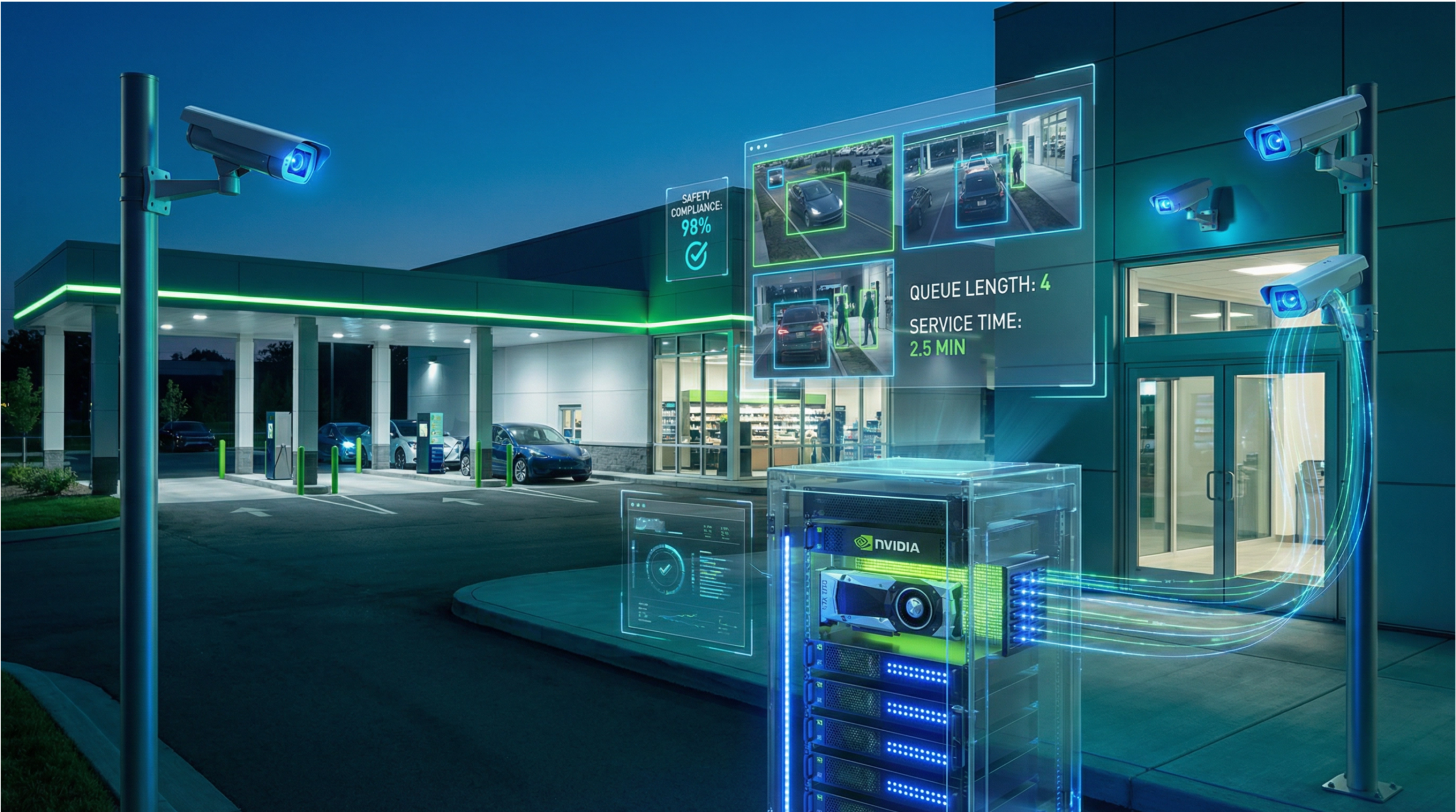
The foundation of the platform was a Cisco Unified Edge system, a rugged and powerful computing device designed for edge environments, equipped with an NVIDIA L4 GPU to handle the demanding AI workloads. On top of this hardware, the team implemented a modern, containerized software stack using Red Hat OpenShift (Kubernetes), allowing for flexible and scalable management of the AI applications.
To make the use case tangible and easy to understand for both business and technical teams, a drive-thru restaurant scenario was created. This allowed the team to simulate a common retail environment with multiple camera feeds and real-time customer interactions. A key innovation was the use of NVIDIA Omniverse to create a digital twin—a realistic 3D virtual replica of the drive-thru. This digital twin could be used to generate synthetic video data for training the AI models and to visualize the real-time data coming from the cameras.
The platform’s computer vision capabilities were impressive. It could:
- Monitor queue length and wait times in real-time.
- Estimate service times to identify bottlenecks.
- Track people and vehicle movement for safety and efficiency.
- Ensure safety and compliance, such as detecting if an employee was wearing the proper safety gear.
Crucially, the solution included a comprehensive GPU performance monitoring dashboard, integrated with Splunk. This gave the team full observability into the system’s performance, allowing them to track GPU utilization, latency, and throughput in real-time. This wasn’t just about making sure the system was working; it was about understanding how well it was working, providing the data needed to make informed decisions about scaling and optimization.
The project was delivered in a structured, five-phase approach:
- Discovery: Assessing AT&T’s priorities and selecting the drive-thru use case.
- Design: Architecting the solution to run on the Cisco Unified Edge hardware.
- Deployment: Installing the full software stack, from the OS and drivers to Omniverse and the AI models.
- Workshop: Demonstrating the live system to AT&T teams and showcasing its capabilities.
- Knowledge Transfer: Providing the documentation and training for AT&T’s engineers to take over and expand the platform.
This end-to-end approach didn’t just deliver a piece of technology; it delivered a working, measurable, and scalable system, ready to be replicated across the AT&T ecosystem.


Results & Impact
The AT&T Labs Edge AI project was a resounding success, delivering critical outcomes that paved the way for large-scale AI adoption. The project successfully moved beyond theoretical discussions and provided concrete, measurable proof that a sophisticated computer vision platform could run effectively on production-grade edge infrastructure.
From Pilot Paralysis to Production Validation
The most important result was the validation of the entire end-to-end system. By building a realistic environment in the lab, AT&T could see firsthand how the AI workloads performed on the same class of hardware they would use in their stores. This eliminated the guesswork and provided the confidence needed to move forward. The project demonstrated that real-time video processing from multiple camera streams was not only possible but also reliable and performant.
Data-Driven Decisions Through Full Observability
The inclusion of a GPU monitoring dashboard was a game-changer. For the first time, business and technical teams could have a shared, data-driven conversation about performance. Instead of talking in abstract terms, they could look at concrete metrics like GPU utilization, memory usage, and inference latency. This observability was critical for making informed decisions about right-sizing infrastructure and for proving the business case for further investment. It answered the question, “How much hardware do we really need?” with hard data.
A Repeatable Blueprint for Scaled Deployment
The project didn’t just produce a one-off solution; it created a repeatable blueprint. The containerized microservices architecture, the structured five-phase delivery model, and the comprehensive documentation provided AT&T with a clear path to replicate and scale the solution across hundreds or even thousands of locations. The knowledge transfer sessions empowered AT&T’s internal engineering teams to take ownership of the platform and continue to innovate on top of it.
Unlocking a Pipeline of New AI Use Cases
The success of the initial project immediately sparked interest in a wide range of new applications. The workshop and demonstration led to the creation of a backlog of high-value computer vision use cases across different parts of AT&T’s business, including:
- Retail: Loss prevention, customer footfall analysis, and optimizing store layouts.
- Telco Operations: Site security, asset tracking, and safety monitoring at cell towers.
- Hospitality: Improving customer flow and service times in partnered venues.
The project’s success was so clear that AT&T requested additional follow-on phases to explore these new opportunities, turning an initial proof-of-concept into a long-term innovation platform.

Future Possibilities
With a validated and scalable blueprint in hand, AT&T is now positioned to become a leader in the use of edge AI. The successful lab deployment has opened the door to a future where intelligent video analytics are a standard part of their operations, driving efficiency and creating new value across their vast network.
The most immediate opportunity is the expansion of the computer vision platform to AT&T’s thousands of retail stores globally. The drive-thru model can be adapted to analyze customer flow, reduce wait times, and personalize the in-store experience. By understanding how customers move through a store, AT&T can optimize layouts, ensure shelves are stocked, and provide a more seamless and enjoyable customer journey.
Beyond retail, the possibilities are immense. The same core technology can be used for a wide range of applications, from monitoring critical infrastructure at remote cell sites to ensuring worker safety in warehouses and on factory floors. The platform’s ability to process video in real-time, right where the data is created, is essential for use cases where latency and data privacy are critical.
This project has created a model not just for AT&T, but for any large enterprise with a distributed physical footprint. It proves that with the right combination of powerful edge hardware, a modern software stack, and a focus on observability, it is possible to move AI from a centralized data center to the far reaches of the network, unlocking a new wave of intelligent, real-time applications that will define the future of business.