The New Production Reality
The Cisco AI Summit 2026 was a declaration. The message, delivered with resounding clarity by a consortium of the tech industry’s most powerful leaders, was that the era of AI experimentation is definitively over. The age of AI production has begun. Cisco CEO Chuck Robbins set the tone in his opening remarks, stating, “We all believe 2026 is going to be a turning point for AI… this will be the year of agentic applications.” This single statement captured the summit’s central thesis: the narrative has irrevocably shifted from speculative chatbots to integrated, task-oriented “AI coworkers” that are expected to deliver tangible ROI.
This deep dive unpacks the critical discussions from the summit, exploring the transition to agentic AI, the monumental challenges that lie ahead, and the strategic realignments shaping the future of technology. We will examine the consensus among leaders from Cisco, NVIDIA, Anthropic, Intel, AWS, and the emerging sovereign AI powerhouse Humane. The core of their discourse revolved around a fundamental tension: while the potential for AI-driven transformation is boundless, its realization is currently throttled by a trifecta of severe constraints—a crippling infrastructure deficit, a pervasive trust deficit, and a looming data gap.
These challenges are not minor hurdles, but are potentially foundational roadblocks that require trillions of dollars in investment, a complete re-architecting of security and trust principles, and a new approach to data itself.
The AI summit laid bare the fierce geopolitical currents running beneath the surface of technological progress. The escalating AI competition between the United States and China, and the rise of sovereign nations like Saudi Arabia determined to build their own end-to-end AI ecosystems, are reshaping the global landscape.
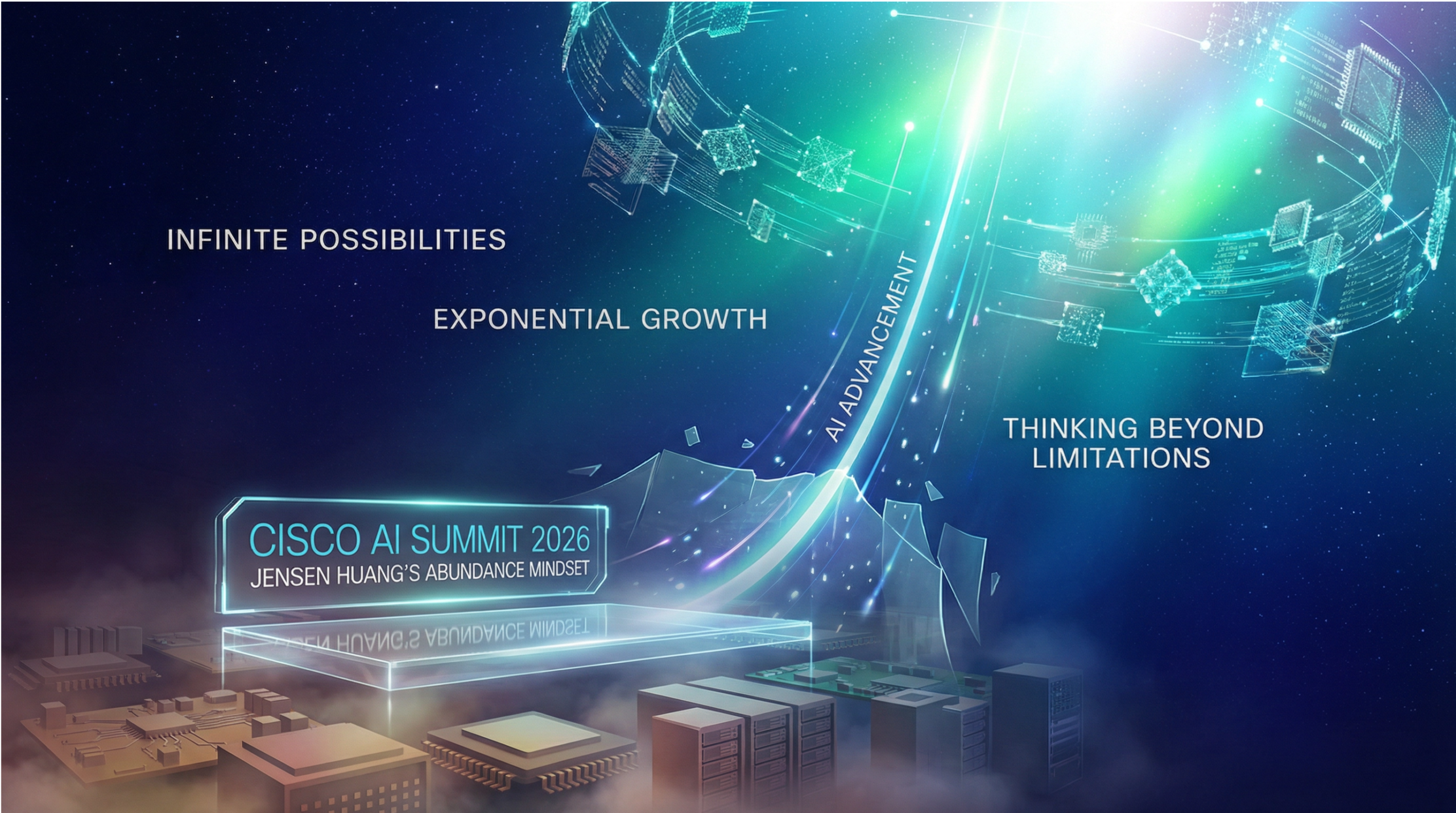
Finally, I wanted to explore the profound philosophical and practical shifts required to operate in this new reality, from the “abundance mindset” championed by NVIDIA’s Jensen Huang to the radical transformation of developer productivity described by Anthropic’s Mike Krieger.
This is the comprehensive story of a pivotal moment in AI, as the industry grapples with the immense opportunities and formidable obstacles of putting AI to work.
Ready to dive in? Let’s do it!
Cisco AI Summit 2026 | The builders of the AI economy
The Architects of the New AI Era
The gravity of the summit was underscored by the seniority and influence of its participants. This was not a gathering of mid-level managers, but of the very individuals architecting the future of AI, from the silicon up to the application layer. Understanding their roles provides context for the weight of their pronouncements.
Hosts
Chuck Robbins, Chair & CEO, Cisco
Jeetu Patel, President & Chief Product Officer, Cisco
Speakers:
Jensen Huang, Founder & CEO, NVIDIA
Sam Altman, CEO & Co-Founder, OpenAI
Marc Andreessen, Co-Founder & General Partner, Andreessen Horowitz
Matt Garman, CEO, AWS
Dr. Fei-Fei Li, CEO & Co-Founder, World Labs
Lip-Bu Tan, CEO, Intel
Amin Vahdat, Chief Technologist for AI Infrastructure, Google
Tareq Amin, CEO, HUMAIN
Kevin Scott, Chief Technology Officer, Microsoft
Mike Krieger, Lead of Anthropic Labs, Anthropic
Kevin Weil, VP, OpenAI for Science, OpenAI
Dylan Field, CEO & Co-Founder, Figma
Aaron Levie, CEO & Co-Founder, Box
Anne Neuberger, Strategic Advisor, Cisco
Brett McGurk, Special Advisor for International Affairs, Cisco & Venture Partner, Lux Capital
Francine Katsoudas, EVP and Chief People, Policy & Purpose Officer, Cisco
The Three Great Constraints: AI’s Grand Challenges
While the summit was imbued with a sense of revolutionary potential, its most substantive discussions centered on the formidable barriers to achieving that potential. Cisco’s Jeetu Patel’s framework of three critical constraints—Infrastructure, Trust, and Data—was a recurring theme, elaborated upon by nearly every speaker.

1. The Infrastructure Constraint: A Crisis of Power and Compute
The most immediate and tangible bottleneck is the physical infrastructure required to power the AI revolution. The industry is facing a crisis of supply that spans the entire stack, from electricity and data center space to the specialized silicon inside the servers.
“We just don’t have enough power, compute, and network bandwidth, now memory, you start to think about data center shells, to go out and satiate the needs of AI.” — Jeetu Patel, President & CPO, Cisco
This is not a problem that can be solved with incremental improvements. The demand for AI computation is growing at a rate that far outstrips the pace of traditional infrastructure build-out. Lip-Bu Tan highlighted the critical importance of cooling technology, noting that traditional air cooling is no longer sufficient for high-performance GPUs and CPUs. The industry is now heavily investing in advanced solutions like liquid cooling, microfluidics, and immersion cooling to manage the immense thermal load of AI hardware.
Cisco, for its part, is tackling this challenge with a full-stack approach, designing silicon specifically for the unique traffic patterns of AI workloads.
Patel detailed their strategy:
- The G200 Chip: Designed for massive scale-out networking within a data center, connecting vast clusters of GPUs.
- The P200 Chip: Designed for building “ultra-clusters” that span multiple data centers, potentially hundreds of kilometers apart, allowing them to function as a single, coherent unit. This is essential as power limitations prevent concentrating enough GPUs in a single location.
- Coherent Optics: Pushing the physical limits of data transmission as the industry moves from copper to optical interconnects to achieve the necessary speed and low latency.
However, the ultimate bottleneck is power. Nazir Al-Nasser of Humane explained that Saudi Arabia’s primary strategic advantage is an abundance of energy. The nation has identified over 15 gigawatts of available power capacity, with 20% coming from renewables, at a cost that can make the total cost of ownership for an AI data center 20-30% cheaper than elsewhere. This has allowed them to attract hyperscalers like AWS, with Matt Garman confirming plans for the first AWS AI factory outside the US to be built in Saudi Arabia. This highlights a future where AI infrastructure development may gravitate towards regions with surplus energy, fundamentally altering the map of global data processing.
2. The Trust Deficit: The Prerequisite for Adoption
If infrastructure is the physical barrier, trust is the psychological one. The summit’s leaders were unanimous in their assessment that without trust, the AI revolution will stall. This is a profound shift from previous technology waves where security was often an afterthought.
“This is the first time that security is actually becoming a prerequisite for adoption. In the past, you always ask the question whether you want to be secure or you want to be productive… now what you’re starting to see is if people don’t trust these systems, they’ll never use them.” — Jeetu Patel, President & CPO, Cisco
This “trust deficit” is multi-faceted. It encompasses:
- Data Trust: Will my proprietary data be used to train a model that benefits my competitor?
- Model Trust: Can I rely on the output of the model? Is it accurate, unbiased, and free from hallucinations?
- Infrastructure Trust: Is the underlying hardware and network secure from tampering and attack?
- Agent Trust: Can I safely grant an AI agent the autonomy to perform critical tasks without causing harm?
Chuck Robbins emphasized that this issue was front and center at the World Economic Forum in Davos, complicated by geopolitical and sovereign dynamics. Enterprises and governments are increasingly wary of where their data resides and who has access to it, fueling the rise of sovereign cloud initiatives. The challenge is no longer just about using AI for cyber defense, but about securing AI itself.
3. The Data Gap: The End of the Human Internet
The third major constraint is the fuel that powers AI models: data. The large language models that have so impressed the world were trained on the vast corpus of human-generated text and images publicly available on the internet. According to Jeetu Patel, “We are now at the point where we’re kind of running out of human-generated data publicly available on the internet.”
This creates a two-fold challenge for the future of AI development:
- The Rise of Synthetic Data: To continue improving models, AI companies are increasingly relying on synthetic data—data generated by other AI models. The quality, diversity, and accuracy of this synthetic data will be a critical factor in the performance of future models. This introduces a new layer of complexity and potential for cascading errors or biases.
- Harnessing Machine-Generated Data: The fastest-growing source of new data is not from humans, but from machines—sensors, logs, and the outputs of other automated systems. As agentic AI becomes more prolific, these agents will work 24/7, generating an exponential explosion of machine data. The ability to effectively process, understand, and learn from this torrent of information will be a key differentiator.
The New World Order: Geopolitics and the AI Race
The summit made it clear that the development of AI is not happening in a political vacuum. It is the central arena for a new era of great power competition, primarily between the United States and China.

A Sobering Wake-Up Call
Lip-Bu Tan, with his unique perspective as a venture capitalist and former head of Intel, delivered a stark assessment of the competitive landscape. He directly challenged the assumption that US restrictions on advanced chip sales would permanently hobble China’s AI ambitions.
“I thought that initially… they will be falling behind because they don’t have the access to the most advanced GPU from Nvidia… But you’ll be surprised… I found out that Huawei have 100 CPU architect, top notch. I was shocked.” — Lip-Bu Tan, Former CEO, Intel
Tan argued that China is demonstrating remarkable ingenuity in overcoming these hardware limitations. By focusing intensely on infrastructure optimization and leveraging what he termed a “poor man’s way” to work around the lack of advanced EDA tools, they are closing the gap. Furthermore, China possesses two strategic advantages: a government that can provide virtually unlimited and rapidly approved power for data centers, and a massive pool of engineering talent. Tan’s conclusion was chilling: “They are just shortly behind us. And then if you’re not careful, they will just leapfrog ahead of us.”
The Rise of Sovereign AI
This intense competition is a major factor driving the trend of “sovereign AI.” Nations are no longer comfortable relying on foreign powers for their critical AI infrastructure. The case of Saudi Arabia’s Humane, led by CEO Nazir Al-Nasser, is the most prominent example. Humane is not simply buying AI services; it is building a complete, end-to-end AI value chain within its borders, encompassing five distinct business entities for data centers, chip procurement, model development (including a focus on Arabic LLMs), applications, and advisory services.
This strategy is made possible by the Saudi government’s aggressive, business-like approach to enablement. Al-Nasser recounted how a request for land and power resulted in 16 government entities collaborating to identify 211 suitable land parcels with over 14 gigawatts of available power in just six weeks—a process that would take years in the West. This level of state-directed acceleration is creating a new class of AI player, one with the resources and political will to compete on a global scale.
The Revolution in the Trenches: AI and the Future of Work
Beyond the macro-level discussions of infrastructure and geopolitics, the summit also provided a ground-level view of how AI is fundamentally changing the nature of work, starting with the work of creating software itself.
The 10x Developer and the New Bottlenecks
Mike Krieger of Anthropic provided some of the most concrete data on the impact of AI. He described how AI coding assistants have transformed his engineering teams.
“We had an outage of our sort of continuous integration system yesterday… that would have been a mild annoyance because you maybe were producing one change set or pull request a day… When you’re producing like no joke a dozen at least per engineer on the team, it was just like I felt physically pained.” — Mike Krieger, CTO, Anthropic
This anecdote illustrates a profound shift. The act of writing code, once a primary bottleneck, has been accelerated by more than an order of magnitude. The new scarcities are now code review, auditing, and integration. The challenge is no longer producing code, but ensuring the quality, security, and coherence of the massive volume of AI-generated code. This places a premium on developer tooling, robust CI/CD pipelines, and, most importantly, clear architectural principles and product alignment.
Krieger’s key insight was that a company’s ability to write software is no longer its competitive moat. The true differentiators are now the assets that AI cannot easily replicate: the trust built with customers, the strength of the brand, deep customer relationships, proprietary data, and complex integrations. He advised companies to stop being wedded to their current product’s form factor and instead be relentlessly focused on the deep customer problem they are solving, using AI to find new and better ways to solve it.
The Abundance Mindset: Jensen Huang’s Philosophy of Infinity

Perhaps the most profound perspective of the summit came from NVIDIA’s Jensen Huang, who argued that AI is not just another tool, but a fundamental shift in the laws of technology, akin to harnessing a new force of nature. He contrasted the slow, linear progress of Moore’s Law (doubling every 18 months) with the explosive, generative power of AI, which he claims has improved by a factor of a million over the past decade.
This has led him to what he calls the “AI sensibility” or the “abundance mindset.”
“When I think about a problem these days, I just assume my technology, my tool, my instrument, my spaceship is infinitely fast… What would I do different if something used to take a year and then now takes real time?… If you’re not applying that logic, you’re not doing it right.” — Jensen Huang, CEO, NVIDIA
He urged the audience to apply this logic to the most impactful problems in their companies. Instead of nibbling at the edges, they should tackle their biggest challenges with the assumption of infinite compute, zero latency, and unlimited data. This, he argued, is the only way to truly leverage the power of AI. This philosophy underpins the transition from a world of retrieval-based computing (where software, like on a CD-ROM, was pre-recorded and merely retrieved) to one of generative computing. In this new world, every interaction is unique, contextual, and generated in real-time, just like a human conversation. This requires a complete reinvention of the entire computing stack, from the chip to the application.
Enterprise Adoption: The Right Way and the Wrong Way
One of the most actionable insights from the summit came from Anthropic’s Mike Krieger, who has seen firsthand which enterprise AI strategies succeed and which fail. His perspective is particularly valuable because Anthropic works directly with large banks, insurance companies, and other enterprises deploying AI at scale.
The Doomed Approach: Peacemeal Pilots
Krieger was blunt about what does not work. The typical enterprise approach of selecting a single, low-value process for a “safe” AI pilot is, in his words, “doomed to failure.” The problem is twofold. First, if the problem is not ambitious enough, the organization never truly learns about AI’s capabilities or what it takes to deploy it effectively. Second, the moment the pilot hits a roadblock or underperforms, the organization gives up, concluding that “AI isn’t ready” rather than recognizing that their approach was flawed.
The Winning Strategy: Ambitious, Critical Processes
In contrast, the enterprises that are succeeding are those that identify a critical business process—one where the stakes are high and the potential impact is transformative. Krieger described working with organizations on problems that “should feel a bit scary,” where the idea of AI handling the task initially makes stakeholders uncomfortable. However, by partnering closely to define success metrics, establish guardrails, and push aggressive timelines, these enterprises are achieving breakthrough results.
The key is persistence and conviction. Organizations must resist the temptation to draw premature conclusions about success or failure. They must also maintain the flexibility to rethink the form factor of their AI solution. Krieger gave the example of Anthropic’s own journey with spreadsheets, where they tried multiple approaches—having Claude read and write code to update spreadsheets, having Claude use computer vision to click within Excel, and finally building direct hooks into Excel itself. The third approach was by far the most successful, but it required the willingness to fail twice and iterate.
The New Competitive Moat
Krieger’s most important message to enterprises was about what constitutes a competitive advantage in the age of AI. With AI coding assistants enabling engineers to be 10x more productive, the ability to write software quickly is no longer a differentiator. What matters now is everything that AI cannot easily replicate: the trust a company has built with its customers, the strength of its brand, the depth of its customer relationships, the proprietary data it has accumulated, and the complex integrations it has negotiated over time. Companies should not be wedded to their current product’s form factor, but rather to the deep customer problem they are solving, and they should use AI to find radically better ways to solve it.
The Agentic Operating System: A Glimpse of the Future

One of the most provocative announcements at the summit came from Nazir Al-Nasser of Humane, who revealed that his company is building what he believes is the “world’s first agentic operating system.” This is not just a new application or a new interface; it is a fundamental reimagining of how humans interact with computers.
The Disappearance of Apps
Humane OS, set to launch in April 2026, is built on a customized Linux distribution where applications are second-class citizens. In this new paradigm, users do not open apps to perform tasks. Instead, they declare their intent, and AI agents carry out the work. Whether it is running payroll, managing performance reviews, handling procurement, or processing finance operations, the traditional application interface disappears.
Al-Nasser described using Humane itself as a “living lab” to validate this approach. Inside Humane, employees no longer see traditional apps. Instead, they act as policy enforcers and governors of agents. The company is also launching Humane One, a multi-agent orchestration platform that manages the coordination of these agents.
The Productivity Paradox Solved?
Al-Nasser argued that this radical approach is necessary to solve what he calls the “productivity paradox.” Despite the immense power of large language models, enterprises have not seen the dramatic productivity gains they expected. His diagnosis is simple: “You cannot just take a model, glue it on top of legacy platforms, and expect to achieve the results you do.” True transformation requires rethinking the entire software stack from the ground up, which is precisely what Humane is attempting.
This is a bold bet, and it remains to be seen whether enterprises will be willing to abandon decades of application-centric workflows. However, it represents the logical endpoint of the agentic AI vision—a world where humans focus on high-level strategy and judgment, while AI agents handle the execution.
The Path Forward: Near-Term, Mid-Term, and Long-Term Outlook
The summit painted a clear picture of the trajectory of AI development over the coming years and decades.
Near-Term (2026-2027): The Production Era Begins
The immediate future is all about moving agentic AI from experimentation to production. Enterprises will begin to see measurable ROI from their AI investments as agents are deployed to handle real workflows. Cisco and NVIDIA’s partnership to build “secure AI factories” for enterprises will accelerate this trend, providing turnkey infrastructure for companies that lack the resources to build their own.
Developer productivity will continue to soar, with 10x to 100x improvements becoming the norm. The infrastructure buildout will continue at a frenetic pace, with continental-scale data centers coming online and Saudi Arabia emerging as a major global AI hub. The focus will shift from “Can AI do this?” to “How do we deploy AI at scale while maintaining trust and security?”
Mid-Term (2027-2029): Physical AI and the Real World
The next major wave, already on the horizon, is Physical AI. This encompasses robotics, autonomous vehicles, and large world models that can understand and interact with the physical environment. As Jeetu Patel noted, this is not a distant dream; the developments are happening at a rapid pace.
During this period, autonomous agents will become ubiquitous, working 24/7 across businesses. The volume of machine-generated data will surpass human-generated data, and synthetic data will become the primary fuel for training new models. Quantum computing will begin to integrate with AI, opening up entirely new classes of problems that can be solved.
Long-Term Vision: Generative Computing and the Abundance Economy
The long-term vision articulated by Jensen Huang is nothing short of a complete reinvention of computing. The shift from retrieval-based systems (where software is pre-recorded and merely retrieved) to generative systems (where every interaction is unique and created in real-time) will be complete. Software will no longer be explicitly programmed; it will be learned.
In this future, AI coworkers will be as standard as email is today. The “abundance mindset” will be applied to the hardest problems in every industry, from curing disease to addressing climate change. The application layer will be the primary differentiator, and infrastructure will be commoditized. Trust and security will be table stakes for any AI deployment.
The competitive dynamics will be clear: companies that aggressively apply AI will dominate their industries, while those that hesitate will be left behind. The geopolitical landscape will be shaped by which nations can build and deploy AI most effectively, with the US-China competition at the center and sovereign AI initiatives proliferating globally.
Conclusion: The Mandate to Apply
If the Cisco AI Summit 2026 had one overarching mandate for the enterprises, governments, and innovators in attendance, it was this: Apply the technology. Jensen Huang’s most impassioned plea was for companies to move beyond building infrastructure and admiring models, and to start using AI to solve real problems. “A company that uses AI will… beat a company that builds AI,” he stated, a powerful reminder that technology is only valuable when it is deployed.
The path forward is both exhilarating and daunting. The promise of agentic AI, of digital coworkers that can amplify human potential by orders of magnitude, is within reach. The productivity gains are real and are already being measured. However, the road to this future is paved with immense challenges. The industry must collectively invest trillions to overcome the infrastructure deficit, work tirelessly to build a foundation of trust, and innovate to bridge the looming data gap. Nations will jockey for position, and enterprises will face a stark choice: embrace the abundance mindset and apply AI to their core challenges, or risk being rendered obsolete by a new generation of competitors who do.
The age of AI speculation is over. The age of AI production is here. The starting gun has been fired.
Are you ready?
About Jason
Jason Fleagle is a Chief AI Officer and Growth Consultant working with global brands to help with their successful AI adoption and management. He is also a writer, entrepreneur, and consultant specializing in tech, marketing, and growth. He helps humanize data—so every growth decision an organization makes is rooted in clarity and confidence. Jason has helped lead the development and delivery of over 500 AI projects & tools, and frequently conducts training workshops to help companies understand and adopt AI. With a strong background in digital marketing, content strategy, and technology, he combines technical expertise with business acumen to create scalable solutions. He is also a content creator, producing videos, workshops, and thought leadership on AI, entrepreneurship, and growth. He continues to explore ways to leverage AI for business transformation.
You can learn more about Jason on his website here.
You can learn more about our top AI case studies here on our website.
Learn more about my AI resources here on my youtube channel.