The job of a software developer is about to be completely rewritten.
For the last 40 years, the fundamental unit of work has been a human engineer translating a problem into code. That era is over.
The new unit of work is the autonomous loop.
This week, five distinct signals emerged that show this isn’t a theoretical future. It’s a present-day reality. The shift from human-led workflows to continuous, machine-driven compute is happening now.
For operators, builders, and investors, understanding this shift is the only thing that matters.
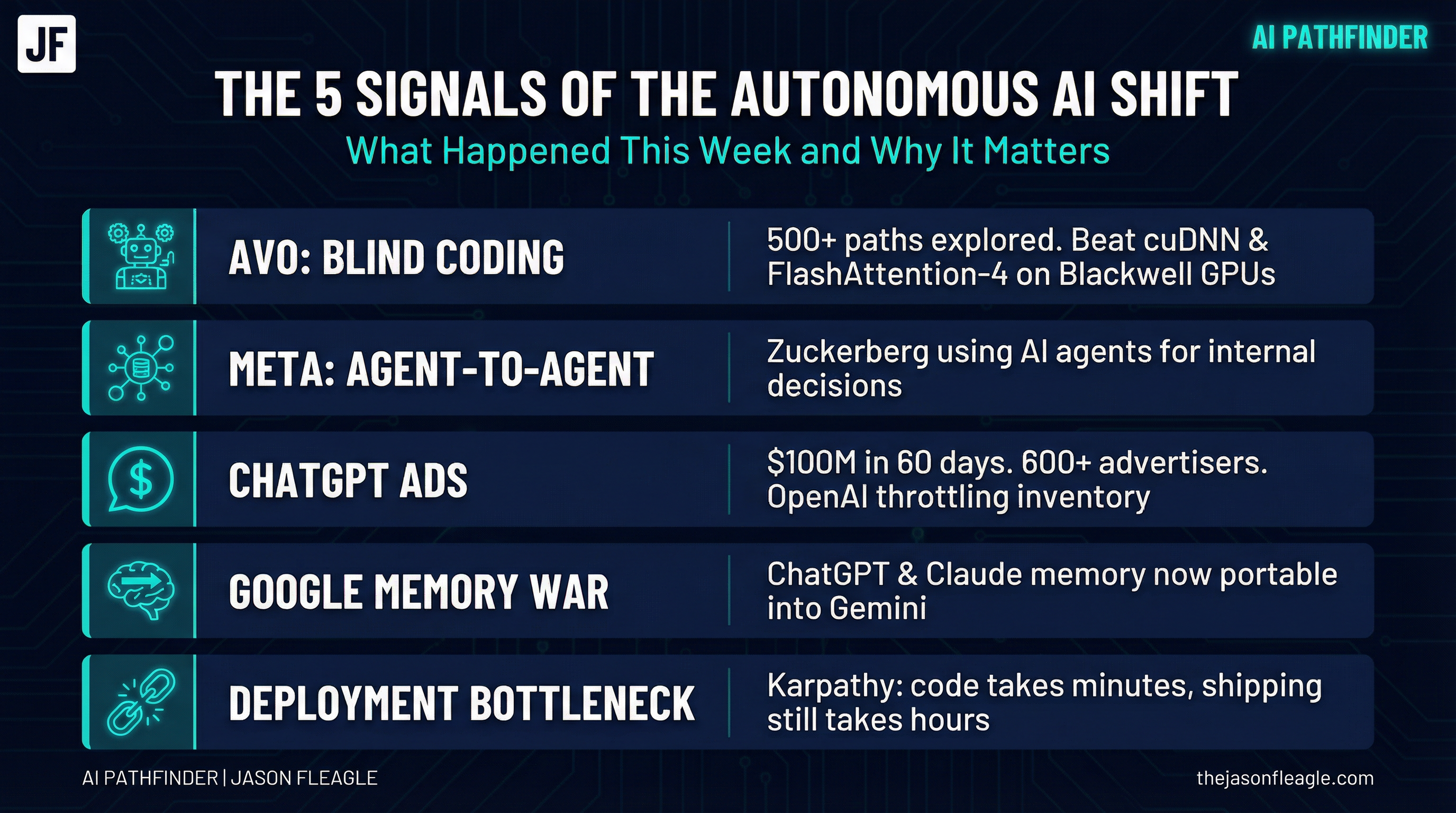
1. NVIDIA’s AVO: The Birth of Blind Coding
NVIDIA just dropped a paper on a system called Agentic Variation Operators (AVO). It’s an agent that runs fully autonomous coding loops with zero human intervention.
It reads documentation, writes low-level CUDA kernels, profiles performance, tests the results, and iterates continuously. In a seven-day unsupervised run, AVO explored over 500 distinct optimization paths and produced attention kernels for NVIDIA’s new Blackwell (B200) GPUs that beat the world’s best, human-engineered solutions:
- Up to 3.5% faster than cuDNN
- Up to 10.5% faster than FlashAttention-4
This is discovering novel, performance-critical micro-architectural optimizations on the most advanced hardware on the planet, completely on its own. The optimizations it found for multi-head attention were then transferred to grouped-query attention in just 30 minutes of autonomous adaptation.
The takeaway: If full “blind coding” holds, the operating unit of a software company is no longer a team of engineers. It’s an objective function plus a compute budget.
2. Meta: The Company Is Becoming an Agent
The Wall Street Journal reports that Meta employees are now using AI agents to access internal documents, chat logs, and even communicate with each other — agent-to-agent.
Mark Zuckerberg himself is using a personal agent to assist in decision-making. This is the shift from AI as a tool to AI as the operating layer of the company itself. When agents start coordinating across teams, the organization stops behaving like a traditional hierarchy and starts behaving like a distributed compute system.
The takeaway: The boundary between the human organization and the software system is dissolving. The companies that figure out how to leverage this first will have an untouchable operational advantage.
3. ChatGPT Ads: $100M in 60 Days
OpenAI’s new ChatGPT ads pilot crossed $100 million in annualized revenue in its first two months, with over 600 advertisers onboard.
This is a signal of where the market’s attention and resources are flowing. The commercial incentives are now aligned to build, scale, and integrate agentic systems into every facet of the economy. The demand is so high that OpenAI is deliberately throttling ad inventory to avoid degrading the user experience.
The takeaway: The economic engine for the agentic shift is now fully online. The capital is flowing to the platforms that can successfully integrate autonomous systems with commercial intent.
4. Google’s Memory War: The Moat Is Now Portable
Google launched a feature to let users import their chat history and preferences from ChatGPT and Claude directly into Gemini. Anthropic did the same.
This is a coordinated attack on the single biggest lock-in for any AI platform: accumulated memory. For years, your chat history was the moat. It was the context that made the model useful to you. Now, that context is becoming a transferable asset.
The takeaway: The platform that controls the memory layer controls how future agents behave. This isn’t just about user migration; it’s about establishing the foundation for persistent, context-aware agents that can operate on your behalf across different systems.
5. Karpathy’s Bottleneck: Deployment Is the New Wall
AI pioneer Andrej Karpathy recently detailed his experience building a simple AI app. Using modern tools, the code was generated in minutes. But deploying it took hours of wrestling with API keys, broken configs, rate limits, and fragmented services.
This is the new reality. Writing code is a solved problem. Shipping it is not. The infrastructure we’ve built over the last 20 years was designed for human speed, not machine speed.
The takeaway: The next wave of billion-dollar companies will be the ones that automate the infrastructure layer for agents. The bottleneck has moved from code generation to deployment. Any process that can’t be executed with a single command by an agent is now a legacy system waiting to be replaced.
Your Action Plan
These five signals point to a single conclusion: the work of building and operating software is collapsing into a continuous loop of autonomous agents.
For operators and builders, the mandate is clear:
- Master the Loop: Your value is no longer in writing code line-by-line. It’s in designing the objective function, managing the compute budget, and interpreting the results of these autonomous loops.
- Automate Your Infra: Treat every manual step in your deployment pipeline as a critical bug. If an agent can’t run it, it’s broken. The future of infrastructure is a single API endpoint for agents.
- Build for Portability: Assume that every model, platform, and context layer is transferable. The only durable moat is the quality of the objectives you define and the efficiency of the loops you run.
The game has changed. The builders who recognize that the unit of work is now the loop, not the human, will be the ones who own the next decade.
Ready to Build Your AI Strategy?
If you’re ready to move beyond pilots and demos to achieve transformative AI results, I can help. My team has delivered hundreds of AI projects for enterprise organizations, and we specialize in building practical, ROI-driven strategies that focus on time, money, and people.