TLDR: A Harvard-led study just revealed that AI can predict 71% of the trades made by active fund managers. The real multi-million dollar question is in the other 29%—the unpredictable moves where true alpha hides. And its where Renaissance Technologies and other Algo-trading firms dominate creating their own AI models to trade.
What Happened
Researchers from Harvard Business School just put the active fund management industry under a microscope, and the results are telling. They built a neural network and fed it over 30 years of data (1990-2023)—fund characteristics, investor flows, stock attributes, and macroeconomic signals.
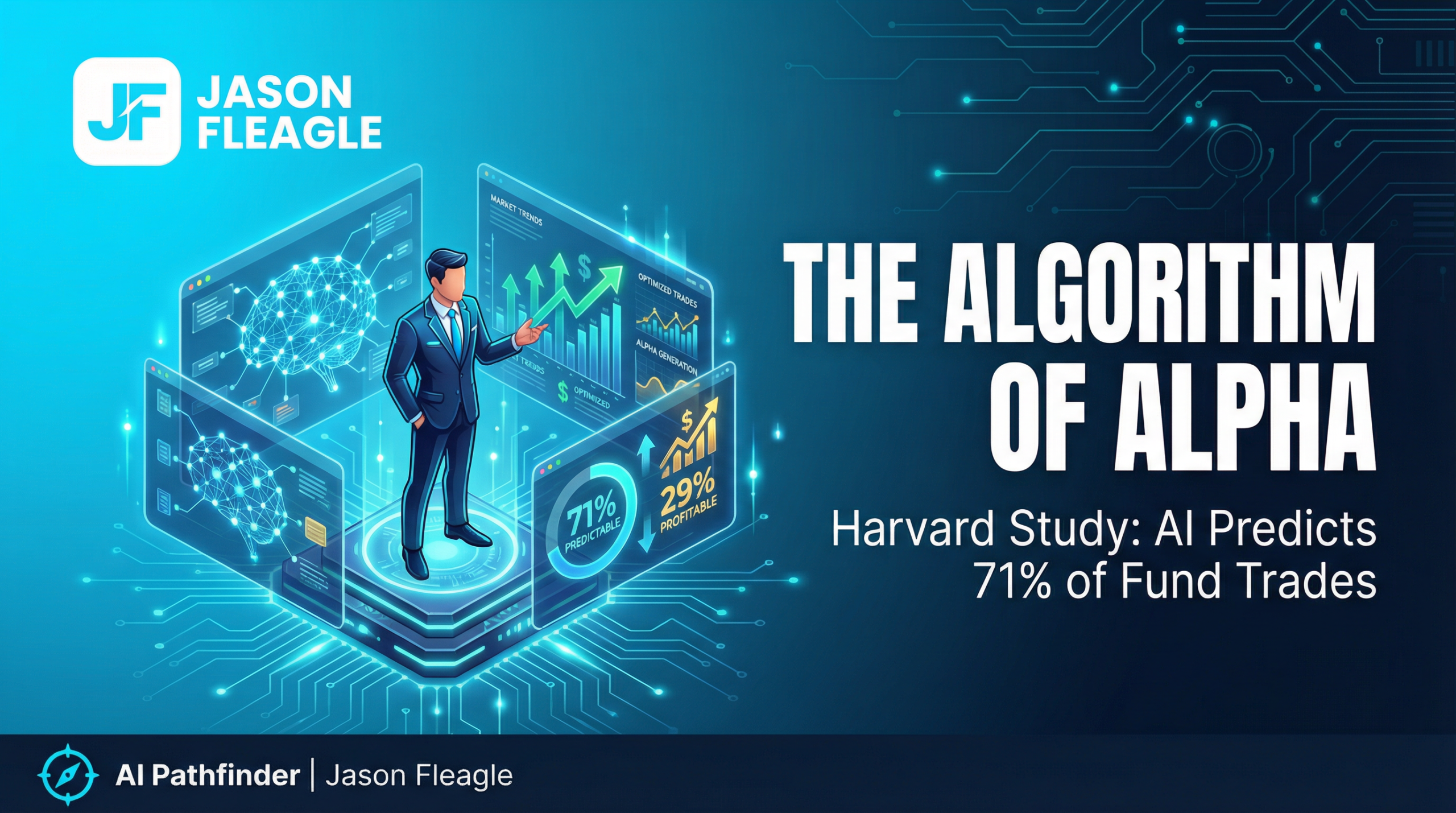
The AI’s mission? To predict the quarterly trading decisions of mutual fund managers. It succeeded with 71% accuracy.
This suggests that a huge portion of what active managers do isn’t unique genius, but more about having a predictable, systematic response to market signals and herd behavior. It’s a playbook, and the machines have learned to read it and recognize the patterns.
Why It Matters (The Board-Level View)
For decades, active managers have justified their high fees with the promise of delivering “alpha”—market-beating returns driven by superior insight. This study puts a number on how much of their activity is just… routine.
The most critical finding isn’t the 71% of predictable trades. It’s the 29% of unpredictable ones. The study found that this small slice of non-routine, counter-intuitive trades is where managers actually generated outperformance.
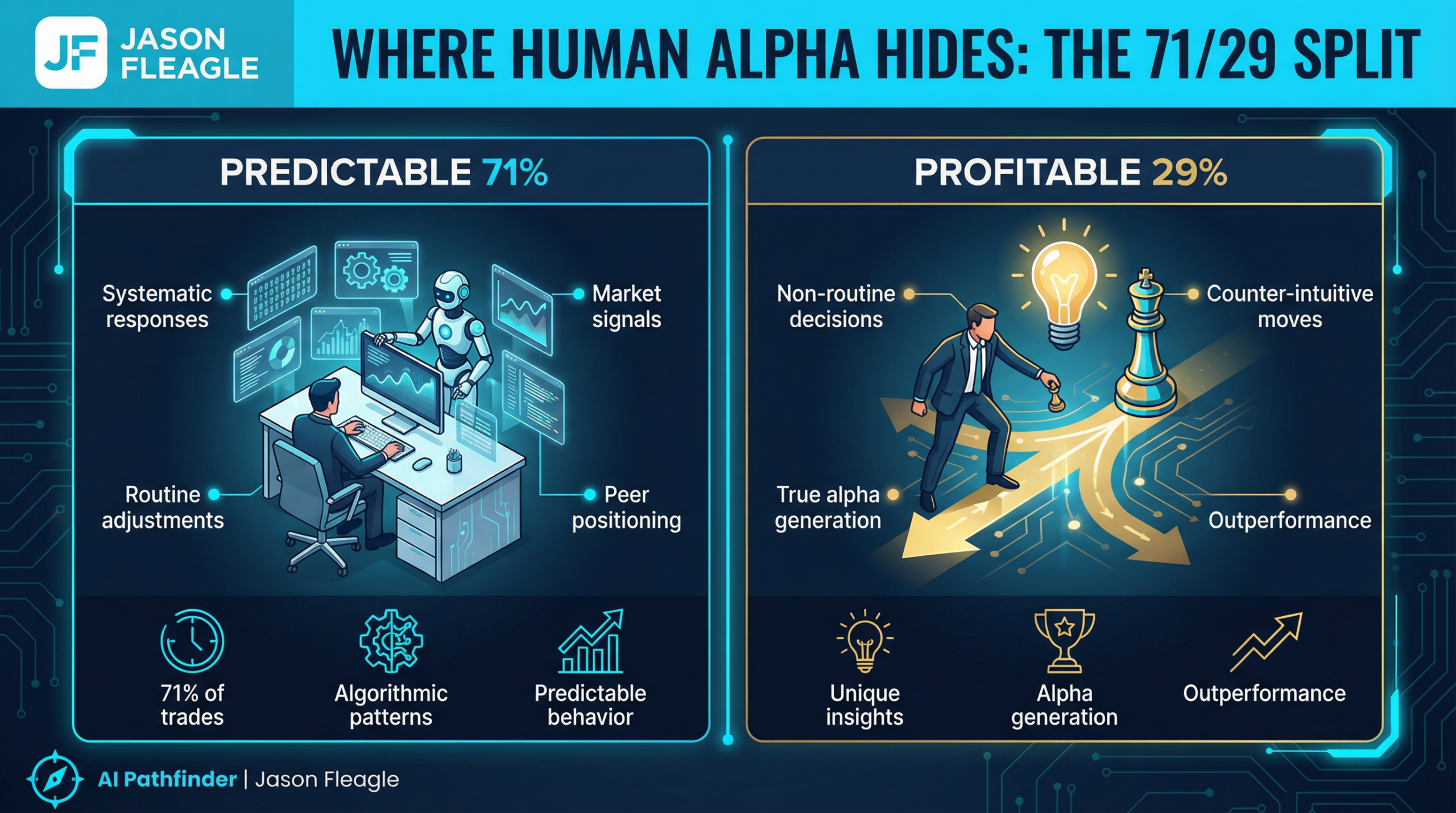
This creates a massive problem for the industry: if an algorithm can replicate 71% of your work, what are clients really paying for? The pressure is now on for managers to prove their value is in that elusive 29% of true alpha, not the predictable beta that can be automated for a fraction of the cost. And other algo trading firms like Ren Tech, Citadel, and others are already dominating that market.
Strategic Imperatives for Leaders
1. Audit Your “Alpha”
If you manage money or any knowledge-based team, you must ask: How much of our “expert” work is just a repeatable process? Use this as a forcing function to identify where your team provides unique, non-obvious value versus what can be systematized or automated. The goal isn’t to replace people, but to free them from the 71% of routine work to focus on the 29% that drives real impact. AI is great at helping recognize patterns, and then creating a system to help execute on those patterns.
2. Redefine Value
The value proposition for any service business is shifting. It’s no longer about the labor, but about the judgment. This study is a clear signal that fees must be tied to the unpredictable, high-value insights that a machine can’t replicate. If your fee structure is based on hours worked on predictable tasks, your business model is at risk. Think about what the value wedge is that you will deliver. What are those outcomes you will deliver?
3. Invest in the Human + Machine Edge
The study showed that larger, more competitive funds were less predictable. This suggests that top performers are already operating in a way that is harder to model. The future isn’t man vs. machine, but more about creating a blended system where AI handles the predictable, and your best people are equipped to find the truly unique opportunities. The winners will be those who can best manage this human-AI interface. It’s going to be a whole new world over the next 2-5 years with AI workers and collaborators becoming more commonplace.
The Bottom Line
The Harvard study isn’t an indictment of human expertise, but it is a clarification of where it truly lies. It separates the predictable process from the profitable insight. For investors, it’s a call to scrutinize fees. For leaders, it’s a roadmap to re-focus your teams on the irreplaceable, high-alpha work that machines can’t touch—yet.
Ready to Build Your AI Strategy?
If you’re ready to move beyond pilots and demos to achieve transformative AI results, I can help. My team has delivered hundreds of AI projects for enterprise organizations, and we specialize in building practical, ROI-driven strategies that focus on time, money, and people.
Work with me on AI consulting →
Subscribe to my YouTube channel →
Learn AI marketing fundamentals →
About Jason Fleagle
Jason Fleagle is a Chief AI Officer and Growth Consultant working with global brands to help with their successful AI adoption and management. He is also a writer, entrepreneur, and consultant specializing in tech, marketing, and growth. He helps humanize data—so every growth decision an organization makes is rooted in clarity and confidence. Jason has helped lead the development and delivery of over 500 AI projects & tools, and frequently conducts training workshops to help companies understand and adopt AI. With a strong background in digital marketing, content strategy, and technology, he combines technical expertise with business acumen to create scalable solutions. He is also a content creator, producing videos, workshops, and thought leadership on AI, entrepreneurship, and growth. He continues to explore ways to leverage AI for good and improve human-to-human connections while balancing family, business, and creative pursuits.
Sources
- Bloomberg Law. “Harvard-Led Study Says AI Can Predict 71% of Active-Fund Trades.” https://news.bloomberglaw.com/banking-law/harvard-led-study-says-ai-can-predict-71-of-active-fund-trades
- Australian Financial Review. “AI can predict 71pc of mutual-fund trading decisions made by active fund managers on Wall Street, says Harvard study.” https://www.afr.com/markets/equity-markets/harvard-led-study-says-ai-can-predict-71pc-of-active-fund-trades-20260225-p5o574
- Investing Live. “Bloomberg: Harvard study finds AI predicts only 71% of active-fund trades.” https://investinglive.com/stock-market-update/bloomberg-harvard-study-finds-ai-predicts-only-71-of-active-fund-trades-20260225/