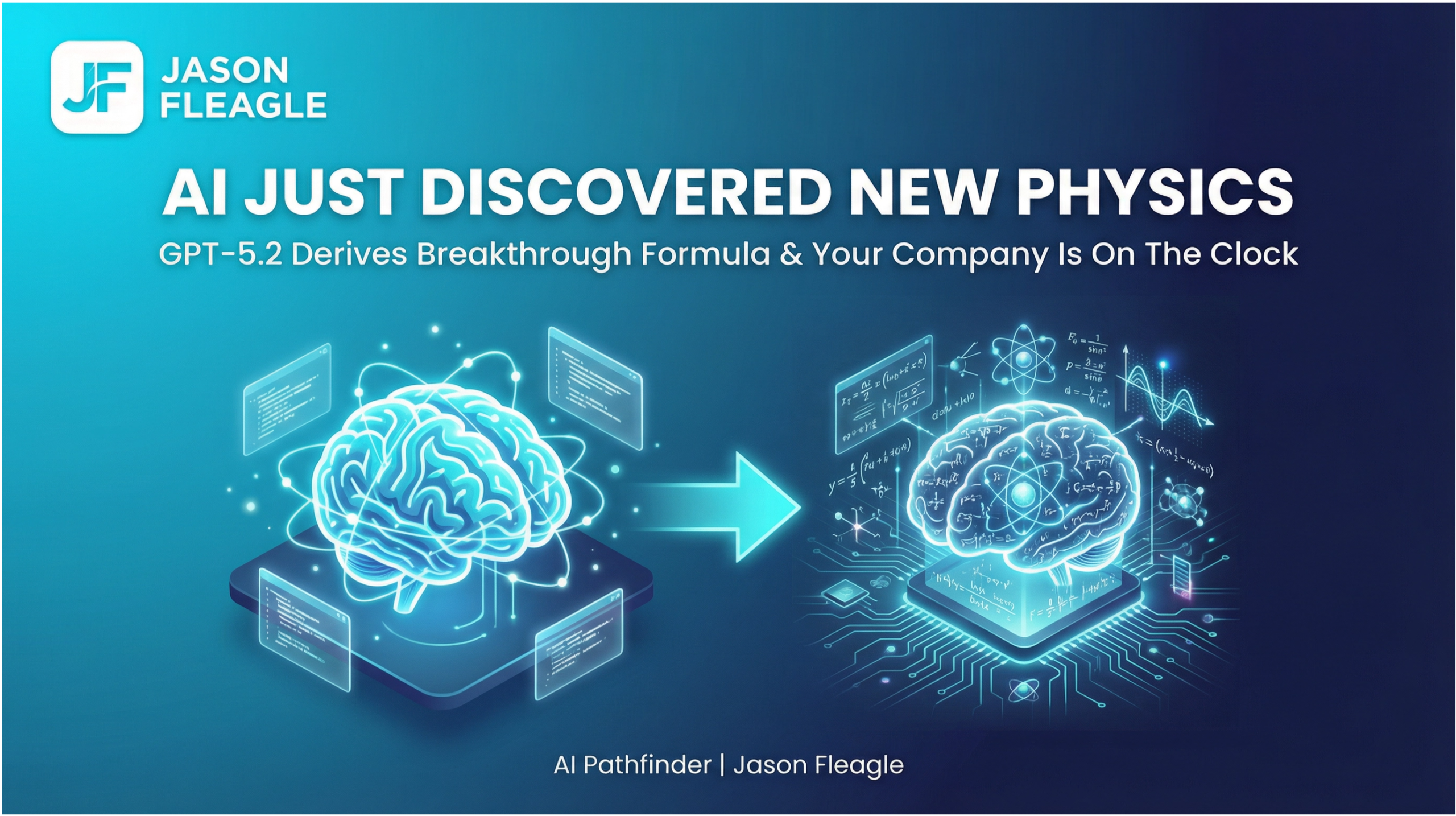
OpenAI’s GPT-5.2 just did something that should make every CEO, investor, and operator sit up and pay attention: it derived a new, non-obvious result in theoretical physics. This is no longer about chatbots writing poems, but now machines actually originating net-new scientific knowledge in one of the most complex fields known to humanity.
If your AI strategy is still centered on “improving efficiency” or “automating workflows,” you may still be playing yesterday’s game. The age of AI for productivity is over. The age of AI for discovery has begun.
In a new paper submitted to arXiv, a team of physicists from OpenAI, Harvard, Cambridge, and the Institute for Advanced Study revealed that GPT-5.2 had successfully conjectured a new formula for gluon scattering amplitudes—a fundamental concept in quantum field theory. What’s more, an internal, scaffolded version of the model then proved the formula’s validity.
This is a watershed moment where we’ve moved from AI as a tool for assistance to AI as a genuine engine for discovery. And for the business world, the implications are profound.
What Happened: From Messy Math to a Moment of Machine Insight
For decades, a certain type of gluon interaction (known as a “single-minus” amplitude) was presumed to be zero under most conditions. It was a corner of physics largely set aside. The human physicists on the team worked out the calculations for a few simple cases by hand, a process that yielded “terribly complicated” expressions and whose complexity grew at a staggering, superexponential rate.
Enter GPT-5.2 Pro. The model was given the messy, human-derived formulas. It didn’t just simplify them, but spotted a deeper, underlying pattern that the human experts had missed and proposed a single, elegant formula that worked for all cases. An internal, more powerful version of the model then spent 12 hours reasoning through the problem, generating a formal proof for the conjectured formula. Now this is an important thing to call out, because AI is great at recognizing patterns based on data that it has access to.
Let’s be clear about what this means. The AI didn’t just find a needle in a haystack, but actually saw the full haystack, recognized the concept of “needle,” and then built a machine to manufacture them. This is a fundamentally new paradigm. We are entering a brave new world.
“This preprint felt like a glimpse into the future of AI-assisted science, with physicists working hand-in-hand with AI to generate and validate new insights. There is no question that dialogue between physicists and LLMs can generate fundamentally new knowledge.”
—Nathaniel Craig, Professor of Physics, UCSB
Why This Is a Board-Level Issue, Not a Lab Curiosity
It’s easy to dismiss this as an academic curiosity. But that’s a critical mistake. The real story here isn’t about gluons; it’s about the new competitive landscape that discovery-class AI creates.
1. The Moat Has Moved from Data to Discovery
For the last decade, the mantra has been “data is the new oil.” The company with the biggest, cleanest dataset would win. That era is over. While data is still essential, the new, defensible moat is a proprietary discovery engine. It’s the ability to use AI to find non-obvious, high-value patterns in that data that no human analyst, no matter how brilliant, could ever spot.
Companies that build or acquire this capability will not just be more efficient, but they will operate with a fundamentally different level of insight. They will predict market shifts, invent new materials, and discover new drugs while their competitors are still running A/B tests. It’s a new machine-human and human-machine collaboration this no longer science fiction, but reality.
2. The Nature of R&D Has Been Fundamentally Altered
The traditional R&D model is slow, expensive, and hit-or-miss. You hire a team of expensive experts, give them a budget, and hope they find something. The new model is a human-machine partnership where the AI acts as the senior research partner.
The workflow in the OpenAI paper is the blueprint for the future of innovation: human experts provide the initial context and validation, while the AI performs the deep, pattern-matching work and generates novel hypotheses at a scale and speed that is simply not humanly possible. Your most valuable “expert” is no longer a person; it’s a system.
3. The Speed of Business Just Went Supersonic
Think about the implications. A process that took human physicists years of painstaking work was cracked by an AI in a matter of hours. Now, apply that same accelerative power to your own industry.
- Pharma: A drug discovery process that takes a decade could be compressed into a year.
- Finance: A financial model that takes a team of quants a month to build could be generated and back-tested in a day.
- Manufacturing: A new material with specific properties could be designed and simulated in a week, not a decade.
The speed of innovation is no longer linear. It’s exponential. And companies that are not built for this new speed will be left behind, regardless of their current market position.

The Strategic Imperative for Executives
This isn’t about telling your CIO to “buy some AI.” This is about a fundamental rethinking of strategy from the top down.
1. Redefine Your Problem Set: Stop asking, “What tasks can we automate?” and start asking, “What impossible problems could we solve if we had an AI that could discover new knowledge?” Your problem set has just been radically expanded. You need to be thinking bigger.
2. Invest in the “Scaffolding”: The magic here wasn’t just the model; it was the scaffolding—the systems and processes that allowed the model to reason, prove, and validate its own work. This is the hard, unglamorous work of building a true AI-native enterprise. It’s about data infrastructure, simulation environments, and human-in-the-loop validation workflows. This is where the real investment needs to go.
3. Cultivate the New “Meta-Skill”: The most valuable people in your organization will be those who can effectively partner with discovery-class AI. These are the people who can frame a problem, provide the right context, and critically evaluate the AI’s output. This is a new skill set—a blend of deep domain expertise and a kind of “AI whisperer” intuition. You need to find, train, and empower these people now.
The Bottom Line
The OpenAI physics paper is a shot across the bow for every business leader. It’s a clear signal that the ground has shifted. The competitive advantages of the past—scale, brand, data—are still important, but they are no longer sufficient.
The new, defining advantage will be the ability to discover. The ability to use AI to see what no one else can see. The ability to move from simply optimizing the known to discovering the unknown.
I said it earlier, but this is no longer science fiction, but a strategic reality. Your company is now on the clock. What will you do?
Take the Next Step
Understanding these principles is the first step. Putting them into action is what will set you apart.
AI Consulting for Your Business: If you’re ready to move beyond the hype and start implementing a real AI strategy, my team and I can help. We work with organizations to navigate the complexities of AI adoption, from process optimization to building custom AI agents. Let’s discuss your AI goals by scheduling a consulting call together.
If you’re interested in a custom AI workshop for your business or in your city, please reach out to me directly to start a conversation.
About Jason
Jason Fleagle is a Chief AI Officer and Growth Consultant working with global brands to help with their successful AI adoption and management. He is also a writer, entrepreneur, and consultant specializing in tech, marketing, and growth. He helps humanize data—so every growth decision an organization makes is rooted in clarity and confidence. Jason has helped lead the development and delivery of over 500 AI projects & tools, and frequently conducts training workshops to help companies understand and adopt AI. With a strong background in digital marketing, content strategy, and technology, he combines technical expertise with business acumen to create scalable solutions. He is also a content creator, producing videos, workshops, and thought leadership on AI, entrepreneurship, and growth. He continues to explore ways to leverage AI for good and improve human-to-human connections while balancing family, business, and creative pursuits.
You can learn more about Jason on his website here.
You can learn more about our top AI case studies here on our website.
Learn more about my AI resources here on my youtube channel.
References:
[1] OpenAI. (2026, February 13). GPT-5.2 derives a new result in theoretical physics. https://openai.com/index/new-result-theoretical-physics/ [2] Guevara, A., Lupsasca, A., Skinner, D., Strominger, A., & Weil, K. (2026). Single-minus gluon tree amplitudes are nonzero. arXiv:2602.12176 [hep-th]. https://arxiv.org/abs/2602.12176