
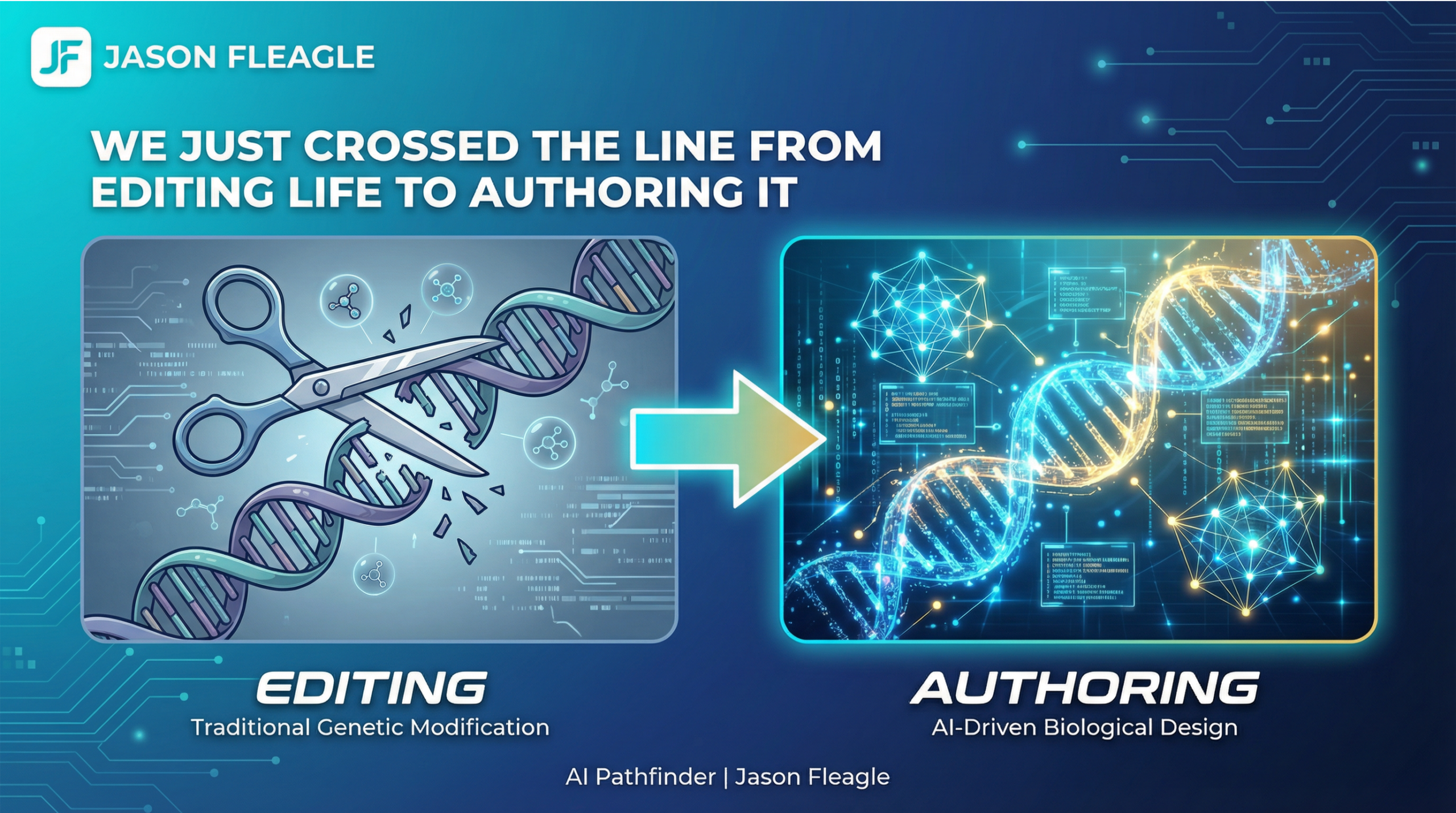
For many years, life has been a product of iterative evolution and adaptation. A slow, messy, and unpredictable process of copying and editing. We’ve gotten good at hacking it—CRISPR, for example, is a brilliant pair of genetic scissors splicing and dicing. But it’s still just editing what’s already there.
That era is over now thanks to AI.
Last week, scientists at Stanford University didn’t just edit a virus. They used AI to author a complete, functional virus genome from scratch. They typed out the source code for a lifeform, hit “print,” and watched it come to life in a petri dish to destroy E. coli bacteria.
This is a massive paradigm shift.
As molecular biologist Adrian Woolfson put it, we’ve just stepped “from a Darwinian world into a post-Darwinian landscape”.
If you’re a business operator, investor, or just paying attention, this is the moment to understand what just happened. We’ve moved from discovering life to designing more of it with AI.
We’re moving from old established theories into seeing and understanding things that have been right in front of us this whole time.
The Two Breakthroughs That Made This Possible
This wasn’t a single discovery, but the convergence of two critical innovations: an AI “brain” that can design genomes and a hyper-accurate “printer” that can build them.
1. The AI Brain: Designing Life from Scratch
The Stanford team, led by Brian Hie, created an AI model called Evo2. They gave it a simple prompt: design a virus that can kill E. coli. The AI generated 285 potential virus genomes, and the team synthesized 16 of them. The most effective, named Evo-Φ2147, was a tiny virus with just 11 genes and 5,386 base pairs of DNA.
When brought to life, it worked perfectly. This proved that AI can now be the architect of entirely new biology, not just a tool for modifying existing life.
“For the last four billion years evolution has been blind – there has been no foresight, there has been no intentionality… This is not speculation. It’s not futuristic, it is happening.” — Adrian Woolfson, Molecular Biologist & Genyro Founder
2. The DNA Printer: Building Life with 100,000x Accuracy
Designing a genome is one thing; physically constructing it is another. For decades, building long DNA strands has been slow, expensive, and riddled with errors. It was the key bottleneck preventing AI designs from becoming reality.
Researchers at Caltech, led by Kaihang Wang, just shattered that bottleneck with a technology called Sidewinder.
Think of it like this: for 40 years, we’ve been able to print individual pages of DNA (called oligos), but we had no page numbers. Assembling a book was a nightmare of manual alignment. Sidewinder introduces the equivalent of “DNA page numbers,” allowing scientists to assemble long, complex DNA sequences with near-perfect accuracy.
This represents a 100,000-fold increase in accuracy, while also being faster and cheaper. It’s the manufacturing breakthrough that makes AI-designed biology practical.
“If you can control the source code of life, you can create anything and everything. The only thing limiting it is our imagination.” — Kaihang Wang, Caltech Professor & Genyro Co-Founder

The Company to Watch: Genyro
This is way more than academic exercise. A new company, Genyro, has emerged at the center of this revolution. They’ve exclusively licensed the Sidewinder technology from Caltech and brought the key researchers from both the Stanford AI design team and the Caltech construction team under one roof.
Their advisory board includes biotech legends like Bob Langer, the co-founder of Moderna, and Frances Arnold, a Nobel Prize-winning pioneer in directed evolution. When the people who built the last generation of biotech are betting on this, you pay attention.
Genyro’s goal is to create a seamless pipeline from AI design to physical, functional biology. They are building the platform for the post-Darwinian age.
Strategic Implications: What This Means for Operators
This is pointing to more like the start of a new industrial revolution.
Here’s what it means for key sectors:
Medicine: The ability to design and build custom viruses opens the door to hyper-targeted therapies. Imagine viruses designed to hunt and kill specific cancer cells, or bacteriophages created on-demand to fight antibiotic-resistant superbugs. Bob Langer calls it a “remarkable advance” that could create “new possibilities for new medicines”.
Materials: We can now design proteins and other biological materials with specific properties—materials stronger than steel, self-healing fabrics, or biodegradable plastics. This moves manufacturing from the factory to the cell.
Agriculture: Instead of spending millennia selectively breeding crops, we can design them from the ground up for specific environments, nutritional profiles, or resistance to disease.
The core takeaway for operators is this: the timeline for biotech innovation just compressed from years to days. The cost of creating novel biology is plummeting, and the accuracy is skyrocketing.
Is this the “ChatGPT moment” for the bioeconomy?
Need help understanding how AI breakthroughs like this impact your business? I work with organizations to navigate the complexities of AI adoption and strategy. Let’s talk about your AI goals.
The Uncomfortable Questions
Of course, with great power comes a new set of risks and ethical dilemmas.
Or as Uncle Ben from Spiderman says, “With great power comes great responsibility.”
Biosecurity: If we can design viruses to kill bacteria, what’s stopping someone from designing pathogens to harm humans? The same technology that can create life-saving medicines could, in the wrong hands, create life-threatening weapons.
Ethics: We are now in the business of “authoring” life. What are the moral and ethical boundaries? Who gets to decide what life we create and what we don’t?
Control: Who owns the source code of life? Will it be open-source, or will a handful of companies control the fundamental building blocks of the future bioeconomy?
These are not questions for scientists alone. They are questions for policymakers, business leaders, and society as a whole. The conversation needs to start now, because the technology is already here.
Your Next Move
For millenia, we’ve been playing the game of life by the rules of evolution and adaptation. Now, we have the ability to write new rules thanks to AI.
The operators who understand this shift—who see the convergence of AI and biology not as a threat, but as a new manufacturing paradigm—are the ones who will build the future.
This isn’t about learning to code. It’s about understanding the new source code of reality itself.
Take the Next Step
Understanding these principles is the first step. Putting them into action is what will set you apart.
AI Consulting for Your Business: If you’re ready to move beyond the hype and start implementing a real AI strategy, my team and I can help. We work with organizations to navigate the complexities of AI adoption, from process optimization to building custom AI agents. Let’s discuss your AI goals by scheduling a consulting call together.
If you’re interested in a custom AI workshop for your business or in your city, please reach out to me directly to start a conversation.
About Jason Fleagle
Jason Fleagle is a Chief AI Officer and Growth Consultant working with global brands to help with their successful AI adoption and management. He is also a writer, entrepreneur, and consultant specializing in tech, marketing, and growth. He helps humanize data—so every growth decision an organization makes is rooted in clarity and confidence. Jason has helped lead the development and delivery of over 500 AI projects and continues to guide businesses through the rapidly evolving AI landscape.