For the past two years, the promise of AI agents has felt like a mirage in the desert. We’ve been sold a vision of autonomous digital assistants that would handle our tedious tasks, only to be met with a reality of buggy, overhyped tools that, as one WIRED reporter put it, “just didn’t work” [1].
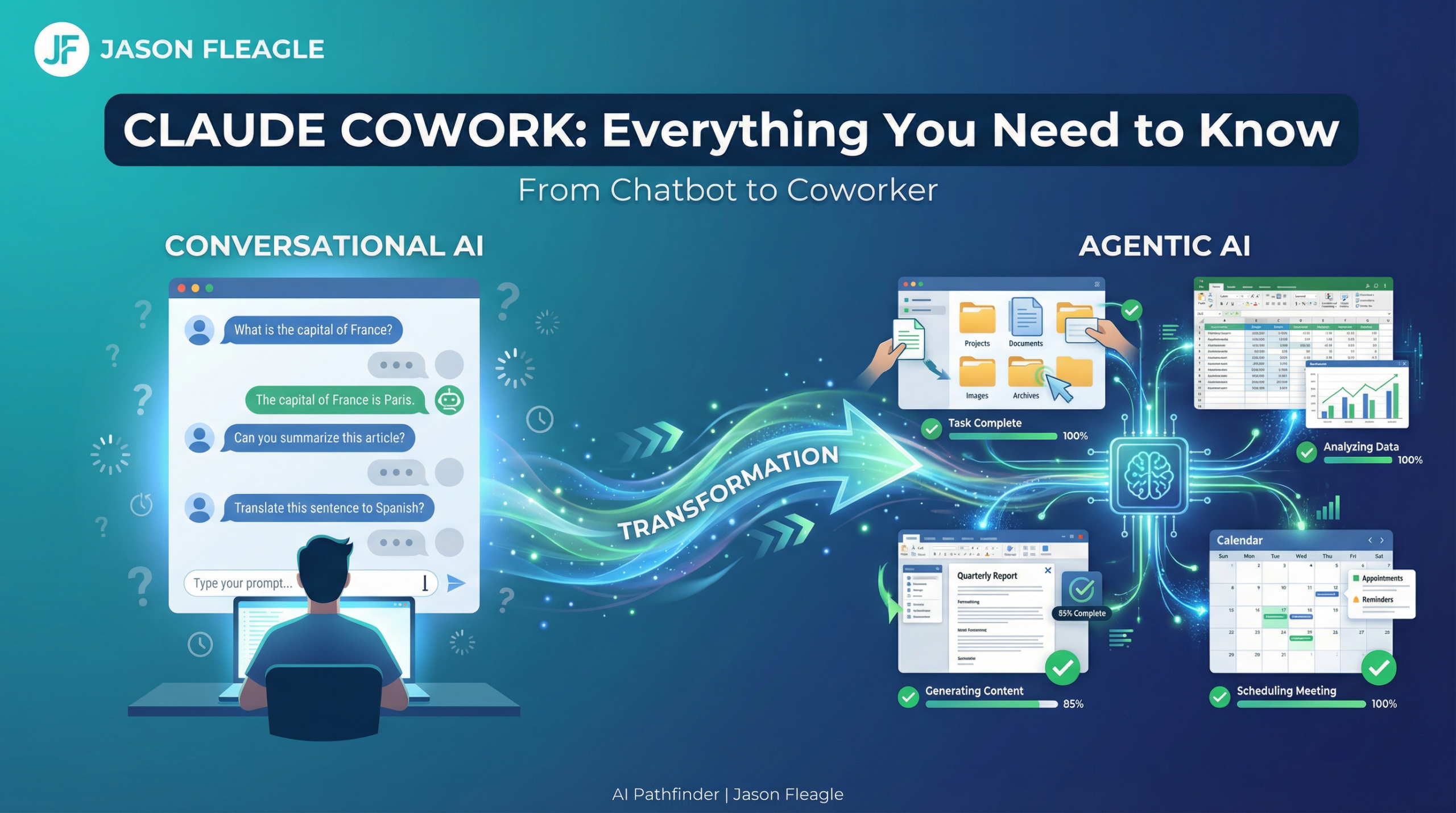
That era of disappointment is over. Anthropic just launched Claude Cowork, a new feature that finally delivers on the promise of agentic AI for knowledge work. This isn’t another incremental update; it’s a fundamental paradigm shift in how we interact with AI. Cowork moves Claude from a conversational chatbot to an active collaborator—an AI that doesn’t just talk about the work, but actually does the work.
This launch is the direct result of Anthropic paying attention to a crucial, unexpected behavior. They noticed that a growing number of subscribers were using Claude Code, their developer-focused agent, for non-coding tasks. They were hacking a developer tool to automate their daily knowledge work. Instead of ignoring this “shadow behavior,” Anthropic embraced it and built Cowork: “Claude Code for the rest of your work” [2].
This is the story of how a developer tool for the 1% became an agentic-powered solution for the 99%. It’s a masterclass in product strategy and a clear signal of where the entire AI industry is headed. The age of the AI agent is here, and it’s time to understand what that means for you.
From Conversational AI to Agentic AI: The Cowork Framework
The launch of Cowork represents a critical evolution in human-AI interaction. We are moving from a world of conversational AI, where we engage in a back-and-forth dialogue with a chatbot, to a world of agentic AI, where we delegate tasks to an autonomous collaborator. This is not a subtle distinction; it’s a complete redefinition of the AI’s role in our workflow.
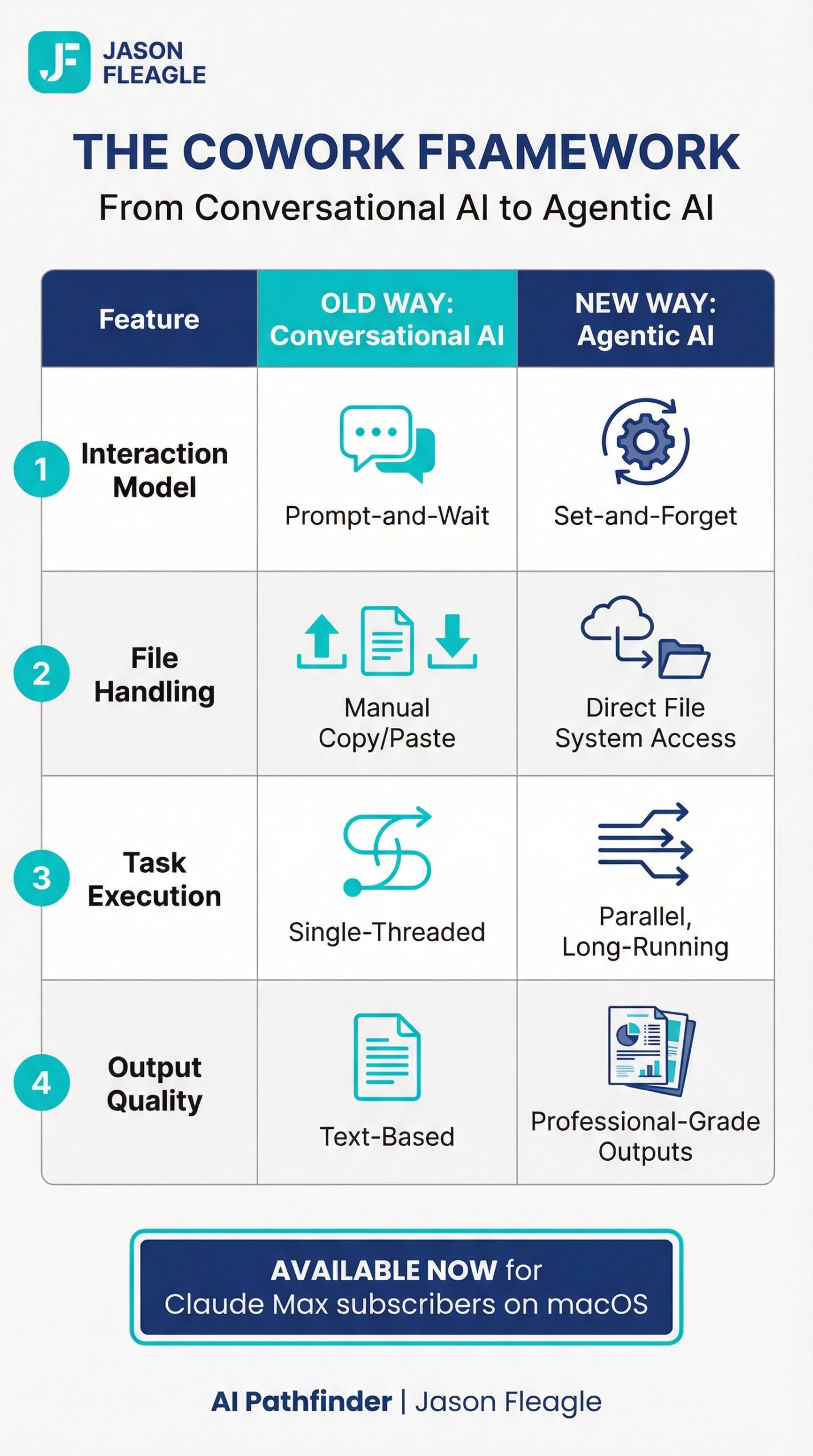
| Feature | The Old Way (Conversational AI) | The New Way (Agentic AI with Cowork) | What It Means For You |
|---|---|---|---|
| Interaction Model | Prompt-and-Wait: You give the AI a prompt, wait for a response, and then manually use that output. | Set-and-Forget: You describe a desired outcome, and the AI makes a plan, executes it, and delivers the finished work. | You are no longer the one doing the work; you are the one managing the work. This frees you up to focus on higher-level strategy and oversight. |
| File Handling | Manual Upload/Download: You have to manually copy and paste information into the chat window and then copy the AI’s output back into your documents. | Direct File System Access: You grant Cowork access to a folder, and it can read, edit, and create files directly on your computer. | The friction of moving information between the AI and your work is eliminated. This enables true automation of document-based tasks. |
| Task Execution | Single-Threaded: The AI can only work on one response at a time, and it has a limited context window and conversation timeouts. | Parallel, Long-Running Tasks: Cowork can break complex work into smaller sub-tasks, coordinate multiple workstreams in parallel, and work for extended periods. | You can now delegate complex, multi-step projects to your AI, not just simple, one-off questions. |
| Output Quality | Text-Based: The AI primarily generates text, which you then have to format and integrate into other applications. | Professional-Grade Outputs: Cowork can create polished deliverables like Excel spreadsheets with working formulas, PowerPoint presentations, and formatted documents. | The AI is no longer just a source of raw information; it’s a producer of finished, ready-to-use work products. |
This shift requires a corresponding shift in our own mindset. We are no longer just “prompt engineers”; we are becoming “AI managers.” Our job is not to tell the AI what to say, but to tell it what to do.
Three Critical Lessons for Leading in the Agentic Age
The arrival of a truly functional AI agent like Cowork has profound implications for leaders in every industry. Here are three critical lessons you need to internalize now:
1. The End of Digital Busywork is Finally Here
For years, we’ve been told that AI would free us from the drudgery of administrative tasks. With Cowork, that promise is finally becoming a reality. The use cases that Anthropic highlights are not trivial; they are the core of modern knowledge work: organizing files, processing receipts, synthesizing research, analyzing transcripts, and creating reports from messy inputs [3].
As a leader, you must now ask yourself: what percentage of your team’s time is spent on these kinds of tasks? And what could they accomplish if all of that time was suddenly freed up? The organizations that move fastest to automate this digital busywork will unlock a massive competitive advantage in productivity and innovation.
2. Governance is No Longer Optional
The power of agentic AI comes with a new set of risks. Anthropic is commendably transparent about these risks, noting that Cowork activity is not captured in audit logs, there are no role-based access controls, and it should not be used for regulated workloads [3]. It can also take destructive actions, like deleting files, if given ambiguous instructions. And the risk of “prompt injection”—where malicious content encountered on the internet could alter the AI’s behavior—is real [2].
This means that you can no longer afford to have a laissez-faire approach to AI governance. You need to establish clear policies and procedures for how your team uses agentic AI, especially when it has access to sensitive data and local file systems. The age of “move fast and break things” is over; the age of “move deliberately and don’t get breached” has begun.
3. The New Moat is AI Literacy, Not AI Access
For a brief period, having access to the best AI models was a competitive advantage. That era is over. With tools like Cowork, powerful agentic capabilities are being democratized. The new competitive advantage is not who has access to the best AI, but who knows how to use it most effectively.
This requires a new kind of AI literacy—one that goes beyond basic prompting. Your team needs to learn how to think like a manager of AI agents. They need to be able to break down complex projects into clear, delegable tasks. They need to be able to provide unambiguous instructions and constraints. And they need to be able to critically evaluate the AI’s work and provide course-correcting feedback.
The companies that invest in developing this AI literacy across their entire organization will be the ones that thrive in the agentic age.
The Bottom Line
Claude Cowork is more than just a new feature; it’s a landmark moment in the history of artificial intelligence. It marks the point where AI agents left the command line and showed up at the desk of the everyday knowledge worker. It’s the end of the beginning for AI, and the start of a new era of human-AI collaboration.
The question is no longer if AI agents will transform your business, but how you will lead your organization through that transformation. The journey starts now.
About Jason
Jason Fleagle is an AI strategist and the founder of Catalyst Brand Group, and his personal brand The Jason Fleagle. He helps leaders navigate the rapidly evolving landscape of artificial intelligence and build AI-powered businesses that scale.
Jason has worked with hundreds of organizations to implement AI strategies that drive measurable results. His insights have been featured in leading publications, and he is a sought-after speaker on the future of AI in business.
Looking for AI Growth?
If you’re ready to harness the power of AI agents like Claude Cowork to transform your business, Jason can help. Whether you need strategic consulting, hands-on implementation, or team training, he offers tailored solutions to meet your needs.
Work with Jason:
- AI Consulting: Schedule a consultation at scalingmillions.com/ai-consultant
- Tulsa AI Workshop: Join Jason’s upcoming workshop on January 23rd at scalingmillions.com/tulsa-ai-workshop
- Custom Workshops: Interested in bringing an AI workshop to your business or city? Reach out to discuss a custom program.
- YouTube Channel: Subscribe for weekly AI insights at youtube.com/@jasonfleagle
- AI Online Course: Learn AI marketing strategies at theaimarketingcourse.com