In the rush to adopt artificial intelligence, many organizations find themselves stuck in “pilot purgatory.” They launch proofs-of-concept with great fanfare, only to see them stall out, fail to scale, and never deliver a meaningful return on investment. The promise of AI transformation remains just that, a promise.
Why? Because successful enterprise AI isn’t about technology alone. It’s an operational discipline that requires a clear strategy, a practical framework, and a relentless focus on governance. Without a roadmap, even the most promising AI initiatives are destined to become expensive science projects.
I see this almost daily at the work I do in AI at OnStak.
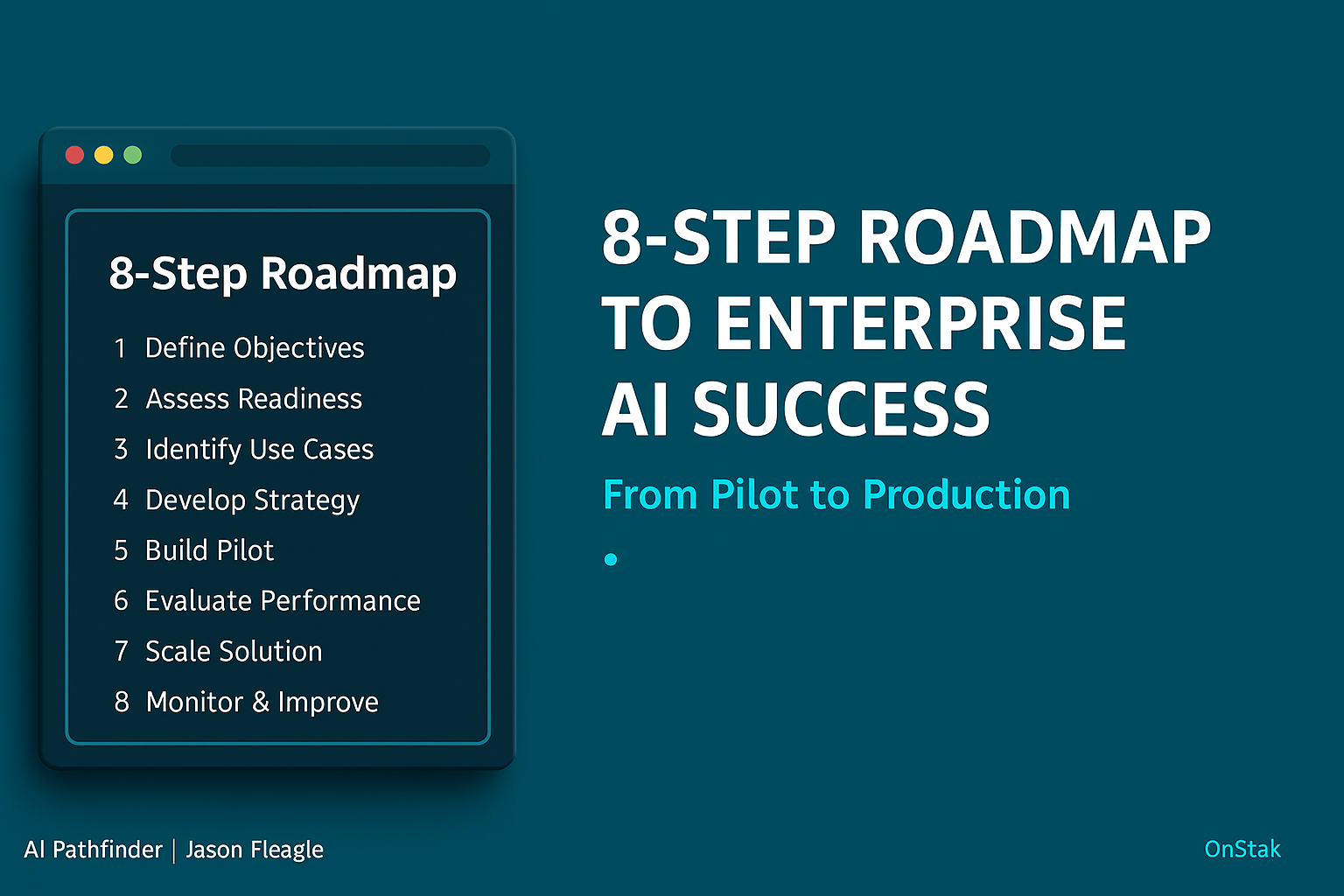
This week, I came across an excellent 8-step roadmap for CIOs from The Deep View, presented in partnership with StackAI, that provides a clear and actionable framework for moving from AI exploration to enterprise-wide implementation. This is a must-read for any leader tasked with driving AI transformation, and I want to share my analysis and insights on each step.
The Problem: Why Most Enterprise AI Initiatives Fail
Before we dive into the roadmap, it’s critical to understand the common pitfalls that derail AI projects. Organizations invest significant time and resources into AI pilots, but the majority never make it to production. The reasons are consistent across industries: lack of clear use cases, failure to scale beyond the pilot phase, messy governance frameworks, and an inability to demonstrate tangible ROI.
Without a structured approach, and a right team of AI experts to guide implementation correctly, AI becomes a solution in search of a problem rather than a strategic tool for solving real business challenges. This 8-step roadmap provides the framework needed to overcome these obstacles and build a sustainable AI operating system for your enterprise.
The 8-Step Roadmap to Enterprise AI Success
Here is a breakdown of the eight essential steps, with my added perspectives for each.
Step 1: Define Use Cases That Matter
The most successful AI initiatives start with a laser focus on real-world business problems. Instead of chasing the latest AI trends, identify specific workflows where AI can deliver measurable improvements in productivity, accuracy, or insight.
Common high-impact use cases include extracting intelligence from unstructured data like PDFs, images, and contracts; automating document processing for claims, invoices, and legal agreements; creating a single source of truth from siloed internal data; and generating drafts of memos, reports, and summaries for human review.
The key question to ask is simple: “Where does manual effort slow us down, and what could an intelligent agent safely take over?” Once you identify these workflows, quantify the impact in hours saved, error rates reduced, or faster cycle times. This ensures you stay grounded with a tangible ROI goal from day one.
From day one, every use case must be evaluated through a governance lens. Ask: What is the data classification? What are the regulatory requirements (e.g., GDPR, HIPAA)? Who is responsible for the output of the AI? By embedding governance into the use case definition, you avoid compliance issues down the road.
Step 2: Build and Iterate with a Visual Workflow Foundation
Speed is a competitive advantage. A visual, no-code or low-code workflow builder allows teams to design, test, and deploy AI agents in minutes, not months. This visual approach democratizes AI development, enabling business users to collaborate with IT to build solutions without a deep engineering background.
When teams can build and iterate visually, ideas move from concept to production much quicker. You can design flows by connecting tools, data, and logic visually instead of being buried in code. You can debug and adapt in real time, seeing how data moves, where actions trigger, and what the agent is doing next. And you can scale easily by adding new models or automations without breaking what already works.
Visual workflows provide a clear audit trail. Every step, every data transformation, and every decision point is documented visually, making it easier to demonstrate compliance and troubleshoot issues. Ensure your platform provides version control and project locking to prevent unauthorized changes.
Step 3: Choose a Platform with LLM and Tool Flexibility
Vendor lock-in is a significant risk in the rapidly evolving AI landscape. Different Large Language Models (LLMs) have different strengths. OpenAI’s GPT series is best for broad reasoning and creative tasks. Anthropic’s Claude series excels at reliability, safety, and handling large context windows. Mistral and Llama offer open-source models ideal for cost-efficient, on-premises deployment.
Your AI platform must be model-agnostic, allowing you to swap, test, and orchestrate different LLMs for different tasks. It also needs to integrate seamlessly with your existing enterprise systems—CRMs, ERPs, databases, and API actions—to enable your AI agents to take meaningful action.
Model flexibility is a key governance control. If a model provider changes its terms of service, raises prices, or is found to have a security vulnerability, you need the ability to switch to an alternative without disrupting your operations. Your governance policy should define the criteria for selecting and validating new models.
Step 4: Design Interfaces People Actually Use
The most powerful AI agent is useless if no one uses it. Adoption depends on providing simple, intuitive interfaces that meet users where they are. This means embedding assistants into the tools your team already uses, like Slack, Microsoft Teams, or SharePoint. It means providing clean, branded chat interfaces for specific tasks. And it means using comprehensive forms to guide users in providing the right inputs.
Interfaces are a critical governance checkpoint. Role-based access control (RBAC) should be enforced at the interface level, ensuring that users can only access the data and AI capabilities relevant to their roles. All interactions should be logged for auditing and monitoring purposes.
Step 5: Unify and Secure Your Knowledge Base
Enterprise AI is only as good as the data it has access to. Before you can deploy intelligent agents, you must create a unified, secure, and up-to-date knowledge base. This involves connecting data sources by integrating with your existing databases, document repositories, and enterprise applications. It involves implementing Retrieval-Augmented Generation (RAG) to provide your LLMs with real-time access to your proprietary data, ensuring responses are accurate and contextually relevant. And it involves data cleansing and preparation to ensure your data is clean, accurate, and properly formatted.
This is the most critical step for data governance. You must establish clear data ownership, define data access policies, and implement robust security controls to protect sensitive information. Your knowledge base should have its own granular permissions to ensure that AI agents and users can only access the data they are authorized to see.
Step 6: Evaluate Agents for Correctness and Accuracy
Once your AI agents are in production, you need a systematic way to evaluate their performance. This goes beyond simple accuracy metrics and involves using one LLM to grade another on a variety of dimensions. Core dimensions include accuracy compared to the source of truth, relevance to the user’s query, factual consistency to avoid contradictions or hallucinations, and compliance with your company’s policies and regulatory requirements.
Platforms should embed this evaluation layer into analytics dashboards so you can monitor performance drift in real time.
Continuous evaluation is a cornerstone of responsible AI. Your governance framework should define the metrics for success, the frequency of evaluation, and the process for retraining or retiring underperforming models. All evaluation results should be logged and auditable.
Step 7: Deploy Securely: On-Prem, Hybrid, or Your Choice
Enterprises have different security and compliance requirements. Your AI platform must offer flexible deployment options to meet your specific needs. Cloud deployment is the fastest way to get started and is ideal for non-sensitive workloads. Hybrid deployment offers a balance of control and scalability, keeping sensitive data on-premises while leveraging the cloud for model training. On-premises deployment provides maximum control and isolation for highly regulated industries.
Your data residency and security policies should dictate your deployment strategy. A robust governance framework will define which workloads can run in the cloud and which must remain on-premises. Ensure your platform is certified for relevant standards like SOC 2, HIPAA, and GDPR.
Step 8: Govern and Monitor Everything
Governance is a continuous process. To move from prototypes to enterprise-grade products, you need a comprehensive governance and monitoring framework with granular role-based access control (RBAC) to control who can build, deploy, and use AI agents. You need version history and project locking to prevent unauthorized changes and maintain a clear audit trail. You need permissions for integrations and knowledge bases to control which data sources your agents can access. You need single sign-on (SSO) to integrate with your existing identity provider for secure access. And you need comprehensive logging to log all runs, tokens, errors, and user interactions for complete operational visibility.
The goal of governance is to enable innovation safely. By providing operational visibility, you build trust with users, auditors, and regulators, creating a foundation for scaling AI across the enterprise.
Going from AI Strategy to an AI Operating System
Enterprise AI is not a one-off project, but more like an operational discipline. By following this 8-step roadmap, you can move beyond the hype and build a sustainable, scalable, and secure AI operating system for your organization.
Define the right use cases, build with a flexible and visual platform, prioritize user-centric design, unify your knowledge base, evaluate performance rigorously, deploy securely, and govern everything. This is the path from pilot to production, and from AI strategy to true AI transformation.
If your organization is ready to move beyond pilot projects and build a real AI operating system, this framework is your guide to success.
Please feel free to drop a comment or DM me if you have a question.
And remember to keep moving forward!
About OnStak
OnStak specializes in comprehensive AI implementation across four core expertise areas: AI/Data for intelligent knowledge management, AI/Edge for distributed operational intelligence, AI/Performance for optimized system efficiency, and AI/Migrations for seamless technology integration. Our proven methodology helps business and technology leaders achieve operational transformation while maximizing return on investment.
You can learn more about our top AI case studies here on our website.
About Jason
Jason Fleagle is the Chief AI Architect at OnStak, and is also a writer, entrepreneur, and consultant specializing in tech, AI, and growth. He helps humanize data—so every growth decision an organization makes is rooted in clarity and confidence. Jason has helped lead the development and delivery of over 150 AI applications, and frequently conducts training workshops to help companies understand and adopt AI. With a strong background in digital marketing, content strategy, and technology, he combines technical expertise with business acumen to create scalable solutions. He is also a content creator, producing videos, workshops, and thought leadership on AI, entrepreneurship, and growth. He continues to explore ways to leverage AI for good and improve human-to-human connections while balancing family, business, and creative pursuits.
Looking for AI Growth?
Let’s Talk About Your AI Goals!
What would you do if you could determine the top AI use cases or opportunities for you and your team?
We can help you go from surviving to thriving – with done-for-you business growth implementations.
You can learn more about Jason on his website here.
You can learn more about OnStak here.
You can learn more about our top AI case studies here on our website.
Learn more about my AI resources here on my youtube channel.