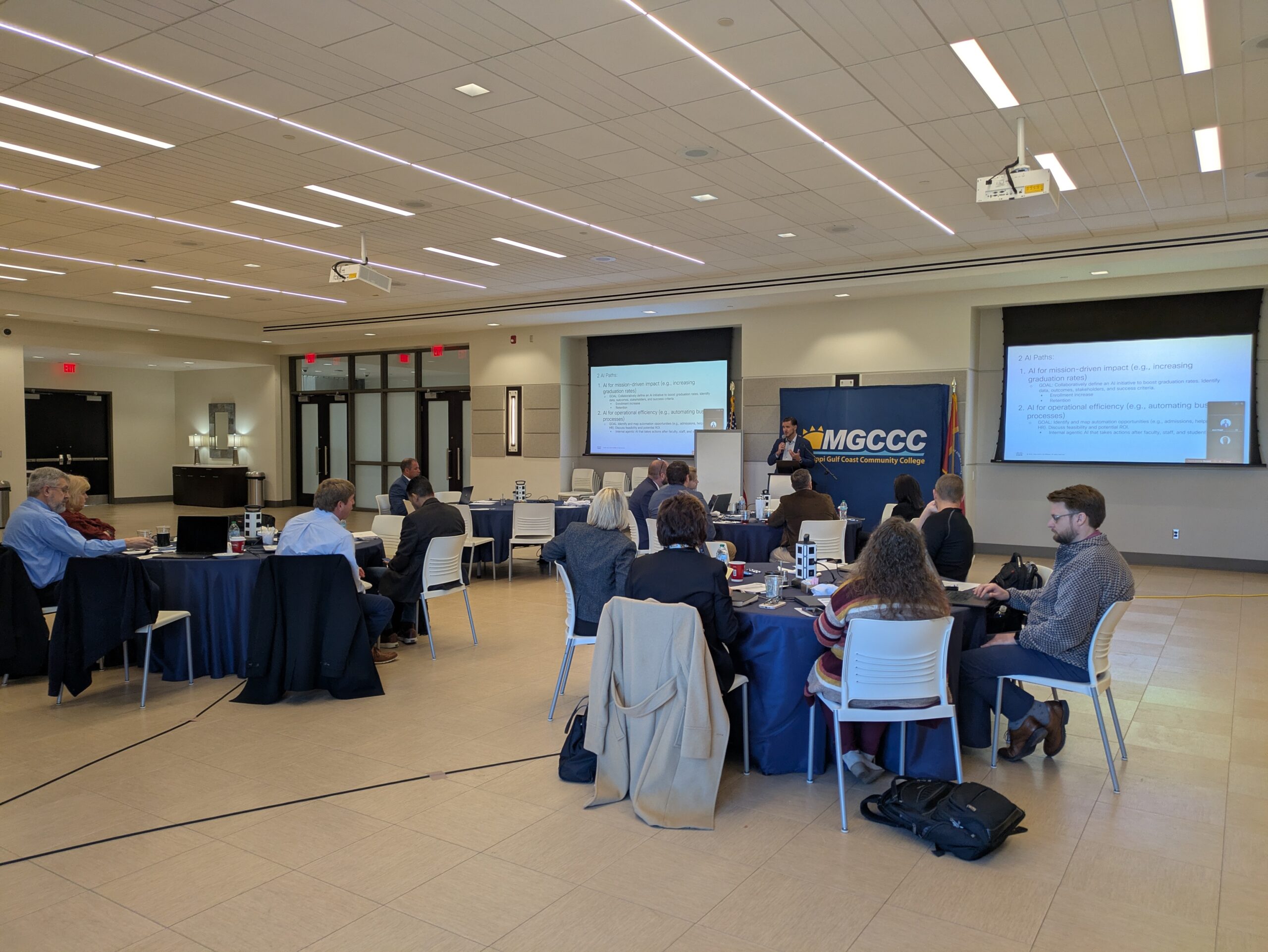
We had the privilege of facilitating a full-day AI Ideation Workshop at a Mississippi College in partnership with amazing Cisco team members. What unfolded was a masterclass in collaborative innovation, a room full of engaged higher education leaders co-creating a practical roadmap to transform their institution through artificial intelligence.
Starting with Success: Building on a Foundation of Excellence
The university came to the table with an impressive track record. Over the past several years, they have doubled their graduation rates from 25% to 50% through data-driven decision-making and strategic initiatives. This wasn’t a group looking for AI to save what they’re already doing, but instead, they wanted to understand how AI could accelerate their momentum and help them reach their ambitious goal of 75%+ graduation rates while simultaneously improving operational efficiency across the institution.
This is the ideal starting point for any AI transformation. Rather than treating AI as a solution in search of a problem, we began by celebrating what was already working. We explored their existing data infrastructure, their proven analytics capabilities, and the cultural commitment to student success that permeated every conversation. This foundation of past success created the confidence and credibility needed to explore bold new possibilities.
The Power of Structured Ideation
Our workshop wasn’t a free-for-all brainstorming session. We brought a structured AI Ideation Framework designed specifically for higher education environments. The day was carefully orchestrated to move from education to inspiration to co-creation:
Morning: Building Shared Understanding
We started with an AI Primer tailored to the higher education context, demystifying concepts like machine learning, generative AI, and hybrid deployment models. We then shared real-world case studies from peer institutions, including a compelling example from another university that used AI-driven student recruitment to increase new enrollments for their online programs.
These weren’t abstract AI success stories or case studies. We gave them concrete examples of institutions solving the exact challenges this Mississippi college faces: improving student retention, detecting fraudulent enrollments, automating administrative workflows, and personalizing student support at scale.
Afternoon: Co-Creating the Future
The real magic happened after lunch. We facilitated intensive co-creation sessions where the university’s cross-functional leadership team—including their President, Vice Presidents of Student Services, Teaching & Learning, and Technology, along with their CIO, Director of Predictive Analytics, AI Strategist, and other key stakeholders—worked together to identify and prioritize AI use cases.
Using our structured framework, we guided them through a systematic process of defining use cases, assessing business impact, evaluating technical complexity, identifying required data sources, and establishing success metrics. The energy and excitement in the room was palpable. Faculty, administrators, and technical staff who might typically work in silos were suddenly building on each other’s ideas, challenging assumptions, and aligning around shared priorities. I love to see the energy and activity in this part as we try to pull out the right information to work with to co-create the right solutions for them.
What Emerged: A Clear, Actionable Roadmap
By the end of the day, the university had identified and prioritized 4+ high-impact AI use cases spanning two strategic themes: mission-driven student success and operational efficiency.
The top three priorities that emerged from our collaborative process were:
1. Early Warning System for At-Risk Students
An AI-powered predictive analytics platform that analyzes academic performance, engagement data, and demographic factors to identify students at risk of dropping out—enabling timely, personalized interventions. The team recognized this as directly aligned with their core mission and estimated it could improve first-year retention by 5-10%, putting them on track to exceed their 75% graduation rate goal.
2. Fraudulent Student Detection and Verification
An AI-based identity verification system using biometric analysis and know-your-customer (KYC) protocols to eliminate “ghost students” and fraudulent enrollments. This use case addressed a critical institutional integrity issue while generating significant cost savings by preventing financial aid misuse.
3. Business Process Automation
Intelligent automation of repetitive workflows in admissions, HR, and help desk operations. This quick-win opportunity promised immediate operational efficiency gains, freeing staff to focus on higher-value student-facing activities.
What made these priorities compelling wasn’t just their potential impact—it was the buy-in. Every stakeholder in the room understood the “why” behind each use case, the data requirements, the success metrics, and their role in making it happen.
The Infrastructure Question: Edge, Cloud, or Hybrid?
One of the most valuable discussions centered on where AI workloads should actually run. This university operates in a highly regulated environment where student data privacy (FERPA compliance) is non-negotiable. They also have distributed campus locations and need real-time performance for time-sensitive applications like early warning alerts.
We walked through the trade-offs between cloud-only, on-premises, and hybrid deployment models. We also had the opportunity mention Cisco’s Unified Edge platform—a purpose-built AI infrastructure solution that brings data center-class compute to the edge with built-in security, zero-touch deployment, and centralized management.
We discussed that typically a hybrid architecture is the most likely optimal path: Cisco Unified Edge at the campus edge for real-time, privacy-sensitive AI inferencing, combined with cloud resources for model training and development and also other existing applications that are in use. This approach delivers the performance, data sovereignty, and operational simplicity they need while maintaining the flexibility to scale as their AI initiatives mature.
Why This Workshop Worked: Lessons for Other Universities
Reflecting on what made this workshop successful, several key principles stand out:
Start with Wins, Not Problems
We didn’t begin by cataloging everything broken. We celebrated their data-driven culture and past successes, then framed AI as an accelerator of what’s already working. This created psychological safety and enthusiasm rather than defensiveness.
Make It Collaborative, Not Consultative
We didn’t come in with a pre-packaged solution. We facilitated a co-creation process where the respective leaders built their own roadmap with our guidance. This created ownership and ensured the priorities reflected their unique context and constraints.
Balance Ambition with Pragmatism
We encouraged bold thinking about AI’s potential while grounding every use case in realistic timelines, resource requirements, and success metrics. The result was a roadmap that felt both inspiring and achievable.
Engage the Full Ecosystem
The room included academic leaders, student services professionals, IT staff, security experts, and institutional researchers. This cross-functional engagement ensured that use cases were vetted from multiple perspectives and had built-in stakeholder alignment from day one.
Provide a Clear Path Forward
We didn’t end with “That was interesting.” We concluded with concrete next steps: finalizing 1-2 pilot use cases, assigning internal owners, defining deliverables (SOW, ROI models, readiness assessments), and potentially establishing a governance framework. The university left with a clear action plan, not just inspiration and ideas.
The Opportunity for Higher Education
This university’s story is not unique. Across the country, community colleges and universities are grappling with similar challenges: improving student outcomes, managing constrained budgets, automating administrative overhead, and competing for students in an increasingly complex landscape.
What makes this moment so exciting is that AI is no longer an abstract concept or a distant future. The technology is mature, the use cases are proven, and the infrastructure is ready. What’s often missing is the structured process to identify the right opportunities, align stakeholders, and build a practical roadmap.
That’s exactly what our AI Ideation Workshop provides. Whether you’re a community college like this organization, a large research university, or a regional public institution, the methodology we used can be adapted to your context:
• Assess your current state: What data do you have? What’s already working? Where are the pain points?
• Educate stakeholders: Build shared understanding of AI capabilities and limitations in higher education.
• Facilitate co-creation: Bring cross-functional leaders together to identify and prioritize use cases.
• Evaluate infrastructure: Determine the right deployment model (cloud, edge, hybrid) for your workloads.
• Establish governance: Define policies, risk frameworks, and success metrics before you build.
• Start with pilots: Choose 1-2 high-impact use cases for proof-of-value before scaling.
What’s Next for the University
In the coming weeks, we’ll be working with their team to develop next steps. And the leadership team left the workshop aligned, energized, and equipped with a clear vision for how AI will help them achieve their mission. They’re not chasing AI for the sake of innovation, they’re strategically deploying it to serve students better, operate more efficiently, and fulfill their institutional promise.
A Call to Action for Higher Education Leaders
If you’re a university president, CIO, provost, or institutional leader wondering how to navigate your institution’s AI journey, I encourage you to start with three questions:
1. What are we already doing well that AI could accelerate?
2. Who needs to be in the room to co-create our AI roadmap?
3. What would success look like in 12 months?
The answers to these questions, developed collaboratively with your stakeholders, will be far more valuable than any vendor pitch or off-the-shelf solution.
At OnStak, we’re passionate about helping higher education institutions unlock the transformative potential of AI in a way that’s practical, responsible, and aligned with their unique missions. The AI ideation workshop reminded us why this work matters: when done right, AI isn’t about replacing human judgment or automating away jobs, it’s about empowering educators, administrators, and student support professionals to do their best work and help more students succeed.
If your institution is ready to explore what’s possible, let’s talk. The future of higher education is being written right now, and it’s a story worth co-creating together.
Please feel free to drop a comment or DM me if you have a question.
And remember to keep moving forward!
About Jason Fleagle
Jason Fleagle is the Chief AI Architect at OnStak, and is also a writer, entrepreneur, and consultant specializing in tech, AI, and growth. He helps humanize data—so every growth decision an organization makes is rooted in clarity and confidence. Jason has helped lead the development and delivery of over 150 AI applications, and frequently conducts training workshops to help companies understand and adopt AI. With a strong background in digital marketing, content strategy, and technology, he combines technical expertise with business acumen to create scalable solutions. He is also a content creator, producing videos, workshops, and thought leadership on AI, entrepreneurship, and growth. He continues to explore ways to leverage AI for good and improve human-to-human connections while balancing family, business, and creative pursuits.
Looking for AI Growth?
Let’s Talk About Your AI Goals!
What would you do if you could determine the top AI use cases or opportunities for you and your team?
We can help you go from surviving to thriving – with done-for-you business growth implementations.
You can learn more about Jason on his website here.
Learn more about my AI resources here on my youtube channel.