TLDR
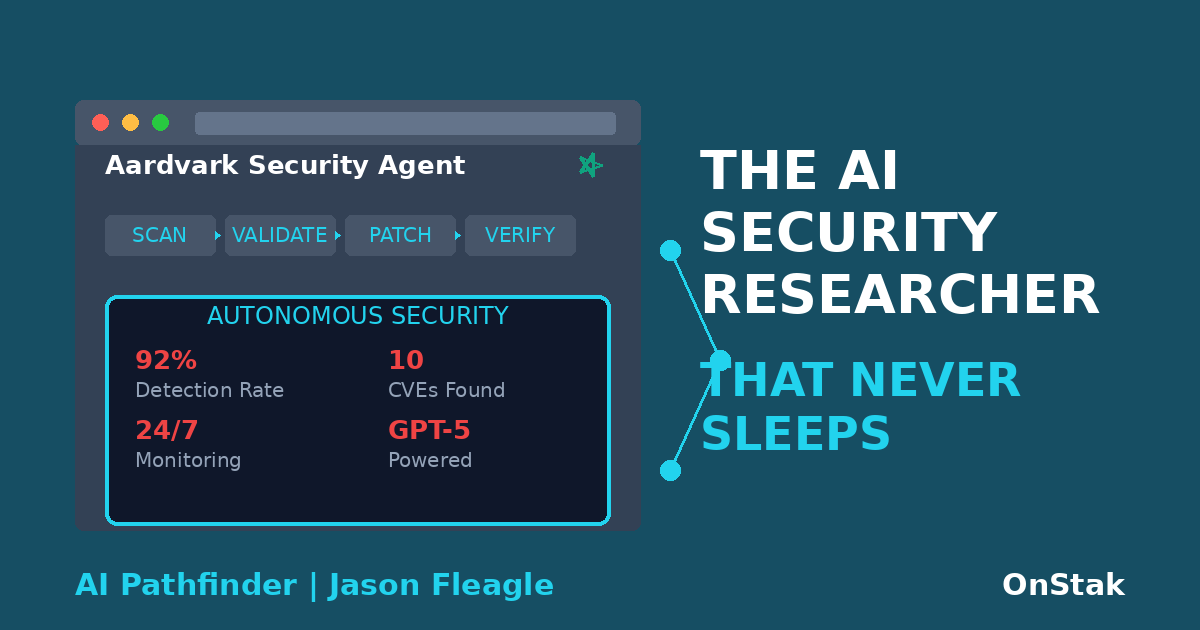
OpenAI just unveiled Aardvark, an autonomous AI agent built on GPT-5 that acts as a dedicated security researcher for your codebase. It continuously scans repositories, reasons about code like a human expert, and not only detects but also validates and helps patch vulnerabilities. Currently in private beta, Aardvark represents a monumental shift from reactive, tool-based scanning to proactive, AI-driven software defense. This isn’t just another cybersecurity vulnerability scanner—it’s an agentic AI system designed to secure your software as it’s being written.
What Just Happened?
On October 30, 2025, OpenAI announced Aardvark, its new agentic security researcher. Unlike traditional security tools that rely on pattern matching or fuzzing, Aardvark uses LLM-powered reasoning to understand code semantics, identify potential exploits, and propose fixes. It integrates directly into the development pipeline, most notably with GitHub, to provide a continuous, autonomous security layer.
The Aardvark Multi-Stage Process
Aardvark’s strength lies in its methodical, multi-stage approach that mimics a human security expert:
| Stage | Description |
|---|---|
| 1. Understand & Model | Aardvark first maps the entire repository to build a contextual threat model, understanding the code’s purpose and security posture. |
| 2. Monitor & Analyze | It continuously monitors new commits, using LLM reasoning to analyze whether changes introduce risk or violate security patterns. |
| 3. Validate in Sandbox | Upon identifying a potential flaw, it attempts to validate its exploitability in a sandboxed environment, drastically reducing false positives. |
| 4. Patch & Verify | It integrates with OpenAI’s Codex to generate a patch, then re-analyzes the fix to ensure it doesn’t introduce new issues, offering a one-click solution for developers. |
In internal and partner testing, Aardvark successfully detected 92% of known and synthetically introduced vulnerabilities, demonstrating high recall and real-world effectiveness in complex codebases.
Why This Is Bigger Than It Looks: The Shift to Autonomous Defense
This isn’t just a better security scanner—it’s a paradigm shift that is really making an impact. For decades, security has been a largely reactive discipline. A vulnerability is discovered, a CVE is issued, and teams scramble to patch. Aardvark flips the script.
From Reactive Scanning to Proactive Reasoning
Traditional tools like SAST (Static Application Security Testing) and SCA (Software Composition Analysis) are good at finding known patterns. Aardvark is designed to understand intent and behavior, allowing it to find novel or complex vulnerabilities that pattern-based systems might miss.
As Pareekh Jain, CEO at EIIRTrend, noted:
“OpenAI Aardvark is different as it mimics a human security researcher. It uses LLM-powered reasoning to understand code semantics and behavior, reading and analyzing code the way a human security researcher would.”
Solving the False Positive Problem
The validation stage is a game-changer. Developers often ignore alerts from security tools because they are flooded with false positives. By attempting to trigger a vulnerability in a sandbox, Aardvark proves an issue is real and exploitable before it ever reaches a human, focusing developer attention where it’s needed most.
The Birth of the AI Security Workforce
Aardvark is one of the first true examples of an autonomous AI agent joining a critical enterprise team. It doesn’t just assist; it performs the core functions of a security researcher—discovery, validation, and remediation support—at machine speed and scale.
The Governance Questions You Can’t Ignore
While the promise is immense, deploying an autonomous agent with access to your source code requires a new level of governance.
1. Data & Access Control
How do you grant an AI agent sufficient access to be effective without creating a new, high-privilege attack vector? The principle of least privilege is paramount.
2. Accuracy & Trust
A 92% detection rate is impressive, but what about the 8% it misses? How do you prevent over-reliance on the agent and ensure human oversight remains effective?
3. Patch Integrity
Who is liable if an AI-generated patch introduces a new, more subtle vulnerability? The one-click patch feature is powerful, but it requires a robust human-in-the-loop review process.
4. Vendor Lock-In
As these autonomous agents become deeply embedded in the development lifecycle, how do organizations avoid becoming completely dependent on a single vendor’s security ecosystem?
5. Training Data & Confidentiality
What safeguards are in place to ensure your proprietary code isn’t used to train future models or inadvertently exposed through the agent’s operations?
What to Do Next
For Security Leaders
Start evaluating how agentic security fits into your “shift left” strategy. The goal is not to replace your security team, but to augment them, freeing up human experts to focus on novel threats and architectural reviews.
For Development Leaders
Sign up for the Aardvark private beta. Begin identifying a non-critical but complex repository to test its capabilities. Measure its impact on your team’s vulnerability remediation time.
For Open Source Maintainers
Keep an eye out for OpenAI’s pro-bono scanning program. Aardvark has already identified 10 CVEs in open-source projects, demonstrating its value to the broader community.
The Bottom Line
With over 40,000 new CVEs reported annually, human-led security is struggling to keep pace. OpenAI’s Aardvark signals the beginning of a new era where autonomous AI agents act as a persistent, proactive layer of defense. It’s a move from finding bugs to building self-healing software. For enterprises, this isn’t just about strengthening security; it’s about embedding resilience directly into the code itself, reducing risk and freeing developers to build, faster and safer.
Good or bad? What do you think? Let me know in the comments.
About OnStak
OnStak specializes in comprehensive AI implementation across four core expertise areas: AI/Data for intelligent knowledge management, AI/Edge for distributed operational intelligence, AI/Performance for optimized system efficiency, and AI/Migrations for seamless technology integration. Our proven methodology helps manufacturing leaders achieve operational transformation while maximizing return on investment.
Here’s a few recent AI projects we’ve delivered:
Case Study: Cricket Sports Team Uses AI to Gain An Advantage
Case Study: Transforming Mental Healthcare With AI
Case Study: ARI AI Chatbot Helps Military Veterans Community
Case Study: AI Helps Healthcare Professionals Roleplay Patient Care
Case Study: AI Document Processing for Real Estate Investment
About Jason Fleagle
Jason Fleagle is the Chief AI Architect at OnStak, and is also a writer, entrepreneur, and consultant specializing in tech, AI, and growth. He helps humanize data—so every growth decision an organization makes is rooted in clarity and confidence. Jason has helped lead the development and delivery of over 150 AI applications, and frequently conducts training workshops to help companies understand and adopt AI. With a strong background in digital marketing, content strategy, and technology, he combines technical expertise with business acumen to create scalable solutions. He is also a content creator, producing videos, workshops, and thought leadership on AI, entrepreneurship, and growth. He continues to explore ways to leverage AI for good and improve human-to-human connections while balancing family, business, and creative pursuits.
Looking for AI Growth?
Let’s Talk About Your AI Goals!
What would you do if you could determine the top AI use cases or opportunities for you and your team?
We can help you go from surviving to thriving – with done-for-you business growth implementations.
- You can learn more about Jason on his website here.
- You can learn more about OnStak here.
- You can learn more about our top AI case studies here on our website.
- Learn more about my AI resources here on my youtube channel.
- And check out my AI online course.