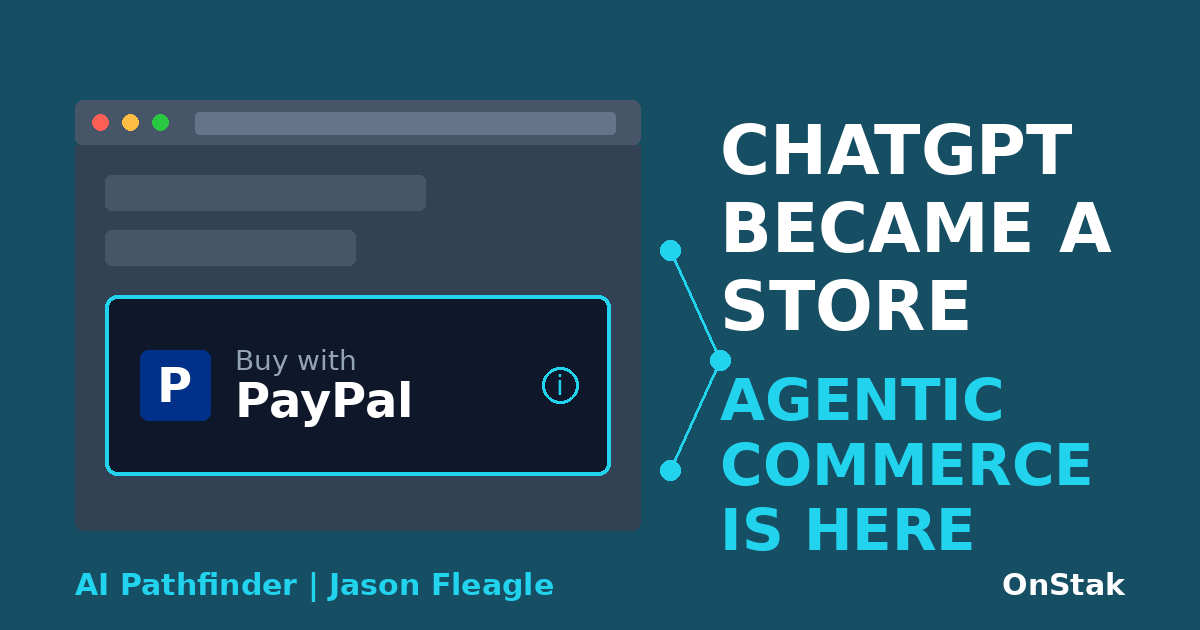
TLDR: ChatGPT is no longer just the bot you ask questions. It’s becoming the place where you buy things. PayPal just signed a deal with OpenAI to embed its digital wallet directly into ChatGPT, launching next year. This means 700 million weekly ChatGPT users will soon see a “Buy with PayPal” button when the AI suggests products. PayPal’s stock surged 13% on the news, and the company raised its full-year earnings guidance.
This is not just a payments integration, but the birth of agentic commerce, and it’s going to reshape how we shop online. Are you ready for that?
What Just Happened?
On October 28, 2025, PayPal and OpenAI announced a partnership sealed over the weekend. Starting in 2026, PayPal’s digital wallet will be embedded directly into ChatGPT. Here’s what that means in practice:
For Buyers: ChatGPT’s 700 million weekly users can now purchase items through the AI platform using the “Buy with PayPal” button. Funds can come from linked bank accounts, credit cards, or stored PayPal balances. You get all the standard PayPal protections—package tracking, dispute resolution, and verified transactions.
For Sellers: PayPal merchants can sell on ChatGPT with their inventory automatically listed. PayPal handles merchant routing, payment validation, and all the behind-the-scenes payment processing. Individual merchants don’t need to sign up with OpenAI separately—if you’re already a PayPal merchant, you’re in.
For PayPal: This is a first-mover play to become the payments backbone for AI-driven commerce. The company is positioning itself as the infrastructure layer for what CEO Alex Chriss calls “agentic commerce”—shopping where AI agents find, recommend, and facilitate purchases on your behalf.
The market loved it. PayPal shares jumped 13%, and the company raised its full-year adjusted earnings-per-share guidance from $5.15-$5.30 to $5.35-$5.39. They also announced a new dividend program paying 14 cents per share this quarter.
Why This Is Bigger Than It Looks
This deal isn’t just about adding a payment button to ChatGPT, but about fundamentally changing the commerce paradigm.
The Old Model: Search → Browse → Buy
Traditional e-commerce looks like this: You go to Amazon, search for “running shoes,” scroll through pages of results, filter by price and reviews, read descriptions, compare options, and eventually click “Add to Cart.” It’s a process you control, but it’s also time-consuming and overwhelming.
The New Model: Describe → AI Finds → Buy
Agentic commerce looks like this: You tell ChatGPT, “I need running shoes for trail running, budget $150, I have wide feet.” ChatGPT understands your needs, searches across PayPal’s merchant network, evaluates options based on your criteria, and presents you with curated recommendations. You say “Buy the second one,” and it’s done. No browsing. No comparison shopping. No decision fatigue.
The AI becomes your personal shopper, product researcher, and transaction facilitator all in one.
OpenAI’s E-Commerce Blitz
This isn’t PayPal’s first rodeo, and it’s not OpenAI’s either. In the past month, OpenAI has been aggressively building out ChatGPT’s commerce capabilities:
Last Month:
- Shopify: ChatGPT users can buy from Shopify merchants
- Etsy: Handmade and vintage goods accessible through ChatGPT
Two Weeks Ago:
- Walmart: Major retail partnership announced
Now:
- PayPal: Payments infrastructure embedded directly into the platform
OpenAI is systematically transforming ChatGPT from a conversational AI into a full-stack commerce platform. They’re not just adding shopping features, but building an ecosystem where discovery, evaluation, and transaction happen in a single conversational flow.
With 700 million weekly users, ChatGPT has more traffic than most e-commerce platforms. If even a small percentage of those users start buying through ChatGPT, the revenue implications are massive. And if you sell anything online, this is a good signal to pay attention.
PayPal’s Strategic Play
For PayPal, this is about survival and dominance in the next era of commerce.
The Threat
Payment processors like PayPal face a real risk in AI-driven commerce. If AI agents handle transactions directly, say, by integrating with Stripe, Square, or even building their own payment rails, PayPal could be cut out of the loop. The company that controls the AI layer could control the payment layer too.
The Response
PayPal is racing to become the default payment infrastructure for AI commerce. They’re not just partnering with OpenAI—they’re also working with Google and AI search engine Perplexity. The strategy is clear: embed PayPal into every major AI platform before competitors can.
CEO Alex Chriss framed it explicitly: “It’s a whole new paradigm for shopping. It’s hard to imagine that agentic commerce isn’t going to be a big part of the future.”
By positioning PayPal as the trusted, verified payment layer for AI platforms, they’re betting they can own the infrastructure even if they don’t control the AI itself.
The Advantage
PayPal brings two critical assets to the table:
- Trust and Verification: Both buyers and sellers are verified by PayPal, reducing fraud risk. In an AI-mediated transaction where you’re not directly vetting the merchant, that trust layer matters.
- Scale: PayPal claims to have the “largest merchant network in the world” and “hundreds of millions of loyal PayPal wallet holders.” That’s a massive two-sided marketplace that OpenAI can plug into instantly.
What This Means for E-Commerce
If agentic commerce takes off, and this deal suggests the major players think it will, the implications for traditional e-commerce are definitely going to be BIG.
Here’s what is probably going to happen:
Winners
- AI Platforms (OpenAI, Google, Perplexity): They become the new storefront. Instead of going to Amazon or Walmart’s website, you go to ChatGPT.
- Payment Processors (PayPal, Stripe, Square): Whoever embeds into AI platforms first captures the transaction flow.
- Merchants with Strong Product Data: If your product catalog is well-structured and easily ingestible by AI, you’ll get recommended. If it’s not, you’ll be invisible.
Losers
- Traditional E-Commerce Platforms: If consumers shift to AI-mediated shopping, platforms like Amazon, eBay, and even Shopify could see reduced direct traffic. They’ll need to integrate with AI platforms or risk becoming invisible.
- SEO-Dependent Businesses: If AI agents are doing the product research instead of humans Googling, traditional search engine optimization becomes less valuable. You need to optimize for AI recommendations instead. That doesn’t mean SEO is going away, by any means, but it does mean it changes a little bit.
- Comparison Shopping Sites: If ChatGPT is doing the comparison for you, sites like PriceGrabber or Google Shopping lose their value proposition.
The Open Questions
- Discovery vs. Intent: Traditional e-commerce works because you know what you want (or think you do). Will people trust AI to decide what they should buy? Or will they still want to browse and discover?
- Impulse Buying: A lot of e-commerce revenue comes from impulse purchases—seeing something you didn’t plan to buy and clicking “Add to Cart.” Does agentic commerce enable that, or does it make shopping too efficient?
- Merchant Control: If AI is curating recommendations, how do merchants influence what gets shown? Do they pay for placement? Optimize for AI algorithms? This is the new SEO battleground.
The Governance Questions You Can’t Ignore
As always, the technology moves faster than the governance.
Here are the questions every organization needs to be asking:
Data Privacy and Surveillance
When you tell ChatGPT “I need running shoes for trail running,” that’s not just a search query, it’s your personal data. OpenAI now knows your shoe size, your budget, your fitness habits. When you complete the purchase through PayPal, they know what you bought, when, and for how much.
Questions:
- How is that data shared between OpenAI and PayPal?
- Is it used to train AI models?
- Can it be sold to advertisers?
- What happens if there’s a data breach?
Algorithmic Bias and Fairness
If ChatGPT is recommending products, how does it decide what to show? Is it based purely on your stated criteria, or is it influenced by merchant fees, affiliate relationships, or algorithmic bias?
Questions:
- Are certain merchants prioritized over others?
- Does the AI favor products from larger brands with better data?
- Can smaller merchants compete for visibility?
- Is there transparency into how recommendations are made?
Consumer Protection
When you buy something through ChatGPT, who’s responsible if something goes wrong? If the product doesn’t match the AI’s description, if it never arrives, or if it’s defective, who do you hold accountable: OpenAI, PayPal, or the merchant?
Questions:
- What are the terms of service for AI-mediated purchases?
- Does PayPal’s buyer protection extend to ChatGPT transactions?
- If the AI makes a mistake (wrong product, wrong price), who’s liable?
- How do refunds and disputes work?
Market Concentration
If ChatGPT becomes a dominant commerce platform, OpenAI gains enormous power over which merchants succeed and which don’t. That’s the same concern we’ve had with Amazon, but potentially more opaque because the AI’s decision-making process is a black box.
Questions:
- Should AI commerce platforms be regulated like marketplaces?
- What transparency requirements should exist for AI-driven recommendations?
- How do we prevent monopolistic behavior in AI-mediated commerce?
What to Do Next
If you’re a consumer:
- Be aware of what you’re sharing. When you shop through ChatGPT, you’re giving OpenAI detailed information about your preferences, needs, and purchasing behavior. Decide whether you’re comfortable with that.
- Verify AI recommendations. Don’t blindly trust what ChatGPT suggests. Cross-check prices, read reviews, and make sure the product actually matches what you asked for.
- Understand the protections. Know what buyer protections apply to ChatGPT purchases and how to resolve disputes if something goes wrong.
If you’re a merchant:
- Optimize for AI discovery. Make sure your product data is clean, structured, and easily ingestible by AI systems. This is the new SEO.
- Get on PayPal (if you’re not already). If PayPal is the embedded payment layer for ChatGPT, being a PayPal merchant means you’re automatically in the ecosystem.
- Monitor where your traffic is coming from. If you start seeing referrals from ChatGPT or other AI platforms, that’s a signal that agentic commerce is starting to matter.
- Experiment with AI-driven marketing. How do you influence what AI recommends? This is uncharted territory, but early movers will learn fastest.
If you’re a business leader:
- Assess your e-commerce strategy. If a significant portion of your revenue comes from online sales, how would your business be affected if consumers shift to AI-mediated shopping?
- Evaluate your payment infrastructure. Are you locked into a single payment processor, or do you have flexibility to adapt as AI commerce evolves?
- Consider your data strategy. If AI platforms need product data to recommend your offerings, how are you structuring and sharing that data?
- Watch the regulatory landscape. AI commerce is new enough that regulations don’t exist yet. But they will. Stay informed about emerging standards and compliance requirements.
If you’re in e-commerce or fintech:
- This is your wake-up call. Agentic commerce is no longer theoretical. Major players (OpenAI, PayPal, Walmart, Shopify) are betting real money on it.
- Decide whether to integrate or compete. Do you partner with AI platforms to be part of the ecosystem, or do you build your own AI commerce capabilities?
- Invest in AI-native experiences. If your platform still relies on traditional search and browse, you’re going to look outdated fast.
The Bottom Line
ChatGPT just became a store. Not a store that sells ChatGPT subscriptions, but a store that sells everything, powered by AI and backed by PayPal’s payment infrastructure.
This is the first major signal that agentic commerce is real. It’s not a concept. It’s not a pilot. It’s a live partnership between two massive companies, launching next year, with 700 million potential customers.
For consumers, this could mean faster, easier, more personalized shopping. For merchants, it’s a new channel with new rules. For payment processors, it’s a land grab to own the infrastructure layer. For traditional e-commerce platforms, it’s an existential question: adapt or become irrelevant.
And for all of us, it’s a reminder that AI isn’t just changing how we work—it’s changing how we buy, sell, and transact. The question isn’t whether agentic commerce will happen. The question is whether you’re ready for it.
PayPal and OpenAI just made their bet. What’s yours?
Have you used ChatGPT to find products?
Would you trust it to complete a purchase?
Drop a comment below and let me know.
About OnStak
OnStak specializes in comprehensive AI implementation across four core expertise areas: AI/Data for intelligent knowledge management, AI/Edge for distributed operational intelligence, AI/Performance for optimized system efficiency, and AI/Migrations for seamless technology integration. Our proven methodology helps manufacturing leaders achieve operational transformation while maximizing return on investment.
Here’s a few recent AI projects we’ve delivered:
- Case Study: Cricket Sports Team Uses AI to Gain An Advantage
- Case Study: Transforming Mental Healthcare With AI
- Case Study: ARI AI Chatbot Helps Military Veterans Community
- Case Study: AI Helps Healthcare Professionals Roleplay Patient Care
- Case Study: AI Document Processing for Real Estate Investment
About Jason Fleagle
Jason Fleagle is the Chief AI Architect at OnStak, and is also a writer, entrepreneur, and consultant specializing in tech, AI, and growth. He helps humanize data—so every growth decision an organization makes is rooted in clarity and confidence. Jason has helped lead the development and delivery of over 150 AI applications, and frequently conducts training workshops to help companies understand and adopt AI. With a strong background in digital marketing, content strategy, and technology, he combines technical expertise with business acumen to create scalable solutions. He is also a content creator, producing videos, workshops, and thought leadership on AI, entrepreneurship, and growth. He continues to explore ways to leverage AI for good and improve human-to-human connections while balancing family, business, and creative pursuits.
Looking for AI Growth?
Let’s Talk About Your AI Goals!
What would you do if you could determine the top AI use cases or opportunities for you and your team?
We can help you go from surviving to thriving – with done-for-you business growth implementations.
- You can learn more about Jason on his website here.
- You can learn more about OnStak here.
- You can learn more about our top AI case studies here on our website.
- Learn more about my AI resources here on my youtube channel.
- And check out my AI online course.