TLDR: Nvidia and TSMC just unveiled the first Blackwell AI chip wafer produced on U.S. soil at TSMC’s new Phoenix, Arizona facility. This isn’t just a manufacturing update; it’s a landmark moment in the global AI arms race. Driven by the CHIPS and Science Act, this milestone signals a historic reversal of a decades-long trend of offshoring advanced semiconductor production. For the first time in recent history, the world’s most critical AI hardware is being built in America, a move that fundamentally reshapes the AI supply chain and has profound implications for national security, economic competitiveness, and the future of AI infrastructure.
For decades, the story of semiconductor manufacturing has been one of relentless offshoring. The world’s most advanced chips, the tiny silicon brains powering our digital lives, have been overwhelmingly produced in Taiwan. This concentration of critical manufacturing in a single, geopolitically sensitive region has long been a source of anxiety for policymakers and business leaders alike. Last week, that story began to change.
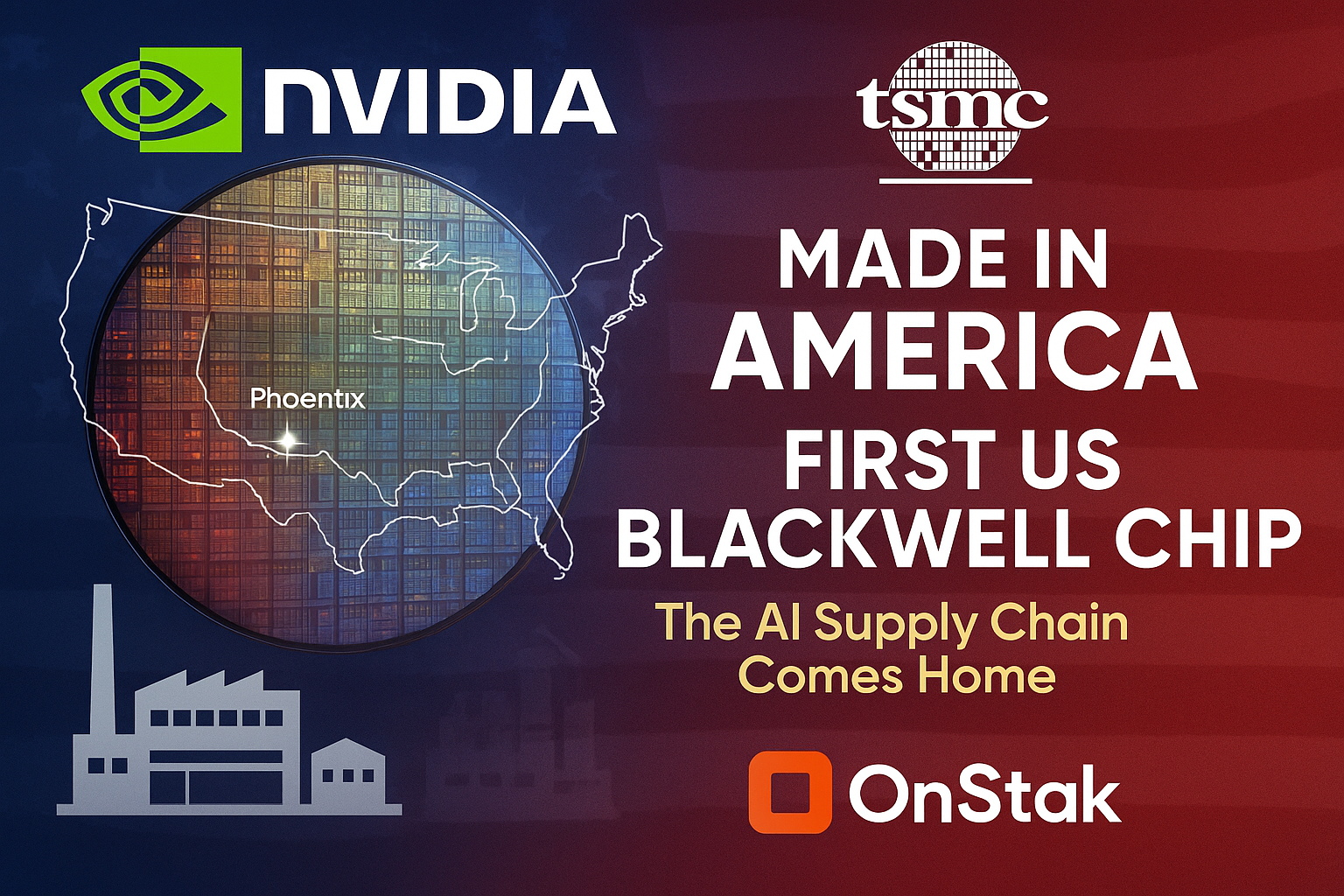
In a ceremony at TSMC’s new $165 billion facility in Phoenix, Arizona, Nvidia CEO Jensen Huang and TSMC executives signed the first Blackwell-generation AI chip wafer produced in the United States. This wafer, built using TSMC’s advanced 4-nanometer technology, represents more than just a new product. It’s a tangible outcome of a multi-year, multi-billion-dollar industrial policy effort to reshore the semiconductor supply chain and secure America’s leadership in the AI era.
As Jensen Huang put it, “This is a historic moment… It’s the very first time in recent American history that the single most important chip is being manufactured here in the United States by the most advanced fab.” Let’s unpack why this is such a pivotal development.
Industrial Policy Meets Market Demand: The CHIPS Act in Action
This milestone is a direct result of the CHIPS and Science Act, a landmark piece of legislation that provides tens of billions of dollars in subsidies to incentivize domestic semiconductor manufacturing. TSMC’s Phoenix facility, which will receive up to $6.6 billion in direct funding and $5 billion in loan guarantees, is one of the flagship projects of this initiative.
But this isn’t just a story about government subsidies. It’s a story about the convergence of industrial policy and explosive market demand. The AI revolution has created a voracious appetite for computing power, and Nvidia’s Blackwell GPUs are the undisputed workhorses of this new era. The demand for these chips is so high that securing the supply chain has become a matter of national and economic security.
This is a powerful example of how government and industry can work together to achieve strategic objectives. The CHIPS Act provided the incentive, but it’s the insatiable demand for AI that is making these massive investments economically viable.
De-Risking the AI Supply Chain: From Taiwan to Arizona
The strategic imperative behind this move is clear: to reduce the world’s dependence on Taiwan for advanced semiconductors. With geopolitical tensions in the region on the rise, the concentration of chip manufacturing in Taiwan represents a significant vulnerability for the global economy. A disruption in Taiwan could bring the AI industry to a screeching halt.
By building a leading-edge fab in Arizona, TSMC is diversifying its manufacturing footprint and creating a more resilient supply chain. While the Phoenix facility will not replace Taiwan’s output overnight (and indeed, the first wafers will still be sent back to Taiwan for final packaging), it is a critical first step in mitigating this geopolitical risk.
For businesses that rely on AI, this is a welcome development. A more resilient and geographically diverse supply chain means less risk of disruption and more predictable access to the hardware that powers their AI initiatives.
The New Geopolitics of Technology: Chips as a Strategic Asset
This milestone underscores a fundamental shift in how we think about technology. In the 21st century, semiconductors are what steel was to the 20th century: the foundational building block of economic and military power. The race to dominate the AI era is, in large part, a race to control the production of advanced chips.
This is why we’re seeing a global race to build domestic semiconductor capacity. The U.S., China, and Europe are all pouring tens of billions of dollars into their own chip manufacturing initiatives. The competition is fierce, and the stakes are high. The countries that control the production of AI chips will have an outsized influence on the future of the global economy.
What This Means for Your Business
1. Supply Chain Resilience is Now a Competitive Advantage: The geopolitical landscape is becoming more complex. Businesses that can demonstrate a secure and resilient supply chain for their AI infrastructure will have a significant advantage.
2. The AI Infrastructure Arms Race is Real: This isn’t just about algorithms; it’s about the physical hardware that powers them. As you build out your AI strategy, you need to be thinking about your access to compute and the security of your supply chain.
3. Government and Industry are Becoming More Intertwined: The CHIPS Act is just one example of how industrial policy is reshaping the tech landscape. Businesses need to understand how these policy shifts will impact their industries and create new opportunities.
The first American-made Blackwell wafer is more than just a piece of silicon. It’s a symbol of a new era, one in which the geopolitics of technology are taking center stage. The AI revolution is not just a technological one; it’s an industrial and geopolitical one. The companies that understand this will be the ones that thrive in the years to come.
At OnStak, we are committed to helping our clients navigate this new and complex landscape. We provide the expertise and infrastructure to help you build and deploy AI solutions that are not only powerful, but also secure, resilient, and aligned with your strategic goals. The future of AI is being built today. Let’s build it together.