
The uncomfortable truth about AI adoption is that most businesses are getting it wrong. They’re chasing the hype, buying the demos, and ending up with a pile of expensive, unused prototypes. I’ve seen it happen time and time again. The excitement of “doing AI” quickly fades, replaced by the frustrating reality of a science project that delivers no real business value.
But it doesn’t have to be this way.
The problem isn’t the technology; it’s the approach. By understanding the most common pitfalls and implementing a proven framework, you can turn AI from a source of frustration into a powerful engine for growth.
In this AI Pathfinder, we’re going to break down the 6 most common mistakes businesses make when they use AI and provide a clear, actionable playbook for how to solve them. This is your AI Adoption 1-pager, designed to help you move from hype to real-world results.
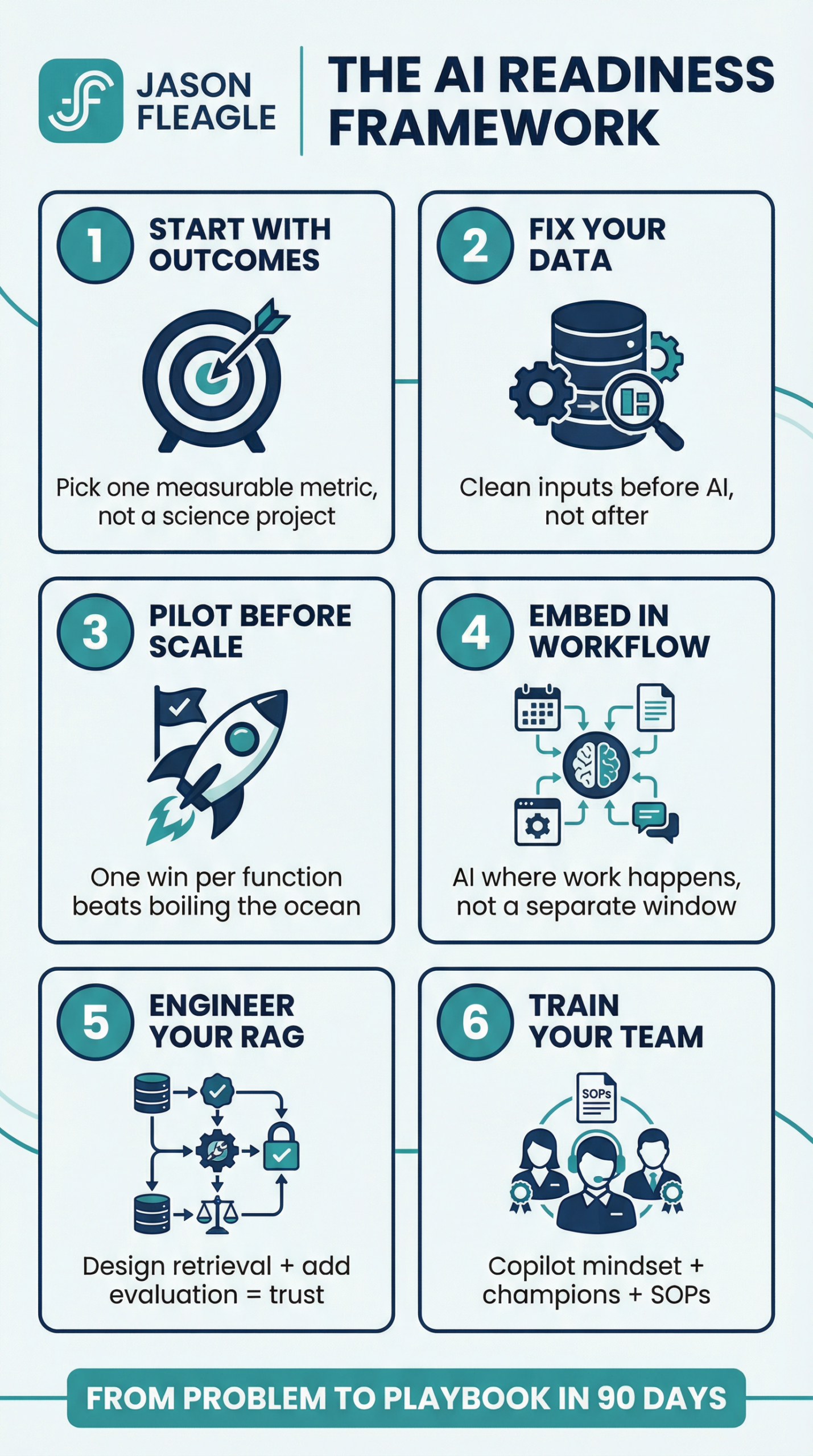
The AI Readiness Framework: From Problem to Playbook
For each of the six common mistakes, we’ll use a simple but powerful framework:
- Problem: What goes wrong and why.
- Diagnosis: The underlying issue that’s causing the problem.
- 90-Day Play: A concrete, actionable plan to get back on track.
- Metrics: How to measure success and ensure you’re moving the needle.
Let’s dive in.
1. Starting with “AI” Instead of a Business Outcome
Problem: The team is excited about AI, so they start exploring different tools and building “cool” demos. The result is a collection of impressive but ultimately useless prototypes that never see the light of day. It becomes a science project, not a business solution.
Diagnosis: The team is focused on the technology, not the outcome. They’re asking “What can we do with AI?” instead of “What business problem can we solve with AI?”
90-Day Play:
- Pick One Measurable Outcome: Identify a single, specific business metric you want to improve. This could be reducing customer support handle time, improving lead speed-to-response, increasing sales close rates, or cutting down on rework. Be specific and make it measurable.
- Define Success Metrics & a 90-Day Target: Set a clear, quantifiable goal for your chosen metric. For example, “Reduce average support ticket resolution time by 25% in the next 90 days.” This creates a sense of urgency and a clear finish line.
- Build the Smallest Workflow: Design and build the minimum viable AI-powered workflow that directly impacts your target metric. Don’t try to boil the ocean. Start small, get a win, and then scale.
Metrics:
- Track your chosen business metric (e.g., handle time, close rate) on a weekly basis.
- Measure the adoption rate of the new workflow among the pilot team.
- Calculate the ROI of the pilot project after 90 days.
2. Underestimating Data Reality
Problem: The team assumes they can just “plug in” their existing documents, CRM, or other data sources and the AI will magically understand everything. In reality, the data is messy, access permissions are a nightmare, and the AI’s outputs are unreliable and untrustworthy.
Diagnosis: The team has a “garbage in, garbage out” problem. They haven’t done the foundational work of cleaning, organizing, and securing their data before feeding it to the AI.
90-Day Play:
- Conduct an AI Readiness Inventory: Map out your key data sources. Where does the “truth” live for different types of information? Who owns it? How is it updated? This will give you a clear picture of your data landscape.
- Fix the Basics: Before you even think about AI, clean up your data. Standardize input fields, establish a clear source-of-truth for key information, and get rid of duplicate or outdated records.
- Implement Access Controls Early: Especially for enterprise and regulated industries, data security is paramount. Define roles and permissions for accessing different types of data, and ensure your AI system respects these controls.
Metrics:
- Percentage of key data fields that are complete and accurate.
- Reduction in the number of duplicate or conflicting records.
- Successful implementation of role-based access controls for sensitive data.
3. Trying to Scale Before You’re Ready
Problem: Leadership is so excited about the potential of AI that they want to roll it out “everywhere” at once. But without a repeatable win and a clear playbook, the initiative stalls, and the initial excitement turns into widespread disillusionment.
Diagnosis: The organization is trying to run before it can walk. They’re skipping the crucial steps of piloting, standardizing, and building a scalable operational model.
90-Day Play:
- Run One High-Impact Pilot Per Function: Instead of trying to do everything at once, select one high-impact use case in each key business function (e.g., sales, operations, customer support). This allows you to get targeted wins and build momentum.
- Use a Staged Rollout: Follow a structured, four-stage rollout process: Discover → Pilot → Standardize → Scale. This ensures you have a proven, repeatable model before you attempt a large-scale deployment.
- Treat Scaling as an Ops Problem: Once you have a successful pilot, think like an operations team. Create detailed playbooks, set up monitoring and alerting, and build a support model to handle issues as they arise.
Metrics:
- Successful completion of at least one high-impact pilot project.
- Creation of a detailed playbook for the pilot use case.
- Establishment of a clear support and maintenance plan for the scaled solution.
4. Not Integrating AI into Existing Tools
Problem: The AI is a powerful tool, but it lives in a separate chat window or application. To use it, employees have to switch contexts, copy and paste information, and manually transfer the AI’s outputs back into their primary work tools. As a result, adoption plummets.
Diagnosis: The AI is a destination, not a part of the natural workflow. It’s creating more work, not less.
90-Day Play:
- Embed AI Where Work Happens: Integrate your AI capabilities directly into the tools your team already uses every day, whether that’s your CRM, ticketing system, document editor, or collaboration platform like Slack or Microsoft Teams.
- Make Outputs Actionable: Don’t just provide “advice” from the AI. Turn its outputs into actionable steps. This could be a button to create a new task, a pre-populated email draft, or an updated field in your CRM.
- Close the Loop: Capture the outcomes of the AI’s suggestions. Did the sales email it drafted lead to a meeting? Was the support ticket it helped resolve actually closed to the customer’s satisfaction? Use this feedback to continuously improve the AI’s performance.
Metrics:
- Adoption rate of the integrated AI features.
- Reduction in time spent switching between applications.
- Improvement in the quality and effectiveness of AI-generated outputs based on feedback.
5. Treating RAG/Agents Like Magic Instead of Engineering
Problem: The team hears that Retrieval-Augmented Generation (RAG) is the solution to all their problems, so they “just add RAG” to their system. The result is a brittle, unreliable agent that hallucinates, provides wrong citations, and quickly erodes user trust.
Diagnosis: The team is treating a complex engineering discipline like a magic wand. They haven’t put in the work to design, build, and evaluate their RAG system properly.
90-Day Play:
- Design Retrieval Intentionally: Don’t just dump your documents into a vector database. Think carefully about your chunking strategy, metadata, filtering rules, and how you’ll handle recency. A well-designed retrieval system is the foundation of a reliable RAG agent.
- Add Evaluation: Create a “golden set” of questions and answers to test your agent’s accuracy. Implement a scoring system to track its performance over time, and systematically analyze its failure modes.
- Use “Self-Checking” Patterns: Build in guardrails to ensure your agent is trustworthy. Require it to provide citations for its answers, report a confidence score, and have a clear fallback behavior when it doesn’t know the answer.
Metrics:
- Accuracy score on your golden Q&A set.
- Reduction in the number of hallucinations or incorrect citations.
- User trust score based on surveys or feedback.
6. Ignoring Change Management & Training
Problem: The new AI system is rolled out with little to no training or communication. Employees feel threatened, confused, or disappointed by the new tool. It becomes shelfware, and the investment is wasted.
Diagnosis: The organization has forgotten that AI adoption is a human problem, not just a technical one.
90-Day Play:
- Run Hands-On Training: Don’t just send out a memo. Run interactive workshops where employees can get hands-on experience with the new tool. Follow up with implementation sprints to help them apply what they’ve learned to their own work.
- Set Expectations: Be clear that the AI is a copilot, not a replacement. Its purpose is to augment their skills and free them up to do more strategic work. Emphasize that accountability still rests with the human.
- Create Champions & SOPs: Identify early adopters who can act as champions for the new system. Work with them to create clear Standard Operating Procedures (SOPs) that outline when to use the AI, how to verify its work, and what to do when it makes a mistake.
Metrics:
- Employee satisfaction and confidence scores related to the new AI system.
- Adoption rate and usage of the AI tool across the target team.
- Creation and adoption of clear SOPs for using the AI.
Take the Next Step
Understanding these principles is the first step. Putting them into action is what will set you apart.
AI Consulting for Your Business: If you’re ready to move beyond the hype and start implementing a real AI strategy, my team and I can help. We work with organizations to navigate the complexities of AI adoption, from process optimization to building custom AI agents. Let’s discuss your AI goals by scheduling a consulting call together.
If you’re interested in a custom AI workshop for your business or in your city, please reach out to me directly to start a conversation.
About Jason
Jason Fleagle is a Chief AI Officer and Growth Consultant working with global brands to help with their successful AI adoption and management. He is also a writer, entrepreneur, and consultant specializing in tech, marketing, and growth. He helps humanize data—so every growth decision an organization makes is rooted in clarity and confidence. Jason has helped lead the development and delivery of over 500 AI projects & tools, and frequently conducts training workshops to help companies understand and adopt AI. With a strong background in digital marketing, content strategy, and technology, he combines technical expertise with business acumen to create scalable solutions. He is also a content creator, producing videos, workshops, and thought leadership on AI, entrepreneurship, and growth. He continues to explore ways to leverage AI for good and improve human-to-human connections while balancing family, business, and creative pursuits.
You can learn more about Jason on his website here.
Learn more about my AI resources here on my youtube channel.
And check out my AI online course.