Hey everyone,
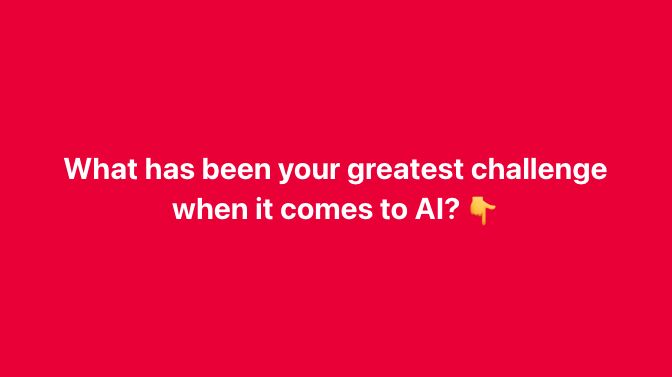
Last week, I asked my network a simple question: “What has been your greatest challenge when it comes to AI?”
The responses revealed something fascinating. Despite all the hype, all the headlines, and all the promises about AI transformation, business leaders are struggling with three fundamental challenges that have nothing to do with the technology itself.
These challenges are killing AI initiatives before they even get started, burning through budgets without delivering results, and leaving leaders frustrated and skeptical about AI’s real potential.
But here’s what’s interesting: the companies that solve these three challenges are the ones seeing transformational results from AI. They’re not just implementing AI—they’re implementing it strategically, sustainably, and successfully.
Today, I want to unpack these three critical challenges and share a framework that addresses all of them. Because getting AI right isn’t about having the best technology—it’s about having the right approach.
Challenge #1: The Focus Problem – Avoiding the AI Rabbit Hole
🇨🇦 Ben Baker🎙️ , a strategic leader driving customer experience excellence, hit the nail on the head when he commented: “Focus is key. There are way too many rabbit holes to go down in AI and the more you can concentrate on a few, learn them well and move on, the better off you will be.”
This is the challenge that’s paralyzing more AI initiatives than any technical limitation. The AI landscape is overwhelming. Every day brings new tools, new models, new capabilities, and new possibilities. It’s easy to get caught up in the excitement and try to explore everything.
But here’s the problem: when you try to do everything, you end up doing nothing well.
I see this constantly with business leaders. They start with ChatGPT for content creation, then discover Claude for analysis, then explore Midjourney for images, then investigate coding assistants, then look into customer service bots, then consider predictive analytics tools. Before they know it, they’re juggling dozens of AI tools without mastering any of them.
The result? Surface-level implementation that delivers surface-level results. No deep integration. No transformational impact. Just a collection of shiny tools that create more complexity than value.
The companies that succeed with AI understand that focus isn’t about limiting possibilities—it’s about maximizing impact. They choose a few AI applications that align with their core business objectives, master those applications completely, and then expand strategically.
This requires discipline. It requires saying no to interesting opportunities that don’t align with your strategic priorities. It requires resisting the urge to chase every new AI trend that emerges.
But the payoff is enormous. When you focus your AI efforts, you can:
Develop deep expertise in the tools and techniques that matter most to your business. Build robust processes and governance around your AI implementations. Measure and optimize performance systematically. Create sustainable competitive advantages rather than temporary productivity boosts.
The key is understanding that AI adoption is a marathon, not a sprint. The goal isn’t to implement every AI tool available—it’s to implement the right AI tools exceptionally well.
Challenge #2: The Hidden Cost Crisis – Understanding True AI Economics
Asif Haider , who specializes in empowering data teams with scalable AI solutions, raised what might be the most important challenge of all: Total Cost of Ownership (TCO).
His insight was eye-opening: “One of the bottlenecks in AI initiatives is a failure to understand the full financial picture—specifically, the concept of Total Cost of Ownership (TCO).”
This is where most AI initiatives fail financially. Business leaders see the initial costs—software licensing, maybe some hardware, perhaps some consulting fees—and think they understand the investment required. But they’re only seeing the tip of the iceberg.
Asif broke down the real costs involved:
Initial Acquisition Costs (CapEx): Hardware investments like GPUs, servers, infrastructure, plus software licensing, deployment, and integration. As he noted, “appetite here is exponential”—costs can spiral quickly as requirements become clear.
Ongoing Operating Costs (OpEx): Energy and cooling, staffing, ongoing retraining, vendor support, compliance, monitoring and maintenance, and scaling the system over time.
Hidden Lifecycle Costs: The costs that nobody talks about until they become problems. Data preparation and cleaning. Model retraining and updates. Security and compliance auditing. Integration with existing systems. Staff training and change management.
I’ve seen companies budget $50,000 for an AI implementation and end up spending $300k when all the hidden costs are factored in. The initial software license might be affordable, but the infrastructure to run it, the staff to manage it, the ongoing maintenance, and the integration work can multiply costs by 5x or 10x.
This isn’t just about money—it’s about realistic planning and sustainable implementation. When you understand the true TCO of AI initiatives, you can:
Make informed decisions about which AI investments make sense for your organization. Budget appropriately for the full lifecycle of AI implementations. Avoid the painful surprises that kill AI projects halfway through. Build business cases that account for all costs and deliver genuine ROI.
The companies that succeed with AI don’t just look at the upfront costs—they model the total economic impact over the full lifecycle of their AI investments.
Challenge #3: The Starting Point Paradox – Where to Begin When Everything Seems Possible
Seth Price , a digital transformation leader, identified perhaps the most practical challenge: “I think one of the biggest challenges is understanding where to start. AI is just a ‘thing’ unless it’s utilized in areas that bring value.”
This is the paradox that stops many AI initiatives before they begin. AI can do so many things that it becomes paralyzing to choose where to start. Should you focus on customer service? Content creation? Data analysis? Process automation? Predictive modeling?
Seth’s insight provides the answer: “I believe the best place to start is looking at your business workflows and understanding the ‘choke points’ that cause frustrations and delays. How can AI be used to eliminate those ‘choke points’ to improve overall operational efficiencies, creating a better customer & workforce experience.”
This is brilliant because it shifts the focus from AI capabilities to business needs. Instead of asking “What can AI do?” you ask “What problems do we need to solve?”
The choke point approach works because:
It’s immediately valuable: You’re solving real problems that are already costing you time, money, or customer satisfaction.
It’s measurable: You can quantify the impact of removing bottlenecks in terms of time saved, costs reduced, or quality improved.
It’s scalable: Once you successfully address one choke point, you can apply the same methodology to identify and solve others.
It’s sustainable: You’re building AI solutions that integrate naturally into existing workflows rather than creating parallel processes.
The key is conducting a thorough workflow analysis to identify where the real friction points exist. These are often not where you think they are. The choke points that seem obvious to management might not be the ones causing the most operational pain.
The Integrated Framework: The FOCUS-TCO-CHOKE Method
After analyzing these three challenges, I’ve developed an integrated framework that addresses all of them simultaneously. I call it the FOCUS-TCO-CHOKE method, and it’s designed to help business leaders navigate AI implementation strategically and successfully.
Phase 1: FOCUS Assessment
Before exploring any AI tools or capabilities, establish your focus parameters:
Strategic Alignment: What are your top three business objectives for the next 12-18 months? Any AI initiative must directly support at least one of these objectives.
Resource Constraints: What’s your realistic budget, timeline, and team capacity for AI initiatives? Be honest about limitations rather than optimistic about possibilities.
Success Metrics: How will you measure the success of AI implementations? Define specific, measurable outcomes that align with business value.
Exploration Boundaries: Set clear limits on how many AI tools or approaches you’ll evaluate simultaneously. I recommend no more than 2-3 concurrent explorations.
This phase prevents the rabbit hole problem by establishing clear criteria for what deserves your attention and what doesn’t.
Phase 2: TCO Analysis
For each potential AI initiative that passes the FOCUS assessment, conduct a comprehensive TCO analysis:
Direct Costs: Software licensing, hardware requirements, implementation services, training costs.
Infrastructure Costs: Cloud computing resources, storage requirements, networking, security enhancements.
Operational Costs: Ongoing maintenance, support, updates, monitoring, compliance.
Human Costs: Staff time for implementation, training, ongoing management, change management.
Opportunity Costs: What other initiatives will be delayed or canceled to accommodate this AI project?
Risk Costs: What’s the potential cost of failure, security breaches, or compliance issues?
This analysis should result in a 3-year financial model that shows total investment, ongoing costs, and projected returns.
Phase 3: CHOKE Point Identification
With your focus established and costs understood, identify the specific workflow choke points where AI can deliver maximum impact:
Process Mapping: Document your current workflows in detail, identifying every step, decision point, and handoff.
Bottleneck Analysis: Where do delays occur? Where do errors happen? Where do tasks pile up waiting for human intervention?
Impact Assessment: What’s the business cost of each choke point in terms of time, money, quality, or customer satisfaction?
AI Suitability: Which choke points involve tasks that AI can realistically improve? Focus on repetitive, rule-based, or pattern-recognition tasks.
Implementation Feasibility: Which choke points can be addressed with your available resources and within your TCO constraints?
Phase 4: Strategic Implementation
With focus established, costs understood, and choke points identified, you can implement AI strategically:
Pilot Selection: Choose one choke point that offers high impact, manageable costs, and reasonable implementation complexity.
Success Criteria: Define specific, measurable outcomes that will indicate success or failure.
Implementation Plan: Develop a detailed project plan that includes all TCO elements and stays within your focus boundaries.
Monitoring Framework: Establish systems to track performance, costs, and business impact throughout implementation.
Scaling Strategy: Plan how successful pilots will be expanded and how lessons learned will inform future AI initiatives.
The OnStak Approach: Making AI Implementation Practical
At OnStak, we’ve used this framework to help 100+ of organizations navigate AI implementation successfully. Our approach recognizes that AI success isn’t about technology—it’s about strategy, economics, and operational excellence.
Our AI expertise spans four critical areas that directly address the challenges we’ve discussed:
AI/Data Solutions: We help organizations implement AI in traditional data lake scenarios, focusing on efficient data management and informed decision-making. This addresses the choke point challenge by optimizing data workflows that often create organizational bottlenecks.
AI/Edge Implementation: Our IoT solutions and Hypershield technology bring intelligence to edge environments, addressing TCO concerns by reducing cloud computing costs and improving performance through local processing.
AI/Performance Optimization: We provide orchestration layers that optimize AI environments and enhance system performance, directly addressing the focus challenge by ensuring AI implementations deliver measurable business value.
AI/Migration Services: We help organizations identify applications suitable for cloud migration or reverse migrations back to on-premises environments, addressing TCO by optimizing infrastructure costs and performance.
The key to our approach is understanding that successful AI implementation requires addressing all three challenges simultaneously. You can’t solve the focus problem without understanding TCO implications. You can’t identify the right choke points without clear strategic focus. And you can’t manage TCO without understanding the operational realities of your specific workflow challenges.
Your Action Plan: Getting Started the Right Way
If you’re ready to tackle AI implementation strategically, here’s your step-by-step action plan:
Week 1-2: Focus Assessment
•Define your top 3 business objectives for the next 18 months
•Establish realistic resource constraints (budget, timeline, team capacity)
•Set clear success metrics for AI initiatives
•Create exploration boundaries (limit concurrent AI evaluations to 2-3 maximum)
Week 3-4: Workflow Analysis
•Map your core business workflows in detail
•Identify bottlenecks, delays, and friction points
•Quantify the business impact of each choke point
•Prioritize choke points by impact and AI suitability
Week 5-6: TCO Modeling
•For your top 3 choke points, develop comprehensive TCO models
•Include all direct, infrastructure, operational, human, and risk costs
•Create 3-year financial projections
•Identify the most economically viable opportunities
Week 7-8: Pilot Selection and Planning
•Choose one high-impact, manageable-cost choke point for your first pilot
•Develop detailed implementation plan within TCO constraints
•Establish monitoring and measurement frameworks
•Create scaling strategy for successful pilots
Week 9+: Strategic Implementation
•Execute pilot with rigorous monitoring and measurement
•Document lessons learned and refine approach
•Scale successful implementations strategically
•Apply framework to additional choke points
The Competitive Advantage
The businesses that master this integrated approach to AI implementation will have a massive competitive advantage. While their competitors are still chasing AI trends, burning through budgets on unfocused initiatives, and struggling with hidden costs, these organizations will be systematically solving real business problems with AI.
They’ll be building sustainable competitive advantages rather than implementing expensive technology experiments. They’ll be delivering measurable ROI rather than hoping for transformation. They’ll be scaling AI strategically rather than randomly.
Most importantly, they’ll be using AI to solve the problems that matter most to their customers, employees, and bottom line.
The AI revolution is real, but success isn’t about having the latest technology—it’s about having the right strategy. The FOCUS-TCO-CHOKE framework provides that strategy.
The question isn’t whether AI will transform your business. The question is whether you’ll transform your business with AI, or whether AI will just add complexity and cost to your existing challenges.
The choice is yours. But the framework is here when you’re ready to choose wisely.
What’s been your biggest challenge with AI implementation? Have you experienced the focus problem, hidden TCO costs, or struggled to identify the right starting point? Share your experiences in the comments below—let’s learn from each other as we navigate this transformation together.
If you need help building out your AI project, feel free to contact our team at OnStak to help you out.
Looking for AI Growth?
Let’s Talk About Your AI Goals!
What would you do if you could determine the top AI use cases or opportunities for you and your team?
We can help you go from surviving to thriving – with done-for-you business growth implementations.
You can learn more about our top AI case studies here on our website.
Learn more about my AI resources here on my youtube channel.
And check out my AI online course.